


Cultivar specific nitrogen and potassium recommendations optimize yield and quality attributes in sugar beet
- PMID: 40730601
- PMCID: PMC12307683
- DOI: 10.1038/s41598-025-10918-x
Cultivar specific nitrogen and potassium recommendations optimize yield and quality attributes in sugar beet
Abstract
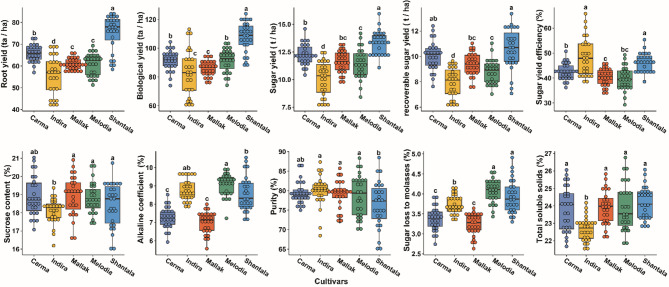
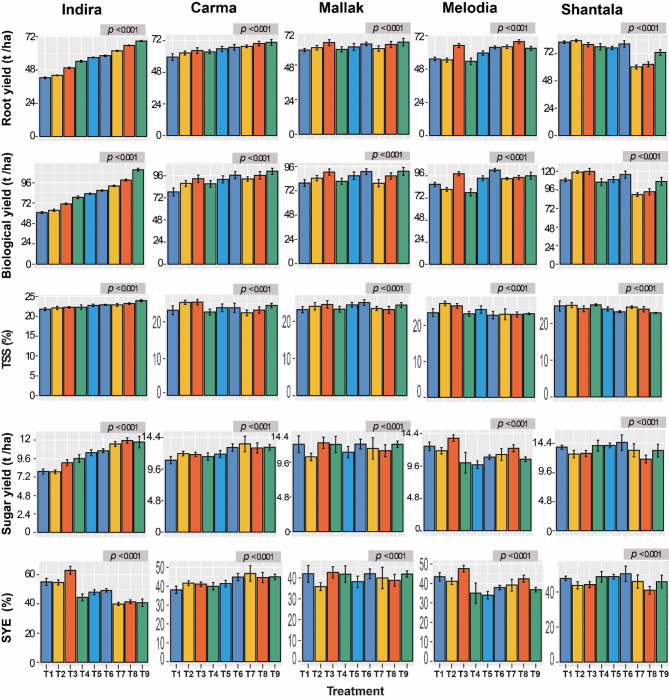
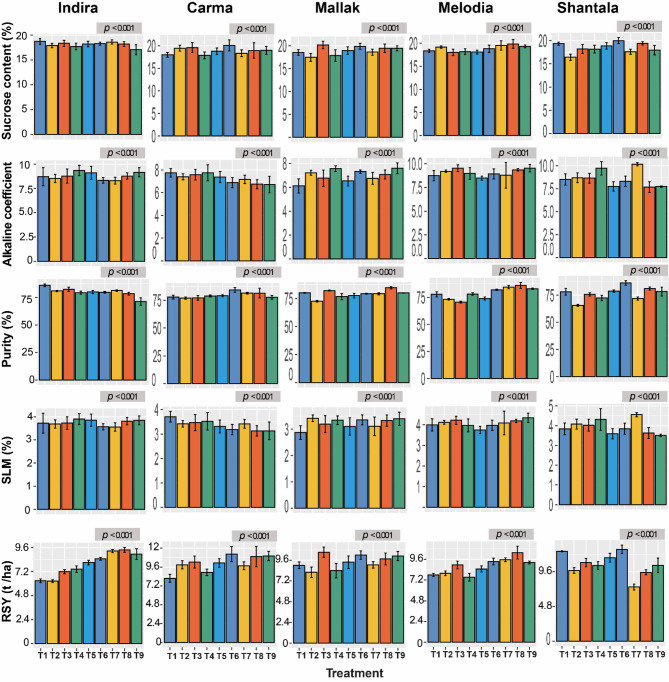
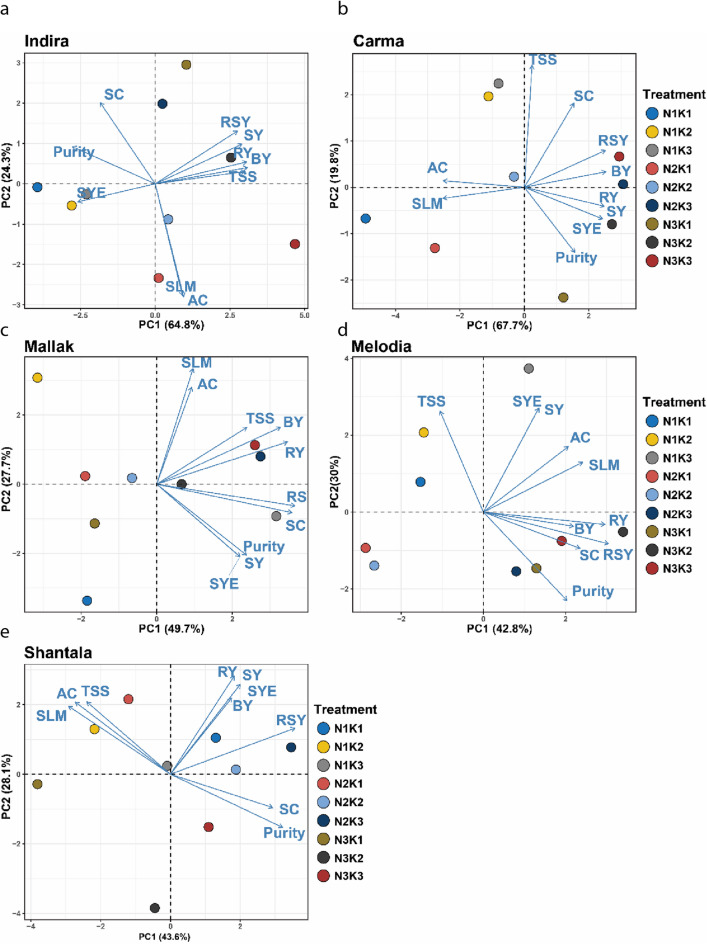
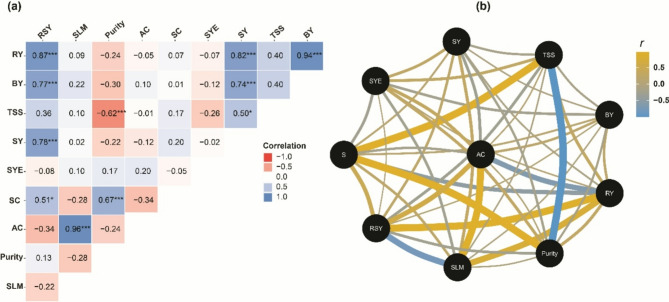
This study aimed to investigate cultivar-specific responses to nitrogen and potassium fertilization in sugar beet (Beta vulgaris) to optimize yield, quality attributes, and fertilizer use efficiency. Five sugar beet cultivars (Indira, Carma, Mallak, Melodia, and Shantala) were evaluated under nine fertilization treatments combining three nitrogen and potassium levels (T1 (144 N,0 K); T2 (144 N,60 K); T3 (144 N,120 K); T4 (216 N,0 K); T5 (216 N,60K2);T6 (216 N,120 K); T7 (288 N,0 K); T8 (288 N,60 K); T9 (288 N,120 K)) in a split-plot design over two growing seasons (2020/2021 and 202120/22 ). Significant cultivar × treatment interactions (p < 0.001) were observed across all parameters. Root yield ranged from 55.72 t/ha (Indira) to 83.33 t/ha (Shantala under T2 treatment). Sucrose content varied from 18.10% (Indira) to 18.92% (Mallak), with corresponding purity levels of 79.93% and 76.39%. Principal component analysis revealed distinct cultivar-specific nutrient responses: lower nitrogen and potassium levels (T1 and T2) positively impacted quality attributes in Indira and Carma, while higher nitrogen and moderate potassium combinations (T3 and T6) enhanced yield attributes in Mallak and Shantala. Economic analysis showed optimal profitability with T3 treatment for Indira and Melodia (ROIs of 89.5% and 91.6%), T2 for Carma and Mallak (ROIs of 123.4% and 113.1%), and T1 or T6 for Shantala (ROI of 166%). Hierarchical clustering and correlation analysis identified strong positive relationships between root yield and biological yield (r = 0.94), recoverable sugar yield (r = 0.87), and sugar yield (r = 0.82). These findings provide valuable recommendations for cultivar-specific nutrient management strategies that farmers can implement to optimize both production efficiency and economic returns while reducing environmental impacts from excessive fertilization.
Keywords: Clustering heatmap; Cultivar selection; Multivariate analysis; PCA; Sugar beet (Beta vulgaris).
© 2025. The Author(s).
Conflict of interest statement
Declarations. Competing interests: The authors declare no competing interests. Ethics approval and consent to participate: This article does not contain any studies on human or animal subjects. The current experimental research and field study, including the collection of plant material, is complying with relevant institutional, national, and international guidelines and legislation and used for research and development. Consent for publication: Not applicable (NA). Institutional review board statement: Not applicable.
Figures

References
-
- Mekdad, A. A., Shaaban, A., Rady, M. M., Ali, E. F. & Hassan, F. A. Integrated application of K and Zn as an avenue to promote sugar beet yield, industrial sugar quality, and K-use efficiency in a salty semi-arid agro-ecosystem. Agronomy11, 780 (2021).
-
- Gumienna, M. et al. The impact of sugar beet varieties and cultivation conditions on ethanol productivity. Biomass Bioenerg.85, 228–234 (2016).
-
- Carr, M. & Knox, J. W. The water relations and irrigation requirements of sugar cane (Saccharum officinarum): A review. Exp. Agric.47, 1–25 (2011).
-
- CCSC. Central Council for Sugar Crops annual report. Ministry of Agriculture and Land Reclamation Cairo, Egypt. (2011).
-
- Abdel-Mawly, S. & Zanouny, I. Response of sugar beet (Beta vulgaris L.) to potassium application and irrigation with saline water. Ass Univ. Bull. Environ. Res.7, 123–136 (2004).
MeSH terms
Substances
LinkOut - more resources
Full Text Sources
Medical
