


Classifying social and physical pain from multimodal physiological signals using machine learning
- PMID: 40731063
- PMCID: PMC12307811
- DOI: 10.1038/s41598-025-12476-8
Classifying social and physical pain from multimodal physiological signals using machine learning
Abstract
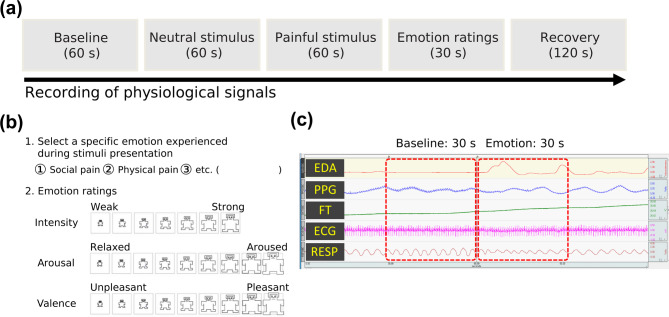
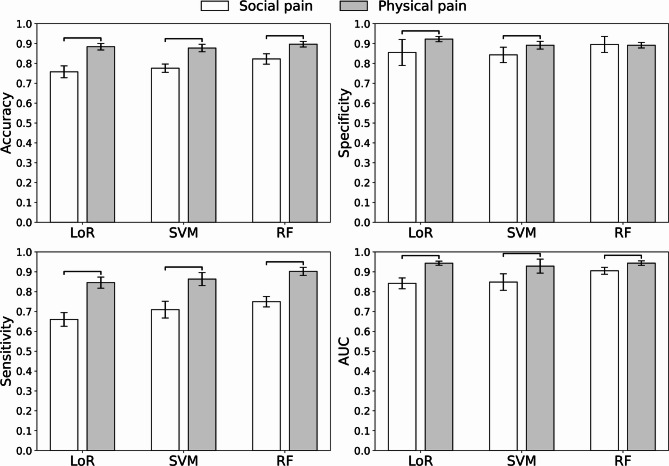
Accurate pain assessment is essential for effective management; however, most studies have focused on differentiating pain from non-pain or estimating pain intensity rather than distinguishing between distinct pain types. We present a machine learning method for classifying physical and social pain using physiological signals. Seventy-three healthy adults participated in experiments involving baseline, neutral, and pain-inducing stimuli related to both types of pain. Physical pain was elicited by pressure cuff inflation, whereas social pain was induced by watching a video depicting a loved one's death. The electrocardiogram, electrodermal activity, photoplethysmogram, respiration, and finger temperature were recorded, and 12 physiological features were extracted. Three machine learning algorithms-logistic regression, support vector machine, and random forest-were employed to classify the input data into baseline versus painful states and physical versus social pain. Our findings demonstrated high accuracy in identifying social pain (0.82) and physical pain (0.90) compared to the baseline. Classification accuracy between physical and social pain was moderate (0.63) when using painful state data alone but improved to 0.77 when incorporating reactivity from neutral to painful states. This study highlights the potential of multimodal physiological signals for differentiating pain types and enhancing personalized pain management strategies.
Keywords: Autonomic nervous system; Machine learning; Multimodal; Physical pain; Physiological signals; Social pain.
© 2025. The Author(s).
Conflict of interest statement
Declarations. Competing interests: The authors declare no competing interests. Ethics statement: All methods were carried out in accordance with the Declaration of Helsinki and all applicable institutional and national regulations, and the study was approved by the Institutional Review Board of Chungnam National University (No. 201309-SB-041-01). All participants provided written informed consent.
Figures


References
-
- Katz, N. The impact of pain management on quality of life. J. Pain Symptom Manage.24, 38–47 (2002). - PubMed
-
- Gureje, O., Von Korff, M., Simon, G. E. & Gater, R. Persistent pain and well-being: a world health organization study in primary care. JAMA280, 147–151 (1998). - PubMed
-
- Eisenberger, N. I. The pain of social disconnection: examining the shared neural underpinnings of physical and social pain. Nat. Rev. Neurosci.13, 421–434 (2012). - PubMed
MeSH terms
LinkOut - more resources
Full Text Sources
Medical
