


The prognostic impact of net ultrafiltration intensity in critically ill patients receiving continuous renal replacement therapy: a multivariable and propensity-matched analysis
- PMID: 40731255
- PMCID: PMC12308870
- DOI: 10.1080/0886022X.2025.2537810
The prognostic impact of net ultrafiltration intensity in critically ill patients receiving continuous renal replacement therapy: a multivariable and propensity-matched analysis
Abstract
Objectives: Net ultrafiltration (UFnet) is widely used for fluid management during continuous renal replacement therapy (CRRT) for critically ill patients over extended periods. Despite widespread use, the relationship between UFnet intensity and clinical outcomes, particularly mortality, remains controversial.
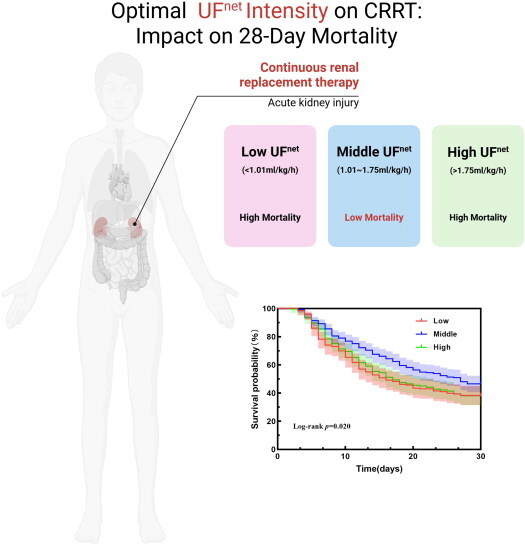
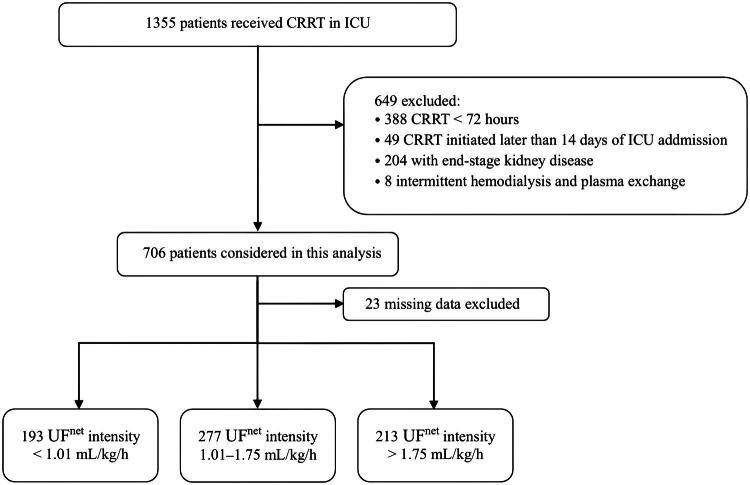
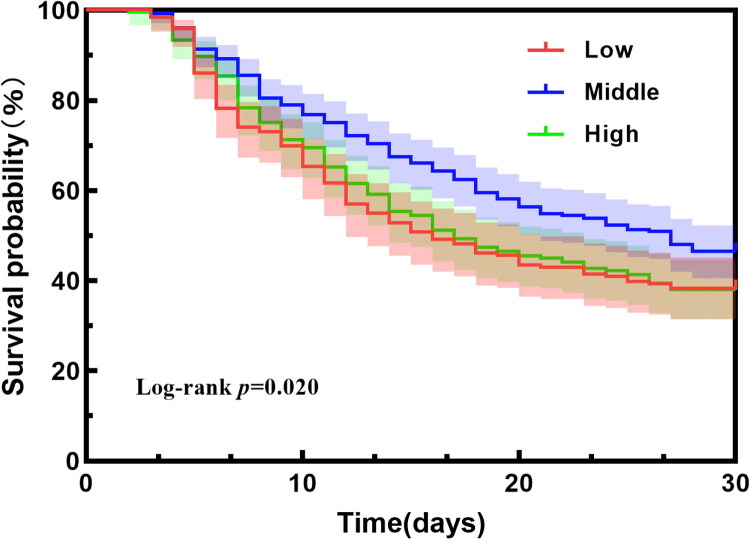
Methods: This retrospective observational study examined critically ill patients undergoing CRRT for more than 72 h from January 2021 to September 2023. Patients were stratified by their UFnet intensity during the initial 72 h of CRRT into low (<1.01 mL/kg/h), moderate (1.01-1.75 mL/kg/h), and high (>1.75 mL/kg/h) groups. The primary outcome was 28-day mortality. Kaplan-Meier's survival curves with log-rank tests, Cox proportional hazards models, and propensity score matching were employed to assess the association between UFnet intensity and mortality.
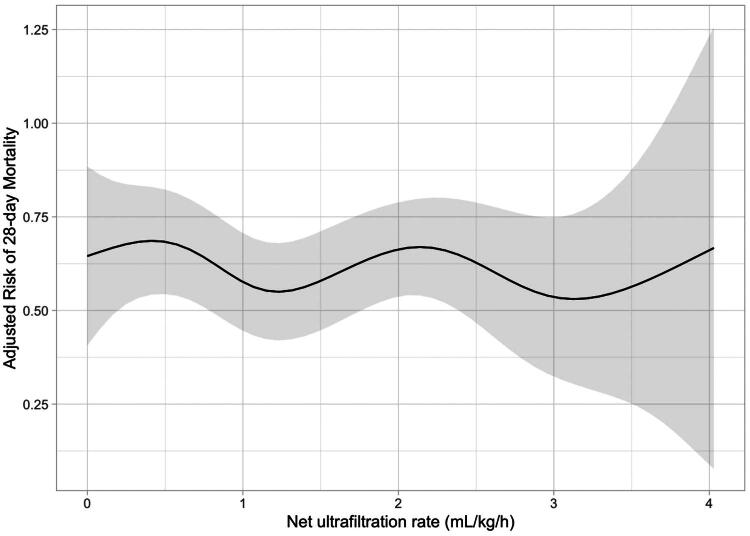
Results: A total of 683 patients were included. Compared with the moderate UFnet intensity, the low UFnet intensity (adjusted hazard ratio (HR) 1.54, 95%CI 1.24-1.91, p = .024) and high UFnet intensity (adjusted HR 1.27, 95%CI 1.03-1.57, p < .001) were associated with higher 28-day mortality. Sensitivity analyses showed similar trends for 60-day and 90-day mortality. Subgroup analyses based on admission diagnosis did not reveal significant differences in the effect of UFnet intensity on mortality risk.
Conclusions: UFnet intensity between 1.01 and 1.75 mL/kg/h during the first 72 h of CRRT was associated with lower 28-day mortality compared to both lower and higher UFnet intensities. However, future studies are needed to better define optimal UFnet thresholds in multicenter ICU cohorts.
Keywords: Net ultrafiltration; acute kidney injury; continuous renal replacement therapy; fluid overload.
Conflict of interest statement
No potential conflict of interest was reported by the author(s).
Figures
References
-
- Kidney Disease: improving Global Outcomes (KDIGO) Acute Kidney Injury Work Group . KDIGO Clinical Practice Guideline for Acute Kidney Injury. Kidney Int Suppl. 2012;2:1–138.
Publication types
MeSH terms
LinkOut - more resources
Full Text Sources
Other Literature Sources
