


Antibacterial Evaluation of Tricyclic Antidepressants Against S. aureus and the Possible Pathways of the Mechanism of Action
- PMID: 40732661
- PMCID: PMC12299878
- DOI: 10.3390/pathogens14070613
Antibacterial Evaluation of Tricyclic Antidepressants Against S. aureus and the Possible Pathways of the Mechanism of Action
Abstract
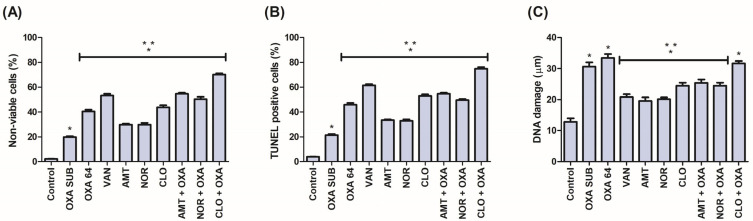
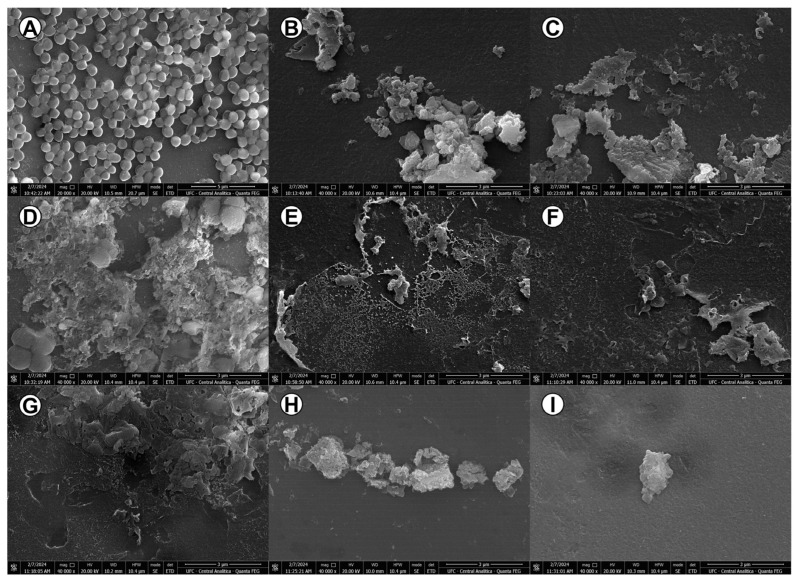
The resistance of Staphylococcus aureus to conventional pharmacological treatments has gradually increased. Thus, new therapeutic strategies are needed. Three tricyclic antidepressants (TCAs), amitriptyline (AMT), nortriptyline (NOR), and clomipramine (CLO), stand out with potential in this regard. Thus, the objective of this study was to evaluate the antibacterial activity of TCAs against S. aureus. The methodology used broth microdilution, checkerboard, flow cytometry, fluorescence microscopy, and scanning electron microscopy (SEM) techniques. The results showed that the minimum inhibitory concentration (MIC) of AMT was 256 µg/mL, while the MIC of NOR was 128 µg/mL, and the MIC of CLO was between 64 and 128 µg/mL. The TCAs exhibited bactericidal activity. In the analysis of the association with oxacillin (OXA), AMT exhibited 75% synergism, while NOR and CLO obtained 62.5%. In combination with vancomycin (VAN), AMT and NOR presented 100% additive interactions, while CLO exhibited 62.5% indifferent interactions. The mechanism of TCAs, isolated and combined with OXA, was associated with a reduction in cell viability, resulting from their action on the bacterial genetic material and generation of oxidative stress. Furthermore, the action of the drugs produced intense morphological changes in the bacterial cells. In conclusion, TCAs are a potential alternative for antistaphylococcal therapy.
Keywords: Staphylococcus aureus; amitriptyline; antibacterial; clomipramine; mechanism of action; nortriptyline; synergism; tricyclic antidepressants.
Conflict of interest statement
The authors declare no conflicts of interest.
Figures

Similar articles
-
Analysis of the anti-Candida activity of tricyclic antidepressants in association with amphotericin B and their antifungal mechanisms.Braz J Microbiol. 2024 Dec;55(4):3617-3628. doi: 10.1007/s42770-024-01459-y. Epub 2024 Aug 29. Braz J Microbiol. 2024. PMID: 39198376
-
Essential oils of Eugenia spp. (myrtaceae) show in vitro antibacterial activity against Staphylococcus aureus isolates from bovine mastitis.Braz J Microbiol. 2024 Dec;55(4):3081-3096. doi: 10.1007/s42770-024-01489-6. Epub 2024 Aug 27. Braz J Microbiol. 2024. PMID: 39190260
-
Pharmacological treatments in panic disorder in adults: a network meta-analysis.Cochrane Database Syst Rev. 2023 Nov 28;11(11):CD012729. doi: 10.1002/14651858.CD012729.pub3. Cochrane Database Syst Rev. 2023. PMID: 38014714 Free PMC article.
-
Amitriptyline Therapy and CYP2D6 and CYP2C19 Genotype.2017 Mar 23 [updated 2025 Jun 23]. In: Pratt VM, Scott SA, Pirmohamed M, Esquivel B, Kattman BL, Malheiro AJ, editors. Medical Genetics Summaries [Internet]. Bethesda (MD): National Center for Biotechnology Information (US); 2012–. 2017 Mar 23 [updated 2025 Jun 23]. In: Pratt VM, Scott SA, Pirmohamed M, Esquivel B, Kattman BL, Malheiro AJ, editors. Medical Genetics Summaries [Internet]. Bethesda (MD): National Center for Biotechnology Information (US); 2012–. PMID: 28520380 Free Books & Documents. Review.
-
Tricyclic antidepressants for autism spectrum disorders (ASD) in children and adolescents.Cochrane Database Syst Rev. 2012 Mar 14;2012(3):CD008372. doi: 10.1002/14651858.CD008372.pub2. Cochrane Database Syst Rev. 2012. PMID: 22419332 Free PMC article.
References
-
- Shoaib M., Aqib A.I., Muzammil I., Majeed N., Bhutta Z.A., Kulyar M.F.e.A., Fatima M., Zaheer C.N.F., Muneer A., Murtaza M., et al. MRSA Compendium of Epidemiology, Transmission, Pathophysiology, Treatment, and Prevention within One Health Framework. Front. Microbiol. 2023;13:1067284. doi: 10.3389/fmicb.2022.1067284. - DOI - PMC - PubMed
MeSH terms
Substances
LinkOut - more resources
Full Text Sources
Medical
