


Reversible Binding of Nitric Oxide in a Cu(II)-Containing Microporous Metal-Organic Framework
- PMID: 40733273
- PMCID: PMC12298806
- DOI: 10.3390/molecules30143007
Reversible Binding of Nitric Oxide in a Cu(II)-Containing Microporous Metal-Organic Framework
Abstract
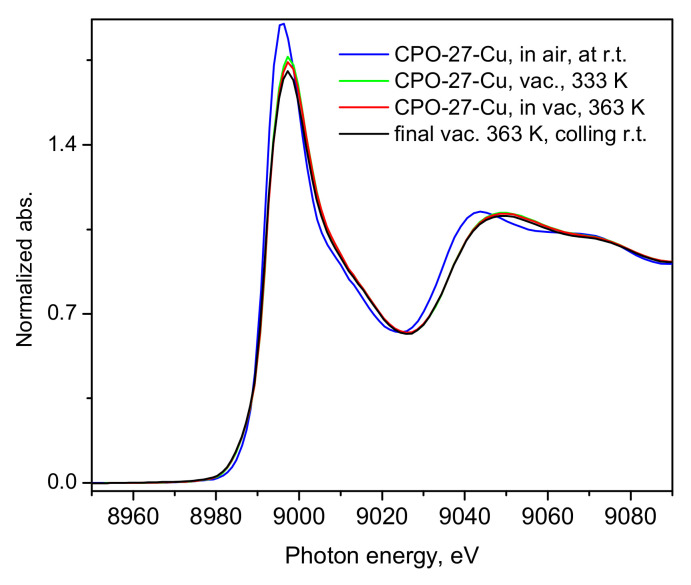
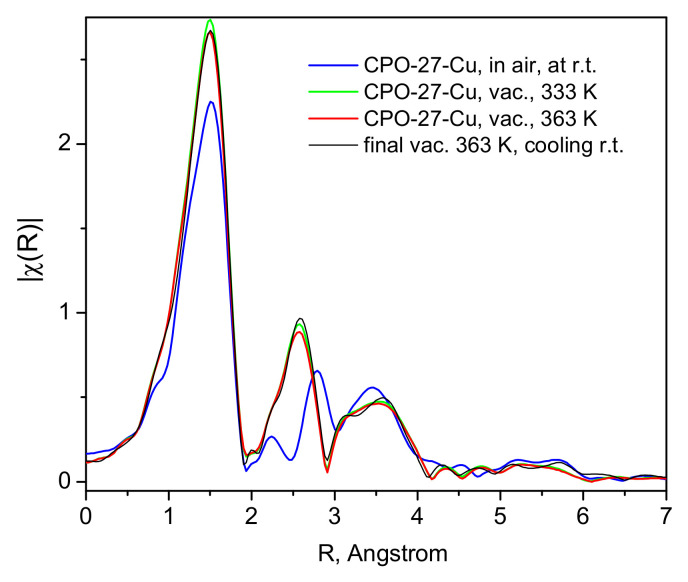
We studied the adsorption thermodynamics and mechanism behind the binding of nitric oxide (NO) in the interior surfaces and structural fragments of the high metal center density microporous Metal-Organic Framework (MOF) CPO-27-Cu, by gas sorption, at a series of temperatures. For the purpose of comparison, we also measured the corresponding CO2 adsorption isotherms, and as a result, the isosteric heats of adsorption for the two studied adsorptives were derived, being in the range of 12-15 kJ/mol for NO at loadings up to 0.5 NO molecules per formula unit (f.u.) of the bare compound (C4O3HCu), and 23-25 kJ/mol CO2 in the range 0-1 CO2 per f.u. Microscopically, the mode of NO binding near the square pyramid Cu(II) centers was directly accessed with the use of in situ NO gas adsorption X-ray Absorption Spectroscopy (XAS). Additionally, during the vacuum/temperature activation of the material and consequent NO adsorption, the electronic state of the Cu-species was monitored by observing the corresponding X-ray Near Edge Spectra (XANES). Contrary to the previously anticipated chemisorption mechanism for NO binding at Cu(II) species, we found that at slightly elevated temperatures, under ambient, but also cryogenic conditions, only relatively weak physisorption takes place, with no evidence for a particular adsorption preference to the coordinatively unsaturated Cu-centers of the material.
Keywords: EXAFS; adsorption; gas storage; microporosity; nitric oxide; thermodynamics.
Conflict of interest statement
The authors declare no conflict of interest.
Figures




References
Grants and funding
LinkOut - more resources
Full Text Sources
