. 2025 Jul 21;7(18):5519-5535.
doi: 10.1039/d5na00365b. eCollection 2025 Sep 10.

Evaluating the impact of bioinspired counterion inclusion on silk nanoparticle physicochemical attributes and physical stability

Affiliations

Evaluating the impact of bioinspired counterion inclusion on silk nanoparticle physicochemical attributes and physical stability

Napaporn Roamcharern et al. Nanoscale Adv. .

Abstract

Silk fibroin is a promising material for nanocarrier-based drug delivery applications due to its biocompatibility, biodegradability, and mechanical properties, which can be fine-tuned through processing conditions. In this study, we explore the impact of Ca2+ and K+ inclusion on the morphology of silk nanoparticles and evaluate the short- and long-term stability of silk nanoparticles formed by antisolvent precipitation in deionized water and sodium phosphate buffer. Using advanced electric asymmetric flow field-flow fractionation multiplexed with online detectors (EAF4-UV-MALS-DLS) and orthogonal analytics (DLS, ELS, NTA, FE-SEM), we analyze the physicochemical attributes of silk nanoparticles. We find significant differences in nanoparticle architecture and stability in different buffers, with notable differences in particle size (R g and R h), charge, and shape measured over 56 days. Notably, nanoparticles formulated with 0.7 mg Ca2+ and 1.1 mg K+ maintained superior physicochemical stability, making them promising candidates for future nanocarrier-based applications.


Conflict of interest statement

The authors declare no conflicts of interest.

Figures

Fig. 1
Fig. 1. Schematic of silk nanoparticle storage stability study illustrating measurement workflow and analytical techniques, performed (a) after 2 h incubation at ambient temperature, (b) over 56 days, and (c) the electrical asymmetric flow field-flow fractionation (EAF4) method used for nanoparticle characterization at day 0 and day 56. Abbreviations: deionized water (DI water); sodium phosphate buffer (NaPi buffer).
Fig. 2
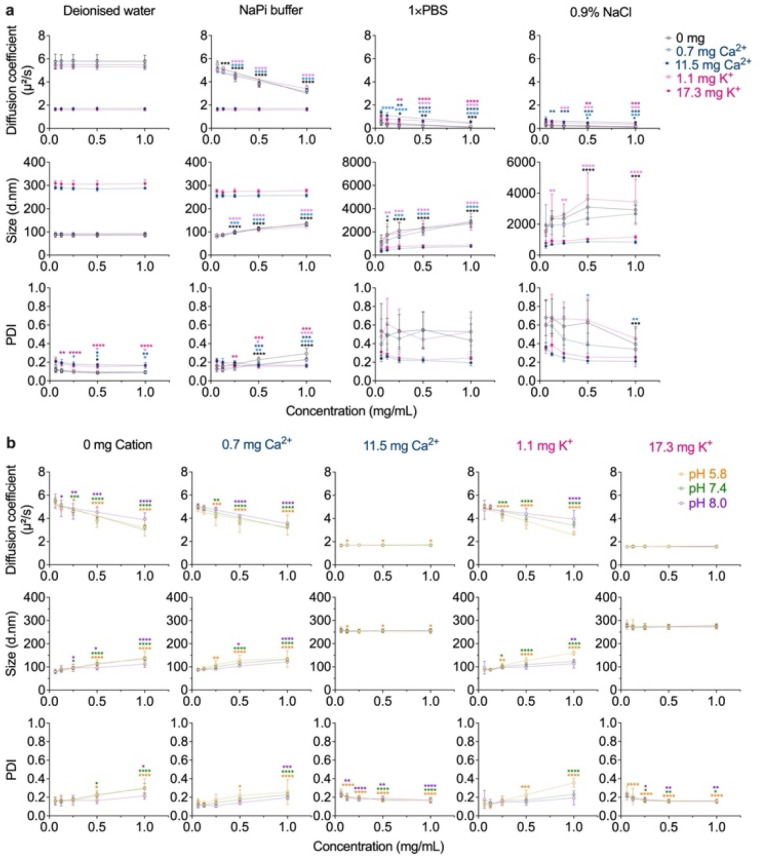
Fig. 2. Colloidal stability of silk nanoparticles. Diffusion coefficients, particle size, and polydispersity index (PDI) were determined by dynamic light scattering (DLS) as a function of nanoparticle concentration. (a) The impact of continuous phase, which was either deionized water (DI water), 10 mM sodium phosphate (NaPi) buffer (pH 7.4), 1× phosphate-buffered saline (PBS) (pH 7.0–7.2), or 0.9% w/v NaCl, on nanoparticle agglomeration behavior (n = 3). (b) Agglomeration behavior of silk nanoparticles as a function of nanoparticle concentration and pH (5.8–8.0) was assessed in 10 mM NaPi buffer (n = 3). All conditions were measured after 2 hour incubation at ambient temperature. Two-way ANOVA and Dunnett's multiple comparisons test were used in the statistical analysis, using 0.0625 mg/mL as a control baseline: p < 0.05 (*), p < 0.01 (**), p < 0.001 (***), and p < 0.0001 (****). Colored asterisks represent statistical analyses for each sample and condition; 0 mg cation (control, black), 0.7 mg Ca2+ (light blue), 11.5 mg Ca2+ (blue), 1.1 mg K+ (light pink), 17.3 mg K+ (pink), pH 5.8 (orange), pH 7.4 (green), pH 8.0 (purple).
Fig. 3
Fig. 3. Storage stability of silk nanoparticles in deionized water at 4 °C. (a) Particle size, concentration, polydispersity index (PDI), and zeta potential (ZP) measured over 56 storage days in deionized (DI) water at 4 °C (n = 3). (b) SEM images (10 000× and 40 000× magnifications) of silk nanoparticles dispersed in deionized water at 4 °C on day 0 and day 56 (n = 1). (c) The fractograms of silk nanoparticles obtained from the conventional asymmetric flow field-flow fractionation (AF4) (no applied current; 0 mA) (n = 3). Two-way ANOVA and Dunnett's multiple comparisons test were used in statistical analysis, comparing the impact of storage day to day 0; p < 0.05 (*), p < 0.01 (**), p < 0.001 (***), and p < 0.0001 (****). Different colored asterisks represent statistical analysis for each sample; 0 mg (control, black trace), 0.7 mg Ca2+ (light blue trace), 11.5 mg Ca2+ (blue trace), 1.1 mg K+ (light pink trace), 17.3 mg K+ (pink trace). Abbreviations: dynamic light scatter (DLS); nanoparticle tracking analysis (NTA); electrophoresis light scattering (ELS); field-emission scanning electron microscopy (FE-SEM); multiangle light scatter (MALS); radius of gyration (Rg); crossflow (X-flow).
Fig. 4
Fig. 4. Storage stability of silk nanoparticles in sodium phosphate (NaPi) buffer (pH 7.4) at 4 °C. (a) Particle size, concentration, polydispersity index (PDI), and zeta potential (ZP) measured over 56 storage days in 10 mM NaPi buffer (pH 7.4) at 4 °C (n = 3). (b) FE-SEM micrographs (10 000× and 40 000× magnifications) of silk nanoparticles dispersed in 10 mM NaPi buffer (pH 7.4) at 4 °C on day 0 and day 56 (n = 1). (c) Corresponding fractograms of nanoparticles obtained from conventional asymmetric flow field-flow fractionation (AF4) (n = 3). Two-way ANOVA and Dunnett's multiple comparisons test were used in statistical analysis, comparing the impact of storage duration; p < 0.05 (*), p < 0.01 (**), p < 0.001 (***), and p < 0.0001 (****). Different color of an asterisk represents statistical analysis for each sample; black: 0 mg cation, light blue: 0.7 mg Ca2+, blue: 11.5 mg Ca2+, light pink: 1.1 mg K+, pink: 17.3 mg K+. Abbreviations: dynamic light scattering (DLS); nanoparticle tracking analysis (NTA); electrophoretic light scattering (ELS); field-emission scanning electron microscopy (FE-SEM); multiangle light scattering (MALS); radius of gyration (Rg); crossflow (X-flow).
Fig. 5
Fig. 5. Electrical asymmetric flow field-flow fractionation (EAF4) fractograms of silk nanoparticles dispersed in deionized water and 10 mM sodium phosphate (NaPi) buffer (pH 7.4). Silk nanoparticles (0.1 mg/mL) were separated in 0.5 mM sodium carbonate under electrical fields with applied positive (+0.2 mA), neutral (0 mA), and negative (−0.2 mA) currents. (a) Nanoparticles EAF4 fractograms for day 0 and day 56 storage were presented as a function of normalized MALS signal and shape factor (Rg/Rh): (a) deionized water storage and (b) NaPi buffer (pH 7.4) storage (n = 3). Abbreviations: hydrodynamic radius (Rh); radius of gyration (Rg); multiangle light scattering (MALS).

Similar articles

References

    1. Matthew S. A. Seib F. P. The dawning era of anticancer nanomedicines: from first principles to application of silk nanoparticles. Adv. Ther. 2025;8(1):2400130. doi: 10.1002/adtp.202400130. - DOI
    1. Tarhini M. Greige-Gerges H. Elaissari A. Protein-based nanoparticles: From preparation to encapsulation of active molecules. Int. J. Pharm. 2017;522(1–2):172–197. doi: 10.1016/j.ijpharm.2017.01.067. - DOI - PubMed
    1. Koeppel A. Holland C. Progress and trends in artificial silk spinning: a systematic review. ACS Biomater. Sci. Eng. 2017;3(3):226–237. doi: 10.1021/acsbiomaterials.6b00669. - DOI - PubMed
    1. Holland C. Numata K. Rnjak-Kovacina J. Seib F. P. The biomedical use of silk: past, present, future. Adv. Healthcare Mater. 2019;8(1):1800465. doi: 10.1002/adhm.201800465. - DOI - PubMed
    1. Huang W. Ling S. Li C. Omenetto F. G. Kaplan D. L. Silkworm silk-based materials and devices generated using bio-nanotechnology. Chem. Soc. Rev. 2018;47(17):6486–6504. doi: 10.1039/C8CS00187A. - DOI - PMC - PubMed

LinkOut - more resources