


Phylogenomic insights into Adenophora and its allies (Campanulaceae): Revisiting generic delimitation and hybridization dynamics
- PMID: 40734837
- PMCID: PMC12302637
- DOI: 10.1016/j.pld.2025.05.010
Phylogenomic insights into Adenophora and its allies (Campanulaceae): Revisiting generic delimitation and hybridization dynamics
Abstract
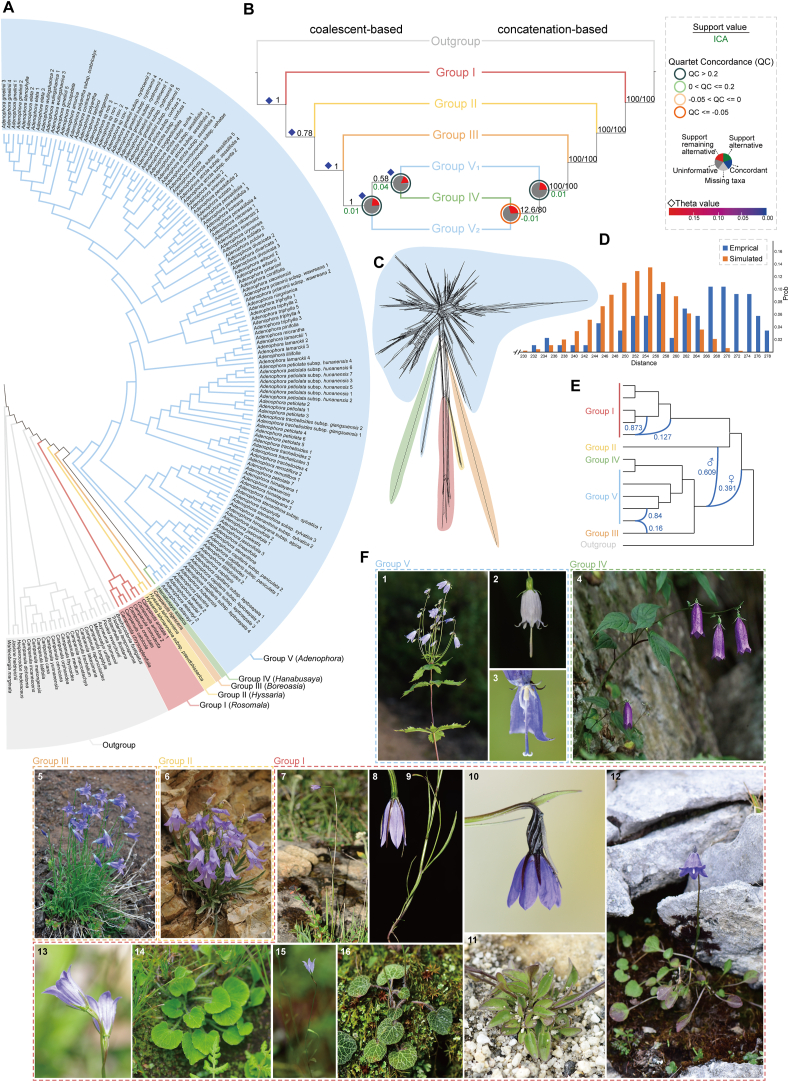
Hybridization and introgression have long obscured relationships within Adenophora and its relatives, complicating generic delimitation. Leveraging deep genome skimming (DGS) data, we generated a large dataset, including thousands of single-copy nuclear (SCN) genes and plastomes, to untangle this reticulate history. Specifically, 9.89 terabytes (TB) of DGS data from 165 samples-representing 48 species and 13 subspecies of Adenophora (out of ca. 72 species) plus 24 outgroup species-yielded 1506 SCN genes and 77 plastid coding sequences. Tree-like phylogenies inferred with both coalescent- and concatenation-based methods revealed pronounced gene tree heterogeneity. Subsequent analysis showed that incomplete lineage sorting contributed minimally to this discordance; instead, hybridization and introgression were the primary drivers of early diversification. Integrating phylogenomic, morphological, and geographic evidence, we propose a revised generic framework for this group. Adenophora is expanded to include Campanula delavayi and the Korean Peninsula endemic genus Hanabusaya. We also recommend reinstating Hyssaria as a distinct Central Asian genus and introducing two new genera, Boreoasia and Rosomala.
Keywords: Campanula; Hanabusaya; Network; Polyphyly; Reticulation; Taxonomy.
© 2025 Kunming Institute of Botany, Chinese Academy of Sciences. Publishing services by Elsevier B.V. on behalf of KeAi Communications Co., Ltdé.
Conflict of interest statement
The authors declare that they have no known competing financial interests or personal relationships that could have appeared to influence the work reported in this paper.
Figures



References
-
- APG IV An update of the Angiosperm Phylogeny Group classification for the orders and families of flowering plants: APG IV. Bot. J. Linn. Soc. 2016;181:1–20. doi: 10.1111/boj.12385. - DOI
-
- Borowiec M.L. Spruceup: fast and flexible identification, visualization, and removal of outliers from large multiple sequence alignments. J. Open Source Softw. 2019;4:1635. doi: 10.21105/joss.01635. - DOI
Associated data
LinkOut - more resources
Full Text Sources
Other Literature Sources
