


Sleep apnea increases odds of 90-day postoperative complications and healthcare utilization following lumbar discectomy
- PMID: 40735148
- PMCID: PMC12305334
- DOI: 10.1016/j.xnsj.2025.100765
Sleep apnea increases odds of 90-day postoperative complications and healthcare utilization following lumbar discectomy
Abstract
Introduction: Postoperative adverse events following lumbar discectomy (LD) are important to characterize for patient counseling and risk management, particularly in potentially vulnerable patient populations, such as those with sleep apnea (SA). Although increasing screening and optimization pathways are starting to be put into place for patients with SA in general, specific attention to this condition in relation to LD has not been reported.
Methods: Adult patients undergoing isolated, single-level, lumbar laminotomy/discectomy were identified from the 2010 to 2022 PearlDiver Mariner database. Those without versus with SA were matched 4:1 based on age, sex, and Elixhauser comorbidity index (ECI). Ninety-day severe and minor adverse events, emergency department (ED) visits, and readmissions were assessed and compared with multivariate analysis. Overall 90-day reimbursements and 5-year revisions were assessed and compared.
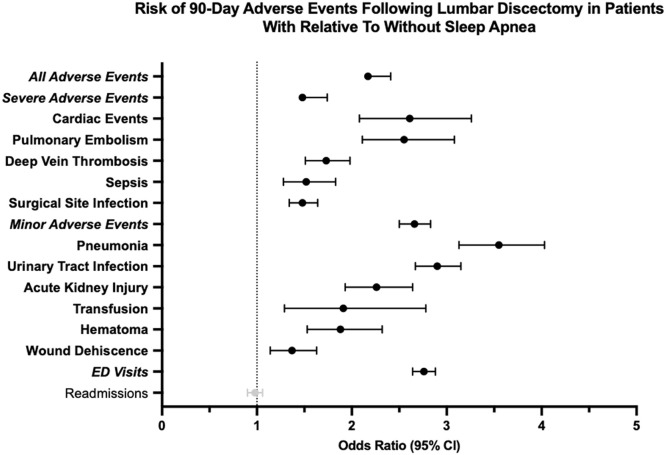
Results: Of a total of 200,515 LD patient, SA was identified for 24,975 (12.5%). After matching, there were 74,391 without sleep apnea and 18,734 with sleep apnea. Patients with SA had independently higher odds-ratio (OR) of experiencing most 90-day postoperative adverse events, as well as aggregated severe (OR: 1.60) and minor (OR: 2.66) adverse events (p<.0001 for each). Patients with SA were also at higher odds of 90-day ED visits (OR: 2.76) and median overall 90-day reimbursement ($3,300.00 vs.. $3,106.00) (p<.0001 for both). Further, patients with SA were more likely to undergo 5-year subsequent lumbar surgery (p=.01).
Conclusions: While increasing attention has been given to SA around surgical interventions, the current study defined that over a tenth of LD patients had diagnosed SA and were at greater odds of severe and minor adverse events, as well as reoperations, in their postoperative period. This translated to greater health care utilization and cost. Consequently, patients with SA ought to receive supplemental risk counseling and postoperative resource planning when considered for LD.
Keywords: Adverse events; Complications; Lumbar discectomy; PearlDiver; Sleep apnea; Spine surgery.
© 2025 The Author(s).
Conflict of interest statement
Jonathan N Grauer: Editor-in-Chief of North American Spine Society Journal, Board Member North American Spine Society. One or more of the authors declare financial or professional relationships on ICMJE-NASSJ disclosure forms." Please include a request on the AQF for the author to approve. The remaining authors declare that they have no known competing financial interests or personal relationships that could have appeared to influence the work reported in this paper.
Figures

References
-
- Butler A.J., Munakomi S., Donnally III C.J. StatPearls. StatPearls Publishing; Treasure Island, FL: 2024. Diskectomy.http://www.ncbi.nlm.nih.gov/books/NBK544281/ Accessed July 11, 2024.
-
- Diskectomy - Mayo Clinic. Accessed July 11, 2024. https://www.mayoclinic.org/tests-procedures/diskectomy/about/pac-20393837.
LinkOut - more resources
Full Text Sources
Research Materials
