


Autistic Children And Adolescents Without Intellectual Disability: Individual And Family Profile
- PMID: 40735385
- PMCID: PMC12302814
- DOI: 10.36131/cnfioritieditore20250305
Autistic Children And Adolescents Without Intellectual Disability: Individual And Family Profile
Abstract
Objective: This study aims to characterize the developmental, cognitive, and behavioral profiles of children and adolescents with autism spectrum disorder (ASD) without intellectual disability (ID).
Method: A cross-sectional observational study was conducted, including children and adolescents with ASD and an intelligence quotient (IQ) of 75 or higher. Parents completed the CBCL, and SNAP-IV 26 Parent Rating Scale to assess developmental milestones, cognitive abilities, and behavioral symptoms.
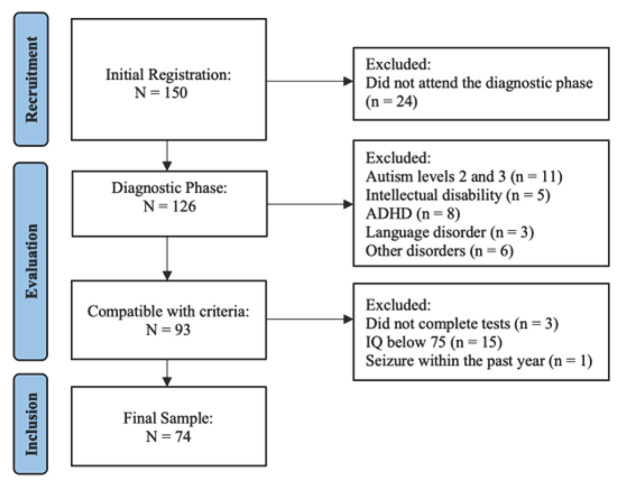
Results: The study included 74 participants, with a mean age of 9.8 ± 2.9 years, of whom 64 (86.5%) were male. Mothers and fathers had a mean age of 33.4 ± 5.5 and 30.2 ± 5.7 years, respectively, with 64.9% of mothers and 47.9% of fathers having completed higher education. Generalized anxiety and depression were the most frequent psychiatric histories reported by parents. Median IQ scores were: total 100 (88-113), verbal 102 (85-117), and performance 97 (90-108). While 82.5% of children spoke their first words before 24 months, only 40% were able to form phrases by age 2. Prosody, pragmatic difficulties, and echolalia were present in over 40% of cases. Moderate or severe symptoms of inattention, hyperactivity, and oppositional behaviors were observed in 33.8%, 16.2%, and 16.2% of participants, respectively. Internalizing symptoms were present in 27%, and externalizing symptoms in 15% of the sample. Learning challenges included difficulties with text interpretation (31%), text production (24%), reading, and math (19% each).
Conclusions: Children and adolescents with ASD without ID exhibit significant behavioral and cognitive challenges, including language delays, inattention, internalizing symptoms, and learning difficulties. These findings emphasize the need for targeted educational and therapeutic strategies to address their unique developmental and behavioral profiles.
Keywords: autism; comorbidities; school inclusion.
© 2025 Giovanni Fioriti Editore s.r.l.
Conflict of interest statement
Competing interests: None.
References
-
- Achenbach, T. M., & Rescorla, L. (2001). Manual for the ASEBA school-age forms & profiles. University of Vermont, Research Center for Children, Youth, & Families.
-
- American Psychiatric Association. (2013). Diagnostic and statistical manual of mental disorders (5th ed.). 10.1176/appi.books.9780890425596 - DOI
-
- American psychiatric association (2023). Manual diagnóstico e estatístico de transtornos mentais: DSM-5-TR. 5. ed. rev. Porto Alegre, Artmed.
LinkOut - more resources
Full Text Sources