


Beyond individual barriers and facilitators: Digital interventions to address diabetes in urban Ghana
- PMID: 40735547
- PMCID: PMC12304655
- DOI: 10.1177/20552076251349705
Beyond individual barriers and facilitators: Digital interventions to address diabetes in urban Ghana
Abstract
Objective: The prevalence of type 2 diabetes (T2D) and other non-communicable diseases (NCDs) in Ghana and other countries in sub-Saharan Africa (SSA) is increasing at a rate notably higher than the rest of the world. Consequently, there is an urgent need to develop low-cost community interventions for diseases including T2D in Ghana, with digital tools potentially empowering community members in prevention and management. This research aimed to identify effective strategies for leveraging digital tools to address T2D in Ga Mashie, Ghana, through community-driven empowerment and action.
Method: This was a mixed methods study involving focus groups (N = 13), qualitative interviews with community representatives (N = 69) and two community workshops (N = 35 participants in each).
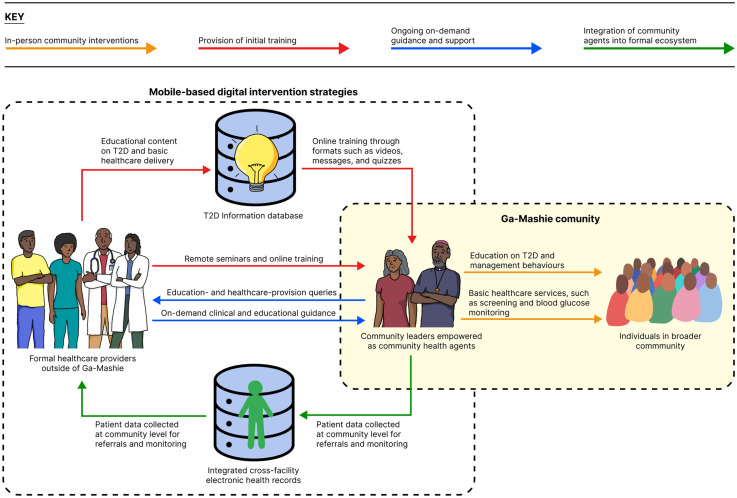
Results: The focus groups and interviews identified strong facilitators for an individual-level digital intervention focused on education; however, workshops highlighted that the community wants greater access to in-person education and healthcare services in Ga Mashie, limiting the likely impact of an individual digital intervention.
Conclusion: Our findings challenge the widespread assumption that digital interventions should be targeted at the individual; rather, digital tools might be used to empower community leaders in Ga Mashie with training and clinical guidance to function as healthcare agents, scaling-up the delivery of education and screening services to their broader community. This suggests a novel system-level strategy for designing community-based, empowerment-focused digital health interventions that reflect the practices and values of community members, though further work is needed to validate this approach.
Keywords: Digital health; community health; empowerment; mHealth; non-communicable diseases; task-shifting; type 2 diabetes.
© The Author(s) 2025.
Conflict of interest statement
The authors declared no potential conflicts of interest with respect to the research, authorship, and/or publication of this article.
Figures


References
-
- Atun R, Davies JI, Gale EAM, et al. Diabetes in sub-Saharan Africa: from clinical care to health policy. Lancet Diabetes Endocrinol 2017; 5: 622–667. - PubMed
-
- Asamoah-Boaheng M, Sarfo-Kantanka O, Tuffour AB, et al. Prevalence and risk factors for diabetes mellitus among adults in Ghana: a systematic review and meta-analysis. Int Health 2019; 11: 83–92. - PubMed
-
- Amoah AGB, Owusu SK, Adjei S. Diabetes in Ghana: a community-based prevalence study in Greater Accra. Diabetes Res Clin Pract 2002; 56: 197–205. - PubMed
LinkOut - more resources
Full Text Sources
Research Materials
