


Integrating ethics in digital mental healthcare technologies: a principle-based empirically grounded roadmap approach
- PMID: 40736629
- PMCID: PMC12380974
- DOI: 10.1007/s11019-025-10283-6
Integrating ethics in digital mental healthcare technologies: a principle-based empirically grounded roadmap approach
Abstract
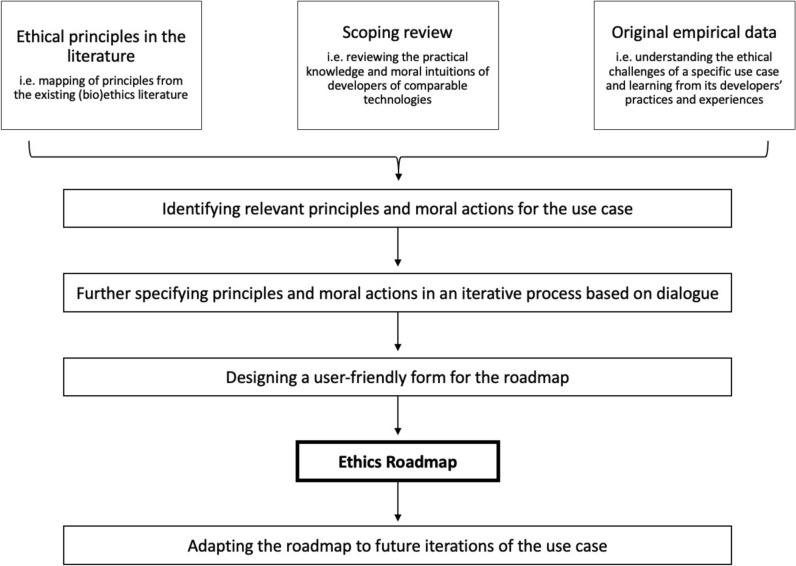
Digital mental healthcare technologies increasingly incorporate gamification, yet relevant ethical considerations remain underexamined. This paper introduces the Principle-Based Empirically Grounded Roadmap Approach (PERA), a methodological contribution to empirical bioethics. It has evolved from ethics research within the Horizon Europe project ASPbelong, which designs a collaboratively played augmented reality intervention for adolescents. PERA refines existing integrated empirical bioethics methodologies by responding to three key characteristics of the use case: a largely predetermined technology with a relatively low degree of openness in technological design, embedded co-development practices led by facilitators from within the project team, and planned future iterations beyond the ethics team's involvement. PERA integrates mapping of principles from the ethics literature, a scoping review of the moral intuitions of developers of comparable technologies, and the collection of original empirical data on the use case. Using abductive reasoning, these insights are synthesized into a tangible output: an ethics roadmap designed to guide and be adapted in future use case iterations. By advancing a methodology of combining normative reasoning with empirical insights on a concrete use case, this paper provides both practical tools for ethics researchers in technology projects and a means to generate empirically grounded conceptual contributions. Its outcomes, when brought into dialogue with findings from other integrated empirical bioethics research, can support the critical examination of broader assumptions and implications of gamified mental healthcare, including questions of good care and the broader social implications of such technologies.
Keywords: Applied ethics; Digital health; Empirical bioethics; Health apps; Methodology; Serious games; mHealth.
© 2025. The Author(s).
Conflict of interest statement
Declarations. Competing interests: The authors have no competing interests to declare that are relevant to the content of this article.
Figures

References
-
- ASPbelong. 2025. ‘Summarising 2024: Cultural Exchanges Accomplished!’ Updates (blog). Accessed 7 January 2025. https://www.augmentedsocialplay.com/updates/summarising-2024-cultural-ex...
-
- Baker, Robert. 2005. Getting Agreement: How Bioethics Got Started. Hastings Center Report 35 (3): 50–51. 10.1353/hcr.2005.0053.
-
- Balmer, Andrew S., Jane Calvert, Claire Marris, Susan Molyneux-Hodgson, Emma Frow, Matthew Kearnes, Kate Bulpin, Pablo Schyfter, Adrian Mackenzie, and Paul Martin. 2016. Five Rules of Thumb for Post-ELSI Interdisciplinary Collaborations. Journal of Responsible Innovation 3 (1): 73–80. 10.1080/23299460.2016.1177867.
-
- Beauchamp, Tom L., and James F. Childress. 2019. Principles of Biomedical Ethics, 8th ed. New York: Oxford University Press.
MeSH terms
LinkOut - more resources
Full Text Sources
