


Role of Computational Modelling in Enhancing Thermal Safety During Cardiac Ablation
- PMID: 40737441
- PMCID: PMC12360848
- DOI: 10.1093/icvts/ivaf184
Role of Computational Modelling in Enhancing Thermal Safety During Cardiac Ablation
Abstract
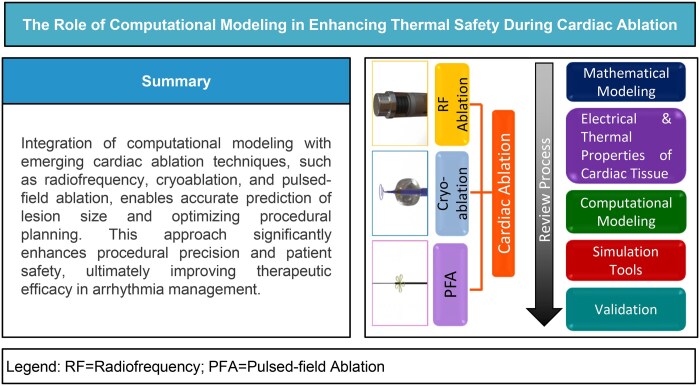
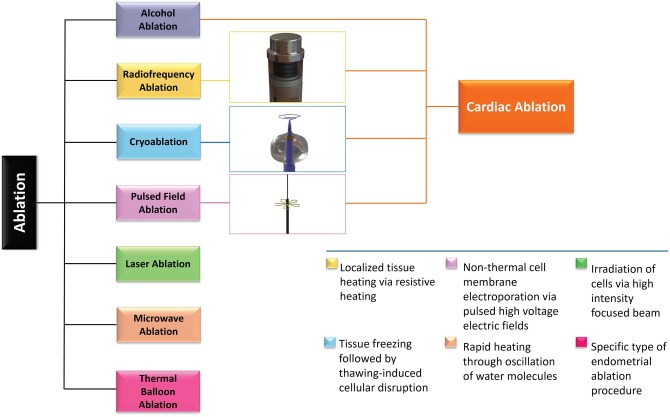
Objectives: In this narrative review, we aim to provide an analysis of current cardiac ablation techniques, such as radiofrequency ablation, cryoablation, and pulsed-field ablation, with a focus on the role of computational modelling in enhancing the precision, safety, and effectiveness of these treatments. Particular attention is given to thermal management, exploring how computational approaches contribute to understanding and controlling energy delivery, heat distribution, and tissue response during ablation procedures.
Methods: We conducted this narrative review based on our expertise and a targeted search using over 50 keywords across major databases. We selected studies for their relevance, impact, and methodological rigor, and included additional references suggested during peer review. While we did not follow a systematic protocol, our approach ensured broad coverage of key developments and emerging trends in the field. We then presented the mechanisms, applications, and limitations of radiofrequency ablation, cryoablation, and pulsed-field ablation. Additionally, we discussed the use of computational approaches, including numerical methods and artificial intelligence based models, for evaluating energy distribution, lesion size, and tissue response during ablation procedures.
Results: Computational methods can be used to predict ablation treatment outcomes and help optimize lesion size, ablation parameters, and procedural safety. However, these models are only reliable when properly validated and verified.
Conclusions: Further research is essential to collect reliable in vivo data for validating computational models and integrating them into clinical practice to improve patient outcomes.
Keywords: cardiac ablation; computational modelling; energy distribution; lesion formation; patient-specific outcomes.
© The Author(s) 2025. Published by Oxford University Press on behalf of the European Association for Cardio-Thoracic Surgery.
Conflict of interest statement
Dr Esmailie’s lab is supported by a funding from Field Medical. Inc, a company that makes PFA ablation devices.
Figures
References
-
- Karpawich PP. Pathophysiology of cardiac arrhythmias: arrhythmogenesis and types of arrhythmias. In: Jagadeesh G, Balakumar P, Maung-U K, eds. Pathophysiology and Pharmacotherapy of Cardiovascular Disease. Cham: Springer International Publishing; 2015: 1003-1014. 10.1007/978-3-319-15961-4_47 - DOI
-
- Wray JK, Dixon B, Przkora R. Radiofrequency Ablation. StatPearls Publishing; 2025. - PubMed
Publication types
MeSH terms
Grants and funding
LinkOut - more resources
Full Text Sources
