


Alterations in GSH/GSSG and CyS/CySS redox status in small cell lung cancer patients undergoing chemotherapy
- PMID: 40739043
- PMCID: PMC12311089
- DOI: 10.1007/s12672-025-03251-2
Alterations in GSH/GSSG and CyS/CySS redox status in small cell lung cancer patients undergoing chemotherapy
Abstract
Background: In small cell lung cancer (SCLC), oxidative stress disrupts redox balance and contributes to tumor progression and treatment resistance through DNA damage, inflammation, and tumorigenesis. Thiol compounds such as glutathione (GSH) and cysteine (CyS) together with their oxidized forms (GSSG and CySS) serve as markers of oxidative stress. The aim of this study was to investigate changes in GSH/GSSG and CyS/CySS ratios during chemotherapy and evaluate their potential as prognostic indicators in SCLC.
Materials and methods: In this longitudinal study, redox biomarkers (GSH/GSSG and CyS/CySS ratios) were investigated in 60 stage III/IV SCLC patients receiving cisplatin-etoposide chemotherapy. Plasma samples were collected before chemotherapy, after two cycles and after four cycles and analyzed by LC-MS/MS.
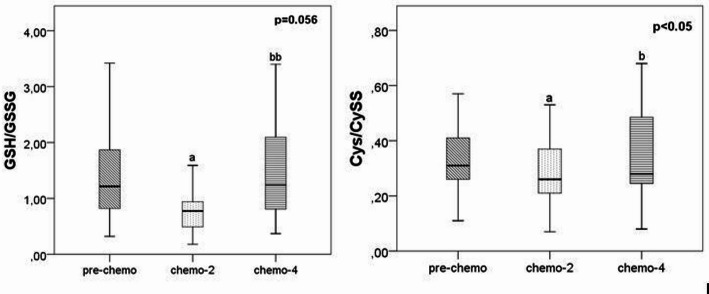
Results: Significant redox changes were observed during chemotherapy. The GSH/GSSG ratio decreased after two cycles (p = 0.029) and increased after four cycles (p = 0.002). The same trend was observed for CyS/CySS dynamics (p = 0.031 and p = 0.030, respectively). The Survivors showed a recovery of the redox balance, while the deceased patients showed persistently lower ratios. Kaplan-Meier analysis showed that a higher GSH/GSSG ratio before treatment (p = 0.037) predicted better survival. A positive correlation was found between GSH/GSSG and CyS/CySS ratios (ρ = 0.306, p = 0.019).
Conclusions: This study demonstrates that redox imbalance reflected in GSH/GSSG and CyS/CySS ratios is an important factor for SCLC treatment response and survival. Higher GSH/GSSG ratios before treatment are associated with improved survival, indicating the potential of redox markers as prognostic tools in SCLC.
Keywords: Lung cancer; Oxidative stress; Prognostic biomarkers; Redox imbalance.
© 2025. The Author(s).
Conflict of interest statement
Declarations. Ethics approval and consent participate: This study was conducted in accordance with the ethical principles outlined in the Declaration of Helsinki. The experiments were conducted with the understanding and consent of each subject. Ethical approval was obtained from Ethics Committee of the Faculty of Medicine, University of Belgrade (Approval No.: 1322/II-81, Date: 02/20/2020). Consent for publication: All authors confirm that they approve the publication of this manuscript. All participants provided informed consent before their inclusion in the study. Competing interests: The authors declare no competing interests.
Figures


References
-
- Moore SM, Zhan LJ, Liu G, Rittberg R, Patel D, Chowdhury D et al. (2022) EP14. 05–020 Population-based Outcomes for Patients with Extensive-Stage Small-cell Lung Cancer from the Canadian SCLC Database (CASCADE). J Thorac Oncol 17:S552. 10.1016/j.jtho.2022.07.995
-
- Megyesfalvi Z, Gay CM, Popper H, Pirker R, Ostoros G, Heeke S, et al. Clinical insights into small cell lung cancer: tumor heterogeneity, diagnosis, therapy, and future directions. CA Cancer J Clin. 2023;73:620–52. 10.3322/caac.21785. - PubMed
-
- National Cancer Institute. Surveillance, epidemiology, and end results program. SEER*Stat database. Bethesda, MD: National Cancer Institute; 2021.
Grants and funding
LinkOut - more resources
Full Text Sources