


Rifampicin-resistant tuberculosis in Fujian Province, Southeast China: a retrospective analysis of drug resistance screening and treatment outcomes, 2019-2024
- PMID: 40740365
- PMCID: PMC12307381
- DOI: 10.3389/fpubh.2025.1611459
Rifampicin-resistant tuberculosis in Fujian Province, Southeast China: a retrospective analysis of drug resistance screening and treatment outcomes, 2019-2024
Abstract
Backgrounds: Rifampicin-resistant tuberculosis (RR-TB) remains a major challenge to global TB control efforts. In Fujian Province, Southeast China, where RR-TB prevalence has been notably high, understanding epidemiological trends and treatment outcomes is crucial for optimizing interventions. This study aimed to analyze RR-TB characteristics, resistance patterns, and treatment outcomes to inform evidence-based control strategies.
Methods: An observational study was conducted utilizing data from China's National Tuberculosis Information Management System, focusing on bacteriologically confirmed tuberculosis cases reported in Fujian Province during 2019-2024. Epidemiological characteristics, drug resistance and outcomes of RR-TB were described as frequency (n) and percentage (%). Risk factors for unsuccessful outcomes were assessed using univariate and multivariate logistic regression.
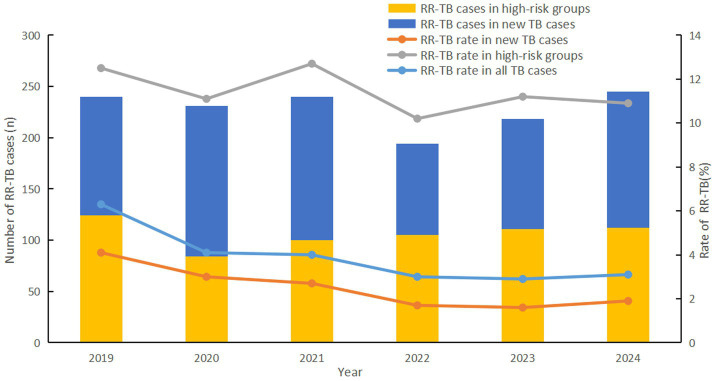
Results: A total of 1,368 RR-TB patients were detected, with an overall resistance rate of 3.7%. The RR rate showed a steady decline year by year (χ2 = 76.214, p < 0.001), mainly due to the decrease in new TB cases (χ2 = 60.966, p < 0.001). RR-TB patients exhibited higher co-resistance to isoniazid (71.9% vs. 6.3%, p < 0.001) and ofloxacin (29.8% vs. 1.8%, p < 0.001) compared to rifampicin-sensitive TB. Of 1,056 RR-TB patients initiated on treatment, 720 had outcome data, revealing a low success rate (58.6%) due to high loss to follow-up (31.1%) and mortality (9.3%). Multivariate analysis identified male sex (AOR = 1.67, 95% CI: 1.11-2.52, p = 0.014), age ≥45 years (AOR = 2.27, 95% CI: 1.58-3.26, p < 0.001), high-risk group status (AOR = 1.42, 95% CI: 1.04-1.94, p = 0.026), and occupation as farmer/worker (AOR = 2.17, 95% CI: 1.10-4.26, p = 0.025) as independent risk factors of unsuccessful treatment.
Conclusion: Fujian Province has demonstrated a steady decline in rifampicin resistance rates, primarily driven by reductions in new TB cases. However, treatment inclusion rate and success rate remains suboptimal, highlighting the need for targeted interventions-including enhanced adherence support, intensive follow-up, and adverse event management-particularly for high-risk groups such as older males and manual laborers. These findings can guide tailored strategies to further reduce RR-TB burden in similar settings.
Keywords: epidemiology; regression analysis; rifampicin-resistant; treatment outcome; tuberculosis.
Copyright © 2025 Zhou, Dai, Lin, Chen, Lin, Chen, Lin and Deng.
Conflict of interest statement
The authors declare that the research was conducted in the absence of any commercial or financial relationships that could be construed as a potential conflict of interest.
Figures
References
-
- World Health Organization . Global tuberculosis report 2024. Geneva: World Health Organization; (2024).
-
- World Health Organization . Companion handbook to the WHO guidelines for the programmatic management of drug-resistant tuberculosis. WHO/HTM/TB/2014.11. Geneva: World Health Organization; (2014). - PubMed
-
- Gupta AK, Katoch VM, Chauhan DS, Sharma R, Singh M, Venkatesan K, et al. Microarray analysis of efflux pump genes in multidrug-resistant Mycobacterium tuberculosis during stress induced by common anti-tuberculous drugs. Microb Drug Resist. (2010) 16:21–8. doi: 10.1089/mdr.2009.0054, PMID: - DOI - PubMed
Publication types
MeSH terms
Substances
LinkOut - more resources
Full Text Sources
