


Guideline-based asthma treatment in Asia: Insights from a robust time-in-state model
- PMID: 40740412
- PMCID: PMC12308026
- DOI: 10.1016/j.jacig.2025.100531
Guideline-based asthma treatment in Asia: Insights from a robust time-in-state model
Abstract
Background: The landscape of guideline-based asthma treatment in Asia remains unclear.
Objective: Leveraging current evidence, we predicted the long-term economic impact of guideline-based asthma treatment in Asian countries, using Singapore as a case study.
Methods: We systematically reviewed evidence between 2014 and 2024 on asthma prevalence, adherence to inhaled corticosteroid (ICS) with or without long-acting β-agonist (LABA), and frequency of short-acting β-agonist (SABA) use in Asian asthma populations. We developed a time-in-state model for the joint impact of ICS/ICS-LABA adherence and SABA use on the economic and humanistic burden of uncontrolled asthma during 2024 to 2043. Accordingly, we projected 20-year total direct costs, indirect costs, and quality-adjusted life-years (QALYs) lost associated with uncontrolled asthma in Singapore and assessed the varied impact of guideline-based asthma treatment.
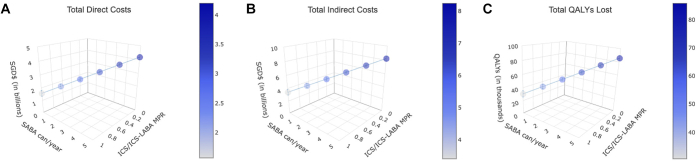
Results: Among 28 Asia-based, population-level studies, asthma prevalence was 1% to 12% in adults and 2% to 14% in children. ICS/ICS-LABA adherence, reported in only 3 countries, ranged from 10% to 90%; average SABA use was 2.5 to 6.4 canisters/year. In Singapore, under current trends of ICS/ICS-LABA adherence and SABA use, the 20-year burden of uncontrolled asthma is SGD$2.772 billion in direct costs, SGD$5.670 billion in indirect costs, and 58,872 QALYs lost. Optimizing guideline-based treatment nationwide (ICS/ICS-LABA medication possession ratio = 0.8, SABA use = 1 canister/year) reduces 20-year direct costs, indirect costs, and QALYs lost by 27.7%, 23.8%, and 28.8%, respectively.
Conclusions: Population-based evidence on guideline-based asthma treatment in Asia is limited. Population-level modeling of its economic impact, using minimal key evidence, revealed substantial reduction in societal economic and humanistic burden in Asian countries such as Singapore.
Keywords: Asthma; asthma control; asthma management guidelines; inhaled corticosteroid; β-agonist.
© 2025 The Author(s).
Conflict of interest statement
This study was funded by the 10.13039/501100001352National University of Singapore (NUS) Start-up Grant. Disclosure of potential conflict of interest: M. S. Koh reports grant support from Astra-Zeneca and honoraria for lectures and advisory board meetings paid to her hospital (10.13039/501100001469Singapore General Hospital) from 10.13039/100004330GlaxoSmithKline, AstraZeneca, Novartis, Sanofi, Boehringer Ingelheim, and Roche outside the submitted work. The rest of the authors declare that they have no relevant conflicts of interest.
Figures


References
-
- Global strategy for asthma management and prevention. Global Initiative for Asthma; 2018. www.ginasthma.org Available at: Accessed April 19, 2025.
-
- Global strategy for asthma management and prevention. Global Initiative for Asthma; 2019. www.ginasthma.org Available at: Accessed April 19, 2025.
-
- Peters S.P., Ferguson G., Deniz Y., Reisner C. Uncontrolled asthma: a review of the prevalence, disease burden and options for treatment. Respir Med. 2006;100:1139–1151. - PubMed
LinkOut - more resources
Full Text Sources
