


The relationship between oxidative balance score, depression, and survival among adult cancer survivors in the United States
- PMID: 40740636
- PMCID: PMC12307194
- DOI: 10.3389/fnut.2025.1622588
The relationship between oxidative balance score, depression, and survival among adult cancer survivors in the United States
Abstract
Background: Depression and oxidative balance score (OBS) are linked to disease risk, yet their combined effects on cancer survival remain unclear. This study assessed OBS, depression, and mortality in cancer survivors.
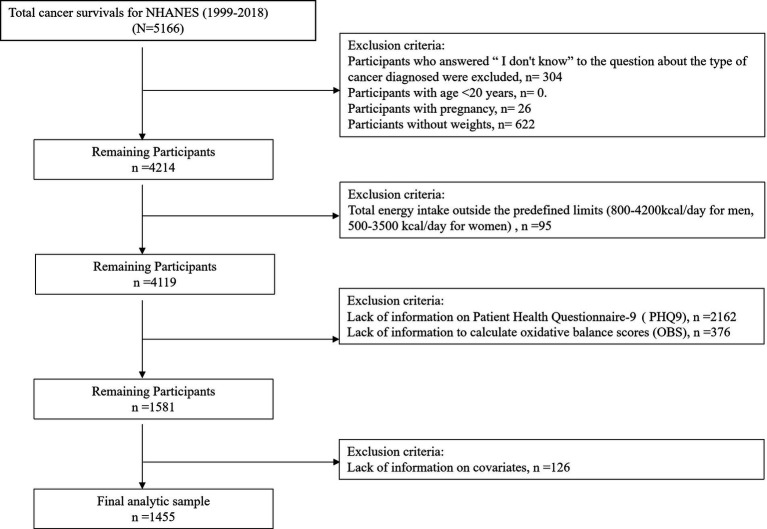
Methods: Utilizing a prospective, population-based cohort design, this analysis enrolled 1,455 adult cancer survivors (age ≥20 years) through the National Health and Nutrition Examination Survey (NHANES) from 1999 to 2018. The OBS was related to diet and exercise, and depression was self-reported. Depressive symptomatology was measured using the established Patient Health Questionnaire-9 (PHQ-9) self-report questionnaire. Depression was defined as a total PHQ-9 score > 4, indicating the presence of depressive symptoms. A score ≤ 4 was considered to indicate no depression. Mortality outcomes (all-cause, cancer-specific, non-cancer) were tracked via the National Death Index through 2019. Cox models adjusted for demographics, socioeconomic status, and comorbidities.
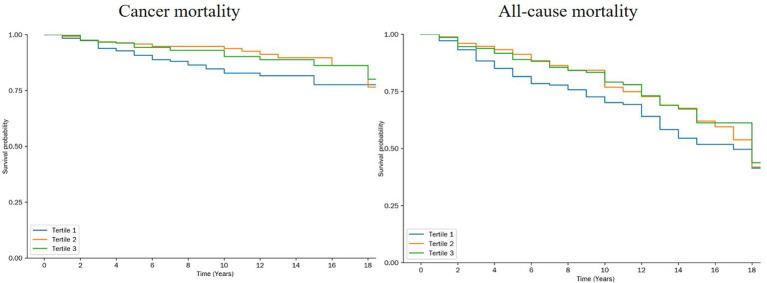
Results: Over 80-90 months, 329 deaths occurred (102 cancer-related). Higher OBS predicted reduced mortality (per-unit HR = 0.94, 95% CI: 0.90-0.98). In OBS tertiles, Tertile 3 vs. Tertile 1 showed HR = 0.30 (95% CI: 0.14-0.63) for cancer mortality. Depression alone had no mortality association (HR = 1.24, 95% CI: 0.49-3.18). However, within the highest OBS tertile, depressed patients exhibited lower cancer mortality (HR = 0.18, 95% CI: 0.05-0.71) versus non-depressed counterparts.
Conclusion: Elevated OBS is protective in cancer survivors. Depression may paradoxically reduce mortality risk in high-OBS subgroups, suggesting nutrition-psychology interactions.
Keywords: NHANES; cancer survivors; depression; mortality; oxidative balance score.
Copyright © 2025 Zhang, Wu, Fan, Zhou and Liu.
Conflict of interest statement
The authors declare that the research was conducted in the absence of any commercial or financial relationships that could be construed as a potential conflict of interest.
Figures

References
LinkOut - more resources
Full Text Sources
