


Effects of Siblings on Cognitive and Sociobehavioral Development: Ongoing Debates and New Theoretical Insights
- PMID: 40741372
- PMCID: PMC12308855
- DOI: 10.1177/00031224231210258
Effects of Siblings on Cognitive and Sociobehavioral Development: Ongoing Debates and New Theoretical Insights
Abstract
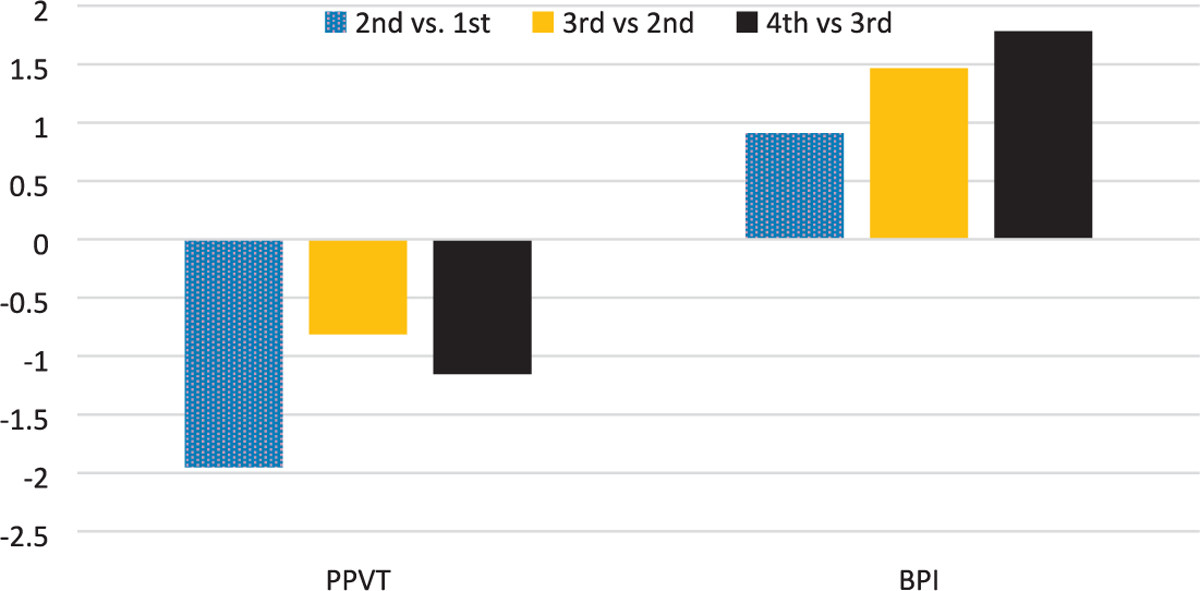
Despite social scientists' long-standing interest in the influences of siblings, previous research has not settled the debates on how relevant sibship size is to child development and whether growing up with more siblings could be beneficial. Using 30 years of longitudinal data and fixed-effects models, this study offers the most comprehensive evidence on how sibship size is tied to cognitive and sociobehavioral development. We also advance the literature by systematically comparing the consequences of gaining a sibling for children with varying ordinal positions. Contrary to prior studies using selective data from limited observation spans, we find that children experience net decreases in cognitive test scores as their family size grows. At the same time, our analysis shows that sibling additions are only important to first- and second-born children's-not later-born children's-cognitive development. Even for the first- and second-born, the marginal effect of adding a sibling lessens with each addition. Our results thus demonstrate the time-dependent nature of family resource-dilution processes. For sociobehavioral development, the evidence indicates that having an older sibling is beneficial, but gaining a younger sibling increases behavioral problems for some (e.g., first-born children). Because more children from large families have older siblings, children from larger families exhibit less problematic behavior, on average. By uncovering the complex relationship between siblings and noncognitive development, this study also generally contributes to the sociology of family and inequality.
Keywords: cognitive development; family size; resource allocation dynamics; siblings; sociobehavioral development.
Figures
References
-
- Barber Jennifer S. 2000. “Intergenerational Influences on the Entry into Parenthood: Mothers’ Preferences for Family and Nonfamily Behavior.” Social Forces 79(1):319–48 ( 10.1093/sf/79.1.319). - DOI
-
- Baydar Nazli, Hyle Patricia, and Brooks-Gunn Jeanne. 1997. “A Longitudinal Study of the Effects of the Birth of a Sibling during Preschool and Early Grade School Years.” Journal of Marriage and Family 59(4):957–65 ( 10.2307/353795). - DOI
-
- Black Sandra E., Devereux Paul J., and Salvanes Kjell G. 2005. “The More the Merrier? The Effect of Family Size and Birth Order on Children’s Education.” Quarterly Journal of Economics 120(2):669–700 ( 10.1093/qje/120.2.669). - DOI
-
- Black Sandra E., Devereux Paul J., and Salvanes Kjell G. 2010. “Small Family, Smart Family?” Family Size and the IQ Scores of Young Men 45(1):33–58 ( 10.3368/jhr.45.1.33). - DOI
Grants and funding
LinkOut - more resources
Full Text Sources