


Evaluating the short-term effects of dance on motor and non-motor outcomes in people living with Parkinson's: A crossover study
- PMID: 40743265
- PMCID: PMC12312918
- DOI: 10.1371/journal.pone.0328293
Evaluating the short-term effects of dance on motor and non-motor outcomes in people living with Parkinson's: A crossover study
Abstract
Purpose: To investigate the short-term effects of a single dance class on motor and non-motor outcomes in people living with Parkinson's.
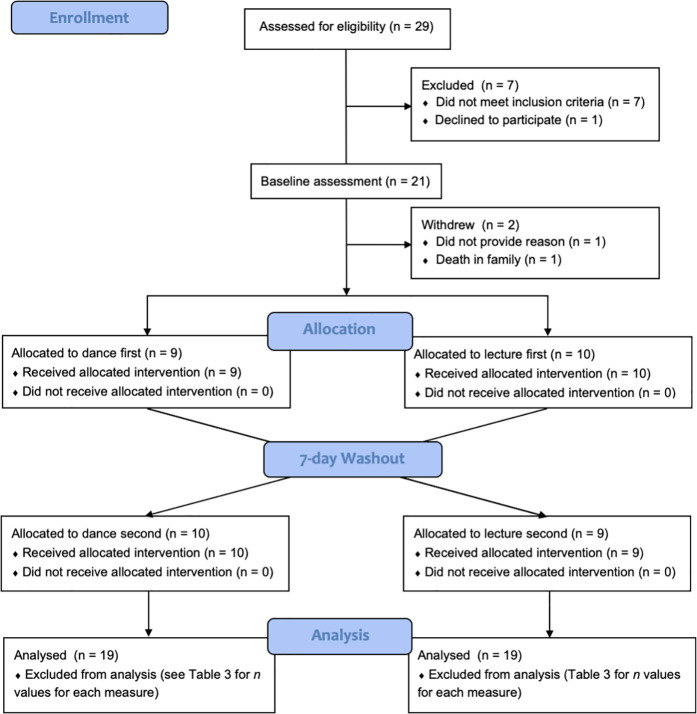
Methods: A crossover design was used. Nineteen people participated. All participants took part in both dance and lecture control conditions seven days apart in a counterbalanced order. Outcomes of gait, balance, functional mobility, and aspects of cognition were measured before and after each condition. A visual analogue scale evaluated self-perceived changes in fatigue, energy, depression, anxiety, concentration, and movement. Statistical analyses were performed using 2x2 repeated-measures ANOVAs with time (pre vs. post) and condition (dance vs. lecture) as factors.
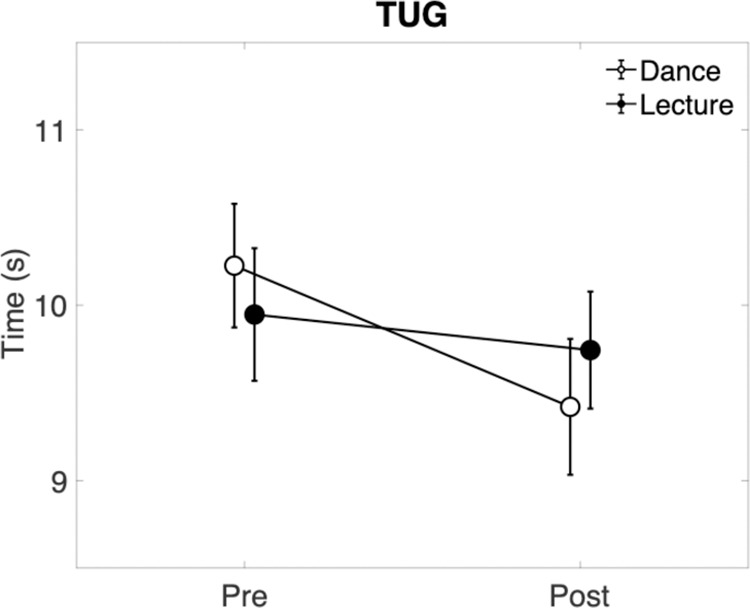
Results: Results showed functional mobility (measured by the Timed Up and Go) improved to a greater extent after dance compared to the lecture. Significant improvements after both dance and lecture sessions were demonstrated for other outcomes measuring balance, cognition, and anxiety, indicating either both conditions had a comparable impact or practice effects may have influenced results.
Conclusions: Further research is needed to confirm the presence and strength of the short-term effect of dance on functional mobility, to assess the impact of dancing on aspects of cognition and anxiety, and to hone the approach to studying the short-term effects of dance.
Copyright: © 2025 Carapellotti et al. This is an open access article distributed under the terms of the Creative Commons Attribution License, which permits unrestricted use, distribution, and reproduction in any medium, provided the original author and source are credited.
Conflict of interest statement
The authors have declared that no competing interests exist.
Figures
References
-
- Heiberger L, Maurer C, Amtage F, Mendez-Balbuena I, Schulte-Mönting J, Hepp-Reymond M-C, et al. Impact of a weekly dance class on the functional mobility and on the quality of life of individuals with Parkinson’s disease. Front Aging Neurosci. 2011;3:14. doi: 10.3389/fnagi.2011.00014 - DOI - PMC - PubMed
-
- Bearss KA, McDonald KC, Bar RJ, DeSouza JFX. Improvements in balance and gait speed after a 12 week dance intervention for Parkinson’s disease. Advances in Integrative Medicine. 2017;4(1):10–3. doi: 10.1016/j.aimed.2017.02.002 - DOI
-
- Prewitt CM, Charpentier JC, Brosky JA, Urbscheit NL. Effects of Dance Classes on Cognition, Depression, and Self-Efficacy in Parkinson’s Disease. Am J Dance Ther. 2017;39(1):126–41. doi: 10.1007/s10465-017-9242-8 - DOI
-
- Koch SC, Mergheim K, Raeke J, Machado CB, Riegner E, Nolden J, et al. The Embodied Self in Parkinson’s Disease: Feasibility of a Single Tango Intervention for Assessing Changes in Psychological Health Outcomes and Aesthetic Experience. Front Neurosci. 2016;10:287. doi: 10.3389/fnins.2016.00287 - DOI - PMC - PubMed
MeSH terms
LinkOut - more resources
Full Text Sources
Medical
Miscellaneous
