. 2025 Jul 31;10(1):58.
doi: 10.1038/s41525-025-00517-0.

A founder BRCA1 exonic duplication involving breakpoint in T2T reference genome-specific region results in constitutional fusion transcript

Affiliations

A founder BRCA1 exonic duplication involving breakpoint in T2T reference genome-specific region results in constitutional fusion transcript

Mathias Schwartz et al. NPJ Genom Med. .

Erratum in

Abstract

Pathogenicity assessment of genetic variants is the cornerstone of genetic counselling. Copy gains of exons are challenging, as pathogenicity depends on the localization of the additional exons. Eight patients form six families carried copy gains of BRCA1 exons 8-20. For appropriate characterization, long-read sequencing aligned on three distinct reference genome assemblies, optical genomic mapping, short-read and long-read RNA sequencing were performed. All patients shared the same pathogenic structural variant, involving a large segment located downstream in the genome. One breakpoint occurred in a region incorrectly annotated in GRCh37/hg19 and GRCh38/hg38. Alignment to the T2T-CHM13/hs1 assembly was therefore necessary for accurate characterization. This rearrangement caused various BRCA1 transcriptomic abnormalities: back-splicing, forward genomic strand transcription by insertion of an ectopic promoter, fusion transcripts with the "Next to BRCA1" gene 1 (NBR1). Our findings underscore the need to combine advanced technologies with the latest genome references to resolve complex rearrangements with significant medical implications.


Conflict of interest statement

Competing interests: The authors declare no competing interests.

Figures
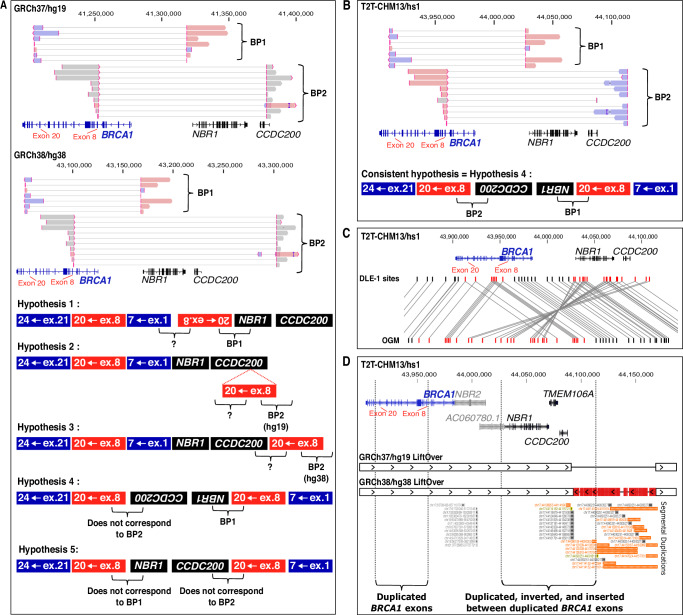
Fig. 1
Fig. 1. Genomic characterization in Family 1 – Patient 2 (F1-P2).
A Long-read DNA sequencing aligned on GRCh37/hg19 and GRCh38/hg38 reference genome assemblies, and diagrams representing various structural hypothesis. Blue boxes represent non-duplicated BRCA1 exons (ex.), red boxes represent BRCA1 duplicated exons (ex.8 to ex.20). None of the hypothesis were totally consistent with long-read DNA sequencing data. BP: Breakpoint. B Long-read DNA sequencing aligned on T2T-CHM13/hs1 reference genome assembly, and diagram representing consistent structural hypothesis. C Optical Genomic Mapping (OGM) confirming general structure of the structural variant. D Rearranged region (T2T-CHM13/hs1) compared to GRCh37/hg19 and GRCh38/hg38 assemblies. Breakpoint 1 (BP1) occurred in BRCA1 intron 20 and first intron of NBR1 antisense transcript. Breakpoint 2 (BP2) occurred in BRCA1 intron 7 and in a region containing many segmental duplications annotated by Vollger and colleagues. LiftOver with prior reference genome assemblies showed this region is totally absent from GRCh37/hg19, and incomplete and inverted in GRCh38/hg38. Figures 1-A and 1-B were prepared from BAM file visualization in Integrative Genome Viewer (IGV) software. Annotation data in 2D Figure 1-D were extracted from UCSC Genome Browser (http://genome.ucsc.edu).
Fig. 2
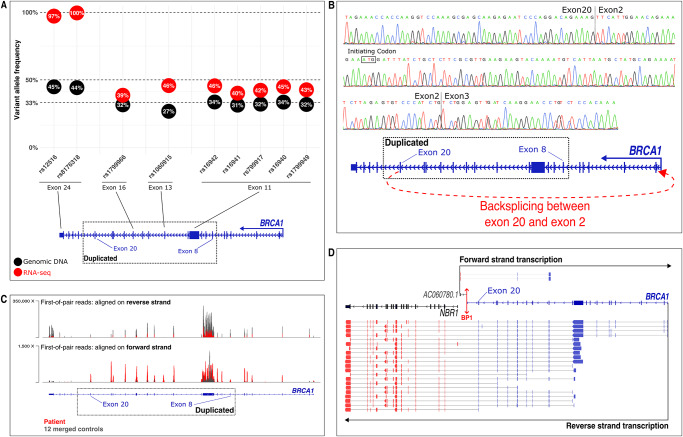
Fig. 2. Transcriptomic characterization.
A Variant allele frequencies of Single Nucleotide Polymorphisms (SNPs) carried in BRCA1 by Family 1 – Patient 2 (F1-P2). Seven SNPs were detected in the duplicated region, all with an allelic ratio of approximately 33% in genomic DNA and approximately 50% in RNA-seq, indicating that only one set of duplicated exons was transcribed. Two SNPs were detected downstream of duplicated exons, with allelic ratios of approximately 50% in genomic DNA and approximately 100% in RNA-seq, indicating that only one allele of the end of the gene is transcribed. B Coding DNA (cDNA) Sanger sequencing showing back-splicing between BRCA1 exon 20 and exon 2. C BRCA1 strand-specific short-read RNA sequencing (RNA-seq) in Family 1 – Patient 2 (F1-P2) and 12 merged controls. Depth of coverage scales are indicated on the left. D Fusion reads involving BRCA1 in long-read direct RNA sequencing (RNA-seq). Represented on rearranged breakpoint 1 (BP1). The two reads aligning on the forward strand of the rearranged region are shown at the top: both started in NBR1 antisense transcript first exon (red) and included BRCA1 exonic sequences (blue). Twenty-one reads aligned on the reverse strand of the rearranged region are shown at the bottom. They all started in BRCA1 (blue) and continued with full NBR1 gene (red) with various alternative splicing. Figures 2-C and 2-D were prepared from BAM file visualization in IGV software.
Fig. 3
Fig. 3
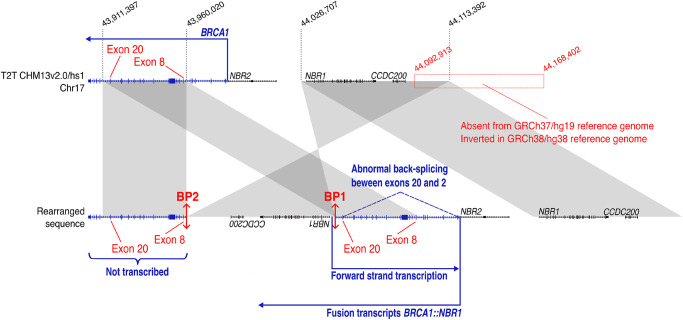
Founder BRCA1 rearrangement and its transcriptomic consequences.

References

    1. Kuchenbaecker, K. B. et al. Risks of breast, ovarian, and contralateral breast cancer for BRCA1 and BRCA2 mutation carriers. JAMA317, 2402–2416 (2017). - PubMed
    1. Tutt, A. N. J. et al. Adjuvant Olaparib for patients with BRCA1 - or BRCA2 -mutated breast cancer. N. Engl. J. Med.384, 2394–2405 (2021). - PMC - PubMed
    1. Parsons, M. T. et al. Large scale multifactorial likelihood quantitative analysis of BRCA1 and BRCA2 variants: An ENIGMA resource to support clinical variant classification. Hum. Mutat.40, 1557–1578 (2019). - PMC - PubMed
    1. Caputo, S. M. et al. Classification of 101 BRCA1 and BRCA2 variants of uncertain significance by cosegregation study: A powerful approach. Am. J. Hum. Genet.108, 1907–1923 (2021). - PMC - PubMed
    1. Brandt, T. et al. Adapting ACMG/AMP sequence variant classification guidelines for single-gene copy number variants. Genet. Med.22, 336–344 (2020). - PubMed

LinkOut - more resources