


The association between brominated flame retardants and serum testosterone levels in American adult men: NHANES 2013-2016
- PMID: 40746672
- PMCID: PMC12310719
- DOI: 10.3389/fpubh.2025.1589047
The association between brominated flame retardants and serum testosterone levels in American adult men: NHANES 2013-2016
Abstract
Background: Brominated flame retardants (BFRs), especially polybrominated diphenyl ethers (PBDEs), are commonly utilized, yet their possible endocrine-disrupting effects have sparked significant concerns. Nonetheless, the link between exposure to BFRs and serum testosterone levels in adult males is still not well comprehended.
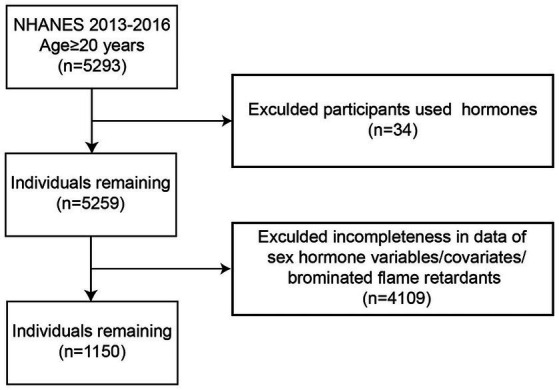
Methods: We analyzed data from 1,150 men aged ≥20 years from the National Health and Nutrition Examination Survey (NHANES) in 2013-2016. Serum concentrations of BFRs (PBDE congeners: PBDE-28, PBDE-47, etc.) and testosterone levels were measured via mass spectrometry and liquid chromatography-tandem mass spectrometry, respectively. Free testosterone (FT) and bioavailable testosterone (BAT) were calculated using the Vermeulen equation, based on measured total testosterone (TT), sex hormone-binding globulin (SHBG), and serum albumin concentrations. Linear regression models were used to evaluate the association between BFRs and TT, BAT, FT, and SHBG, adjusting for confounders including age, race, and lifestyle factors. We also evaluated potential associations modified by age, and conducted a sensitivity analysis to assess the robustness of the observed associations.
Results: After all continuous variables were log2-transformed and potential confounders were adjusted, significant inverse associations were found between PBDE-28 and PBDE-47 levels with TT (β = -0.641, 95% CI: -1.098, -0.185) and FT (β = -0.883, 95% CI: -1.616, -0.149). Specifically, in the stratified analysis, older men (≥60 years) showed stronger associations between PBDE-28 and PBDE-47 exposure with lower testosterone levels (β = -0.892, 95% CI: -1.472, -0.311 for PBDE-28 and β = -0.695, 95% CI: -1.199, -0.191 for PBDE-47). Sensitivity analysis confirmed that PBDE-28 and PBDE-47 were consistently associated with reduced testosterone and free testosterone levels, with the associations remaining significant even after adjusting for potential co-exposures and lifestyle factors.
Conclusion: Our findings suggest that exposure to PBDE-28 and PBDE-47 is associated with lower testosterone levels, particularly in older men. These results highlight the potential reproductive risks posed by BFR exposure, warranting further investigation into the long-term health impacts.
Keywords: NHANES; brominated flame retardants; endocrine disrupting; serum testosterone; sex hormone binding globulin.
Copyright © 2025 Li, Chen, Zheng, Wang, Lin and Peng.
Conflict of interest statement
The authors declare that the research was conducted in the absence of any commercial or financial relationships that could be construed as a potential conflict of interest.
Figures
References
-
- Besis A, Samara C. Polybrominated diphenyl ethers (PBDEs) in the indoor and outdoor environments--a review on occurrence and human exposure. Environ Pollut Barking Essex. (1987) 2012:217–29. - PubMed
-
- Zhao X, Yang X, Du Y, Li R, Zhou T, Wang Y. Polybrominated diphenyl ethers in serum from residents living in a brominated flame retardant production area: occurrence, influencing factors, and relationships with thyroid and liver function. Environ Pollut Barking Essex. (1987) 270:116046 - PubMed
MeSH terms
Substances
LinkOut - more resources
Full Text Sources
Miscellaneous
