


Early Cancer Survivorship Distress Trajectories Associated With Socioeconomic Status and Age: Findings From a Multicenter Prospective Study
- PMID: 40747744
- PMCID: PMC12314646
- DOI: 10.1002/cam4.71076
Early Cancer Survivorship Distress Trajectories Associated With Socioeconomic Status and Age: Findings From a Multicenter Prospective Study
Abstract
Background: Socioeconomic status' (SES) impact on distress during cancer survivorship has been insufficiently studied, although the consequences of low SES can be cumulative and adversely impact a person's ability to access resources required for improved health and quality of life.
Patients and methods: We conducted a prospective study involving newly diagnosed patients within 2 months of diagnosis (t1), and at 6-, 12-, and 18-month follow-up (t2-t4) using the Distress Thermometer (DT). Generalized Linear Mixed Models (GLMM) were used to test for changes in distress over time, with fixed effects of time, SES, and age.
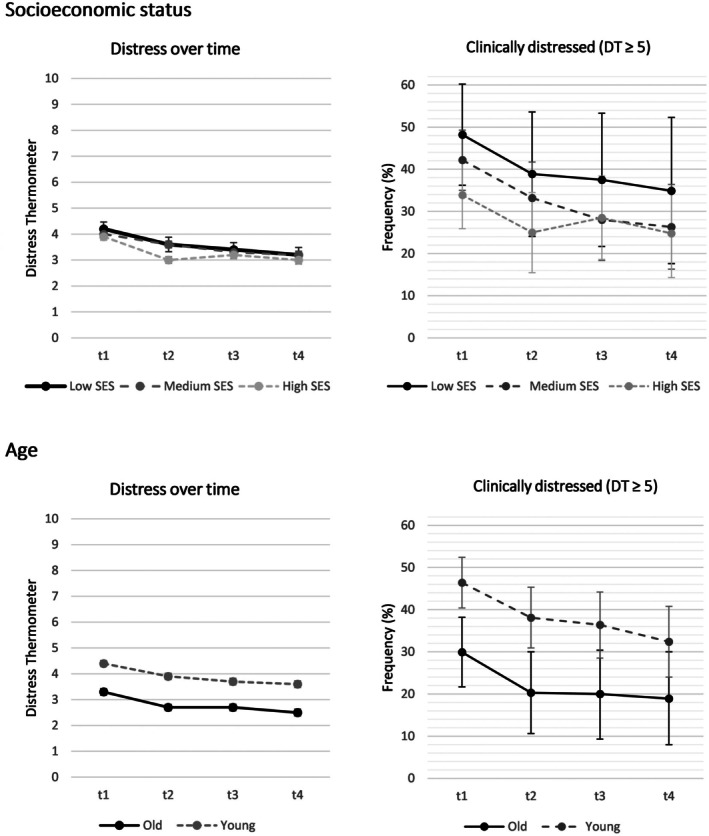
Results: Out of 1702 eligible patients, 965 completed the baseline DT (53% men, 60.5 years); 779, 681, and 626 participated at follow-ups. Out of 554 completers, 9% were chronically distressed, while 40.8% were never distressed. Distress decreased in 21.3%, increased in 11.0%, and 17.8% fluctuated over time. Low-SES patients consistently had the highest rates of distress. Distress scores and the frequency of distress (DT ≥ 5) decreased over time in all SES and age groups: For DT mean scores, GLMM revealed a significant effect of time (χ2(3) = 72.0, p < 0.001), but not of SES (χ2(2) = 5.9, p = 0.052). For frequency of distress, there was a main effect of time (χ2(3) = 41.4, p < 0.001) and SES (χ2(2) = 15.5, p < 0.001). Younger patients (< 65 years) consistently experienced more distress than older patients (≥ 65 years). For DT mean scores, GLMM showed an effect of time (χ2(3) = 72.1, p < 0.001) and age (χ2(1) = 66.2, p < 0.001). Similarly, for frequency of distress we found an effect of time (χ2(3) = 41.7, p < 0.001) and age (χ2(1) = 52.8, p < 0.001).
Conclusion: Effective psychosocial interventions require a customized approach to decrease distress in vulnerable groups.
Trial registration: This study was registered in the International Clinical Trials Registry (NCT04620564, https://clinicaltrials.gov/).
Keywords: age; cancer survivorship; distress; longitudinal study; psycho‐oncology; socioeconomic status.
© 2025 The Author(s). Cancer Medicine published by John Wiley & Sons Ltd.
Conflict of interest statement
The authors declare no conflicts of interest.
Figures

References
-
- Mehnert A., Hartung T. J., Friedrich M., et al., “One in Two Cancer Patients Is Significantly Distressed: Prevalence and Indicators of Distress,” Psycho‐Oncology 27 (2018): 75–82. - PubMed
-
- Götze H., Friedrich M., Taubenheim S., Dietz A., Lordick F., and Mehnert A., “Depression and Anxiety in Long‐Term Survivors 5 and 10 Years After Cancer Diagnosis,” Supportive Care in Cancer 28 (2020): 211–220. - PubMed
-
- Kuba K., Esser P., Mehnert A., et al., “Risk for Depression and Anxiety in Long‐Term Survivors of Hematologic Cancer,” Health Psychology 38 (2019): 187–195. - PubMed
-
- Brown S. L., Hope‐Stone L., and Cherry M. G., “Seven‐Year Distress Trajectories in Uveal Melanoma Survivors,” Health Psychology 42 (2023): 247–256. - PubMed
Publication types
MeSH terms
Associated data
Grants and funding
LinkOut - more resources
Full Text Sources
Medical
