


Optimizing diagnostic yield in pulmonary lesions: impact of combined sampling tools and EBUS-TBNA during radial EBUS
- PMID: 40748006
- PMCID: PMC12319195
- DOI: 10.1177/17534666251357699
Optimizing diagnostic yield in pulmonary lesions: impact of combined sampling tools and EBUS-TBNA during radial EBUS
Abstract
Background: Radial endobronchial ultrasound (r-EBUS) is a minimally invasive procedure used to evaluate pulmonary lesions suspicious of cancer. Current information on the effect of combining different sampling tools used during r-EBUS or the addition of linear EBUS (EBUS-TBNA) on its diagnostic performance is limited.
Objectives: To evaluate the effect on diagnostic performance of the systematic addition of different sampling tools and EBUS-TBNA during r-EBUS, as well as the rate of peri-procedural complications.
Design: This was an observational, analytical cohort study designed to evaluate diagnostic accuracy.
Methods: We calculated diagnostic accuracy statistics and used the Cochran-Armitage statistical test to assess the effect of combining techniques on diagnostic performance. Diagnostic success (DS) was defined as true positives and true negatives, while diagnostic failure was defined as false positives and false negatives.
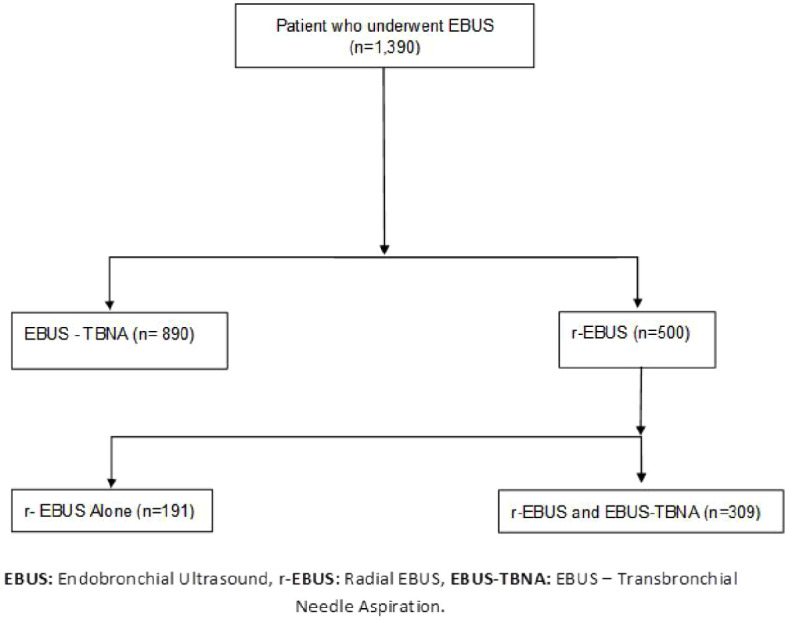
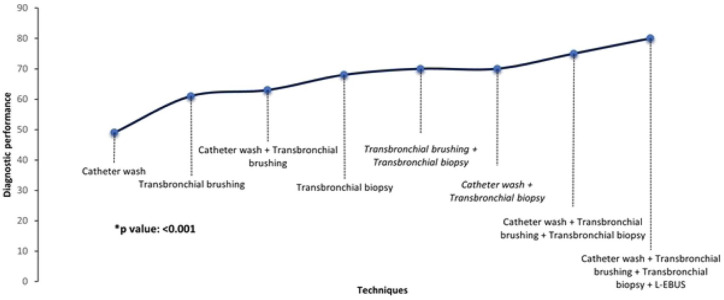
Results: A total of 309 patients were included, with a mean age of 67.9 years (standard deviation: 10.97); 50.8% (157/309) were male. The bronchial washing had a DS rate of 49%, while bronchial brushing showed a DS rate of 61%. The combination of bronchial washing and bronchial brushing improved the r-EBUS performance to 63%. Combining bronchial washing, bronchial brushing, and transbronchial biopsy increased the performance to 70%, and the addition of EBUS-TBNA raised the diagnostic performance to 80% (p < 0.001; Cochran-Armitage test). The overall complication rate was 6.4% (20/309), with pneumothorax occurring in 1.2% (4/309), bronchospasm in 3.8% (12/309), and bleeding in 1.2% (4/309).
Conclusion: The use of multiple sampling tools significantly contributes to the DS of r-EBUS, particularly with the addition of EBUS-TBNA. This approach maintains a low complication rate.
Keywords: bronchoscopy; diagnostic techniques and procedures; lung neoplasms; sensitivity and specificity; ultrasonography.
Figures
References
-
- Choi HK, Mazzone PJ. Lung cancer screening. Med Clin North Am 2022; 106(6): 1041–1053. - PubMed
-
- Jonas DE, Reuland DS, Reddy SM, et al. Screening for lung cancer with low-dose computed tomography: updated evidence report and systematic review for the US Preventive Services Task Force. JAMA 2021; 325(10): 971–987. - PubMed
-
- Steinfort DP, Khor YH, Manser RL, et al. Radial probe endobronchial ultrasound for the diagnosis of peripheral lung cancer: systematic review and meta-analysis. Eur Respir J 2011; 37(4): 902–910. - PubMed
Publication types
MeSH terms
LinkOut - more resources
Full Text Sources
Medical
