


Burden of gram-positive bacteria from urinary tract infection: A four-year retrospective study in a tertiary health setting in southern Saudi Arabia
- PMID: 40748877
- PMCID: PMC12316280
- DOI: 10.1371/journal.pone.0328042
Burden of gram-positive bacteria from urinary tract infection: A four-year retrospective study in a tertiary health setting in southern Saudi Arabia
Abstract
Background: Antibiotic resistance is a worldwide problem causing significant health-related and economic losses. Gram-positive causes of urinary tract infections (UTIs) are usually underestimated or overlooked by physicians.
Aim: To examine the prevalence of antibiotic resistance among major gram-positive bacteria from UTIs in a tertiary care health hospital in southern Saudi Arabia.
Method: A cross-sectional retrospective study was done in a tertiary health setting in southern Saudi Arabia between 2019 and 2022, to identify the major gram-positive bacteria and antibiotic resistance. Data were collected from the hospital records and was analyzed using the SPSS statistical package.
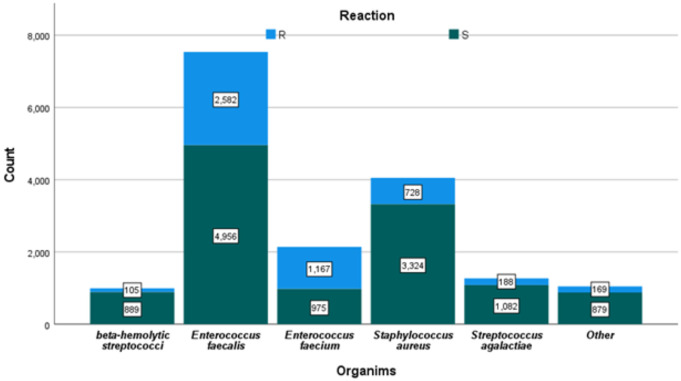
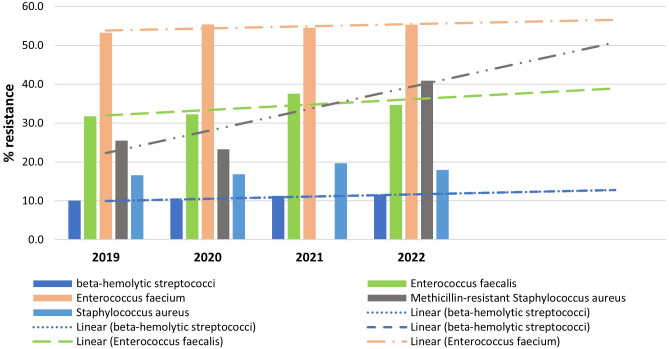
Results: The most common gram-positive species were Enterococcus faecalis (44.7%), Staphylococcus aureus (15.1%), and Enterococcus faecium (12.9%), beta-hemolytic streptococci (8.4%), and methicillin-resistant Staphylococcus aureus (MRSA) (1.8%). The 1540 isolates showed an overall susceptibility of 71.0%, compared to a resistance of 29.0%. The most resistance was among Enterococcus faecium (54.5%), Enterococcus gallinarum (42.4%), Enterococcus faecalis (34.3%), and MRSA (27.2%). The most common resistance was to erythromycin (75.7%), followed by cefotaxime (73.9%), tetracycline (70.5%), ciprofloxacin (54.3%), and Synercid (53.6%). The prediction model indicates an increase in the prevalence of resistance in MRSA and, to a lesser extent, with E. faecalis, E. faecium, and beta-hemolytic streptococci.
Conclusions: Enterococcus faecalis was the predominant gram-positive species, surpassing Staphylococcus aureus. Almost remarkable resistance was observed to most of the antibiotics that are frequently used in the study area, mainly erythromycin, cefotaxime, and tetracycline. Performing continuous monitoring of drug susceptibility may help with the empirical treatment of bacterial agents in the region.
Copyright: © 2025 Alkahtani et al. This is an open access article distributed under the terms of the Creative Commons Attribution License, which permits unrestricted use, distribution, and reproduction in any medium, provided the original author and source are credited.
Conflict of interest statement
Authors declare that they have no conflict of interest.
Figures
References
-
- Abbasi Montazeri E, Khosravi AD, Saki M, Sirous M, Keikhaei B, Seyed-Mohammadi S. Prevalence of Extended-Spectrum Beta-Lactamase-Producing Enterobacteriaceae Causing Bloodstream Infections in Cancer Patients from Southwest of Iran. Infect Drug Resist. 2020;13:1319–26. doi: 10.2147/idr.s254357 - DOI - PMC - PubMed
-
- Hussein RA, AL-Kubaisy SH, Al-Ouqaili MTS. The influence of efflux pump, outer membrane permeability and β-lactamase production on the resistance profile of multi, extensively and pandrug resistant Klebsiella pneumoniae. J Infect Public Health. 2024;17(11):102544. doi: 10.1016/j.jiph.2024.102544 - DOI - PubMed
MeSH terms
Substances
LinkOut - more resources
Full Text Sources
Medical
