. 2025 Aug 1;16(1):6751.
doi: 10.1038/s41467-025-61718-w.

Acquisition of Escherichia coli carrying extended-spectrum ß-lactamase and carbapenemase genes by hospitalised children with severe acute malnutrition in Niger

Affiliations

Acquisition of Escherichia coli carrying extended-spectrum ß-lactamase and carbapenemase genes by hospitalised children with severe acute malnutrition in Niger

Kirsty Sands et al. Nat Commun. .

Abstract

Hospitalisation and routine antibiotic treatment are recommended for children with complicated severe acute malnutrition (SAM) but this may exacerbate antimicrobial resistance. Here, we investigate carriage of Gram-negative bacteria in children under five years of age receiving treatment for SAM in Niger, comparing the frequency of colonisation with bacteria carrying resistance genes at admission, during hospital stay and at discharge. E. coli isolates carrying a blaNDM-5 gene were selected for whole-genome sequencing. Rectal colonisation with bacteria carrying ß-lactamase genes is high, with 76% (n = 1042/1371) of children harbouring bacteria carrying a blaCTXM-1-group gene and 25% (n = 338/1371) carrying a blaNDM-5 gene. Over two-thirds of children who did not carry bacteria with a carbapenemase gene at admission are colonised with bacteria carrying a carbapenemase gene at discharge (n = 503/729, 69%). E. coli ST167 carrying blaNDM-5 gene is recovered from 11% (n = 144/1371) of children. Here we highlight infection control and bacterial AMR transmission concerns amongst a vulnerable population in need of medical treatment.


Conflict of interest statement

Competing interests: The authors declare no competing interests.

Figures
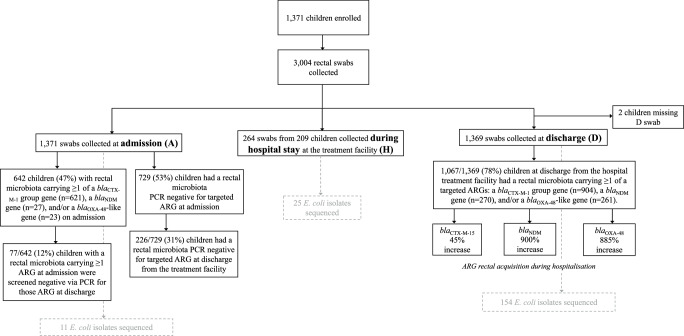
Fig. 1
Fig. 1. Study flow diagram describing patient enrolment and rectal swab collection.
Rectal swabs were collected at admission (A), during hospitalisation if clinical symptoms suggested that the patient was deteriorating (H) and at patient discharge (D). The number of children with a rectal microbiota positive for screened antibiotic resistance genes (ARG) at admission and at discharge are summarised.
Fig. 2
Fig. 2. Bacterial species carrying carbapenemase ARG in rectal microbiota.
a The number of children who were carrying and acquiring bacteria with a carbapenemase gene in their rectal microbiota at admission, during hospitalisation for treatment, and at patient discharge. Data is split according to the two most dominant bacterial species; E. coli and K. pneumoniae, with the remaining grouped as others (a child with a/≥ 1 carbapenemase gene in different bacteria resulted in a single count per bacterial species). b The species diversity of bacterial isolates carrying a blaNDM and blaOXA-48 gene from rectal swabs; ECO – Escherichia coli, ACT – Acinetobacter spp., ECC – Enterobacter cloacae complex, KLU – Kluverya georgiana, KPN – Klebsiella pneumoniae, ENT – Enterobacter spp., CIT – Citrobacter spp., PAN – Pantoea septica, PSA – Pseudomonas aeruginosa, KLE – Klebsiella spp.
Fig. 3
Fig. 3. Antibiotic susceptibility of E. coli isolates.
All isolates contain blaNDM-5. a Stacked bar graphs showing the percentage of isolates with a sensitive, increased exposure or resistant profile to antibiotics; CTA – cefotaxime, CTZ – ceftazidime, CTR – ceftriaxone, CEP – cefepime, CTV – ceftazidime/avibactam, MER – meropenem, IMI – imipenem, LEV – levofloxacin, GEN – gentamicin, AMI – amikacin, TIG – tigecycline, CIP – ciprofloxacin, PIT – piperacillin/tazobactam, FOS – fosfomycin, TOB – tobramycin. b The number of E. coli genomes carrying antibiotic resistance genes.
Fig. 4
Fig. 4. E. coli ST167 SNP phylogenetic tree.
The clades within the tree are labelled A-I and are enhanced for visualisation in the purple and blue boxes. Blue boxes within clade H indicate isolates with the most pairwise SNPs detected within that group. The tree leaves are coloured according to sample type (at admission, during hospital stay, discharge) and named according to patient ID. The sex of the patient is indicated (F, female, M, male), followed by the age of the child in months and the date of the sample (month and year). The presence of acquired β-lactamase antibiotic resistance genes (ARG) is denoted with a presence/absence heatmap with a carbapenemase gene denoted blue, a blaCTX-M-1 group denoted green and a blaOXA-1/blaTEM (variants grouped) denoted brown.
Fig. 5
Fig. 5. E. coli plasmid types.
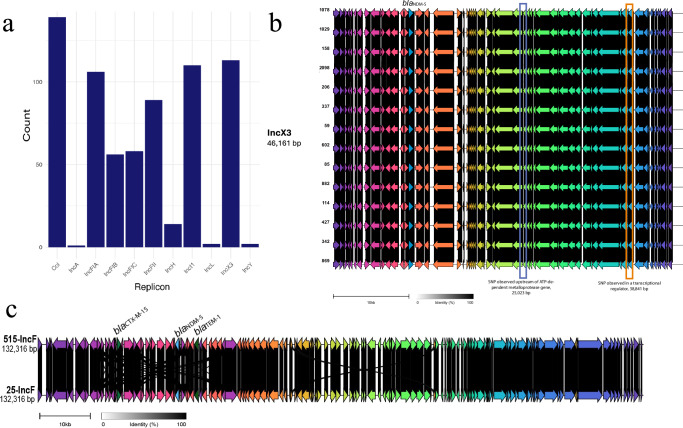
a plasmid replicons detected across the n = 190 genomes grouped to 11 categories (b) plasmid genomic architecture of all 46,161 bp IncX3 plasmids carrying a blaNDM-5 gene assembled from long read data, (c) plasmid genomic architecture of 132,316 bp IncFIA/FIC plasmid carrying a blaNDM-5 gene assembled from long read data. Individual plasmid sequences are annotated with the corresponding E. coli isolate sample number (Source Data links sample number to study participant ID).
Fig. 6
Fig. 6. E. coli plasmid population mapping.
Competitive E. coli short read mapping to the IncF blaNDM-5 plasmid (pIncF-NDM5) and the IncX3 plasmid (pIncX3-NDM5-a), separated per E. coli ST. The prominent mutations observed in the mutations denoted in the IncX3 plasmid sequences across the E. coli population are also shown; snp – single nucleotide polymorphism.

References

    1. Trehan, I. & Manary, M. J. Management of severe acute malnutrition in low-income and middle-income countries. Arch. Dis. Child.100, 283–287 (2015). - PubMed
    1. World Health Organisation. WHO/UNICEF. WHO Child Growth Standards and Identification in Infants. WHO Library. (2009).
    1. Deconinck, H. et al. Challenges of estimating the annual caseload of severe acute malnutrition: The case of Niger. PLoS ONE11, e0162534 (2016). - PMC - PubMed
    1. World Health Organization. Guideline: Updates on the Management of Severe Acute Malnutrition in Infants and Children. (World Health Organization, Geneva, 2013). - PubMed
    1. World Health Organisation, Nutrition and Food Safety (NFS). UNICEF, WHO, Group & The World Bank Group. Joint Child Malnutrition Estimates: Levels and Trends in Child Malnutrition: Key Findings of the 2021 Edition. Who 24, (2021).

MeSH terms

LinkOut - more resources