


Comparison of Globorisk, SCORE2, and PREVENT in the Stratification of Cardiovascular Risk and its Relationship with End-Organ Damage Among Adults With Arterial Hypertension
- PMID: 40751467
- PMCID: PMC12317332
- DOI: 10.1111/jch.70106
Comparison of Globorisk, SCORE2, and PREVENT in the Stratification of Cardiovascular Risk and its Relationship with End-Organ Damage Among Adults With Arterial Hypertension
Abstract
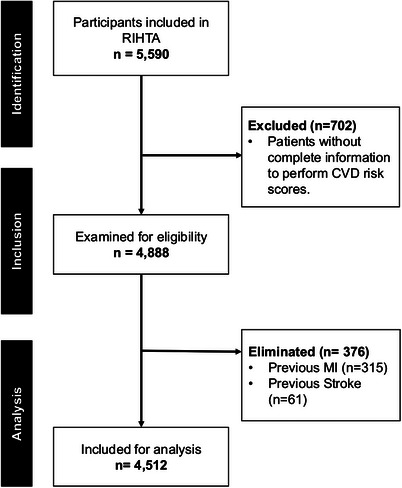
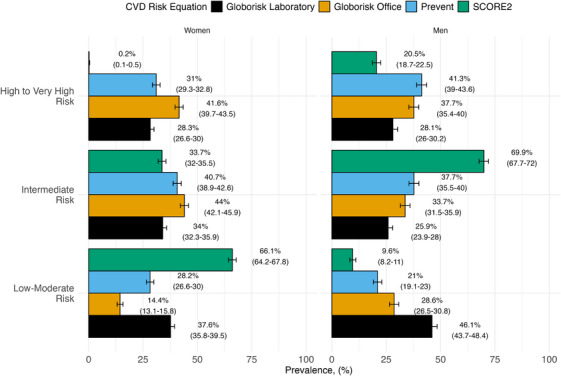
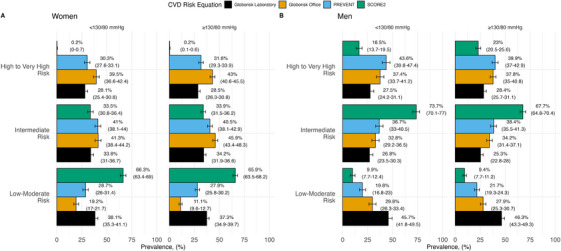
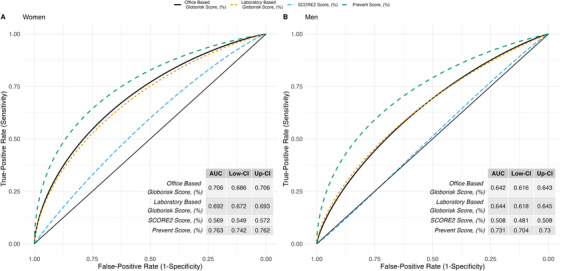
Arterial hypertension often coexists with comorbidities that increase vascular damage. Although the primary goal is to reduce cardiovascular risk, the available risk scores can produce varying estimates. Here, we aim to compare the prevalence of cardiovascular risk categories using three equations (Globorisk, SCORE2, and PREVENT) in adults living with arterial hypertension and to assess their association as stratification tools for end-organ damage (EOD). To achieve this, we performed a cross-sectional sub-analysis of the RIHTA study, an electronic health record-based registry of adults with arterial hypertension in Mexican primary care centers. EOD was defined as aortic stiffness, reduced eGFR, hypertensive retinopathy, peripheral artery disease, or left ventricular hypertrophy. Inverse probability weighting (IPW) was used to evaluate the association between cardiovascular risk and EOD, adjusting for relevant confounders, and areas under the receiver operator curve (AUROC) were calculated to assess detection capacity. Among 4512 participants (median age 64 years; 61% women), EOD was present in 33% (n = 1492). The PREVENT equation yielded the highest median 10-year risk (15%, IQR 8-24), followed by Globorisk laboratory-based (12%, 7-22), Globorisk office-based (11%, 7-19), and SCORE2 (5.06%, 3.86-7.18). In IPW models, each 1% increase in score was associated with higher odds of EOD (PREVENT OR 1.16, 95% CI 1.15-1.17; Globorisk-office 1.09, 1.08-1.10; Globorisk-lab 1.07, 1.06-1.08; SCORE2 1.04, 1.02-1.06). The PREVENT score demonstrated the strongest discrimination for detecting EOD (AUROC: 0.751, 0.735-0.750). These findings suggest that among adults with arterial hypertension, the PREVENT score identifies high-risk individuals and improves discrimination for EOD.
Keywords: Mexico; arterial hypertension; cardiovascular risk; end‐organ damage; epidemiology.
© 2025 The Author(s). The Journal of Clinical Hypertension published by Wiley Periodicals LLC.
Conflict of interest statement
The authors declare that they have no competing interests.
Figures
References
-
- Parati G., Lombardi C., Pengo M., Bilo G., and Ochoa J. E., “Current Challenges for Hypertension Management: From Better Hypertension Diagnosis to Improved Patients' Adherence and Blood Pressure Control,” International Journal of Cardiology 331 (2021): 262–269. - PubMed
Publication types
MeSH terms
LinkOut - more resources
Full Text Sources
Medical
Research Materials
Miscellaneous
