


Rapid, season-specific PCR testing versus traditional diagnostics for pneumonia in the emergency department
- PMID: 40753203
- PMCID: PMC12318422
- DOI: 10.1186/s12890-025-03843-2
Rapid, season-specific PCR testing versus traditional diagnostics for pneumonia in the emergency department
Abstract
Background: Traditional culture-based diagnostics for emergency-department (ED) pneumonia are slow and season-agnostic, delaying targeted therapy. We evaluated whether season-tailored multiplex PCR panels accelerate pathogen identification and improve antibiotic stewardship.
Methods: In a single-center, prospective study, adults with radiographically confirmed pneumonia were enrolled consecutively and allocated by a rotating week-on/week-off schedule to either a seasonal PCR panel or conventional diagnostics. Primary outcomes were (i) time to final pathogen report and (ii) diagnostic yield (≥ 1 pathogen detected). Secondary outcomes included empiric-antibiotic appropriateness within 24 h, regimen changes ≤ 72 h, antibiotic duration, length of stay (LOS) and 30-day mortality.
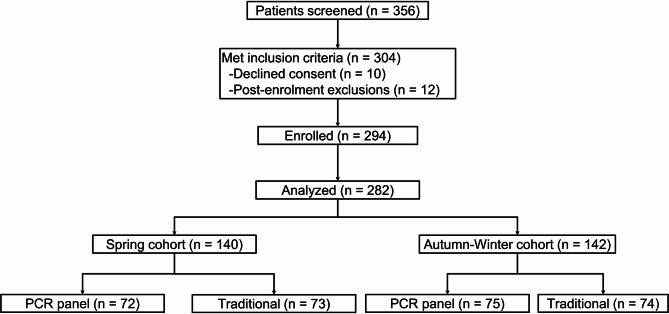
Results: Among 282 analyzable patients (spring = 140; autumn-winter = 142), PCR slashed turnaround time from 48 h to 12 h in spring and from 50 h to 14 h in autumn-winter (median difference - 36 h, 95% CI: - 42 to - 30; p < 0.001). Diagnostic yield rose from 61.6 to 80.6% in spring and from 56.8 to 80.0% in winter (risk differences 19.0 pp and 22.3 pp, respectively; both p < 0.01). In the winter cohort, guideline-concordant empiric therapy increased (78.7% vs. 64.9%; +13.8 pp) and antibiotic changes ≤ 72 h fell (14.7% vs. 28.4%; - 13.7 pp). Mean antibiotic courses shortened by 1.5-1.7 days across seasons, while LOS showed a non-significant 1-2-day reduction. Thirty-day mortality did not differ. Effects were consistent in older adults (≥ 65 y) and patients with COPD.
Conclusions: Locally adapted, season-specific multiplex PCR panels deliver near-four-fold faster, higher-yield pathogen detection and support measurable stewardship gains without compromising safety. Implementation in other settings should consider local pathogen seasonality, workflow, and cost structures.
Keywords: Diagnostic accuracy; Emergency department; PCR test panel; Pneumonia diagnosis; Seasonal infections.
© 2025. The Author(s).
Conflict of interest statement
Declarations. Ethics approval and consent to participate: Ethical approval was obtained from the hospital’s institutional review board Shanghai Public Health Clinical Center (2023-S072-01). All procedures complied with the principles of the Declaration of Helsinki. Written informed consent was obtained from all participants prior to enrollment. Consent for publication: Not Applicable. Competing interests: The authors declare no competing interests.
Figures
References
-
- Krishnan PS. (2024). The Deep Dive into the Use of Image Processing and Object Detection to Identify Pneumonia. 2024 International Symposium on Networks, Computers and Communications (ISNCC), 1–9.
-
- Sabbagh WA, Karrar HR, Nouh MI, Alkhaifi NM, Badayyan SY, Shaikh LK, Ghamdi A, N. A., Abdullah FF. Perspective of pneumonia in the health-care setting. J Pharm Res Int. 2024;36(7):51–8. 10.9734/jpri/2024/v36i77538.
-
- Kim TJ, Lee KH, Choe YH, Lee KS. Pulmonary infection (pneumonia). Emergency chest radiology. Singapore: Springer; 2021. pp. 85–102. 10.1007/978-981-33-4396-2_8.
-
- Ojuawo O, Ojuawo A, Aladesanmi A, Adio M, Iroh Tam PY. Childhood pneumonia diagnostics: a narrative review. Expert Rev Respir Med. 2022;16(7):775–85. 10.1080/17476348.2022.2099842. - PubMed
Publication types
MeSH terms
Substances
LinkOut - more resources
Full Text Sources
Medical
Miscellaneous
