


Knowledge, attitudes, and practices regarding heart failure among Chinese patients: a cross-sectional study
- PMID: 40753205
- PMCID: PMC12317643
- DOI: 10.1186/s12889-025-23860-4
Knowledge, attitudes, and practices regarding heart failure among Chinese patients: a cross-sectional study
Abstract
Background: Understanding patients’ knowledge, attitudes, and practices is essential for effective heart failure (HF) management, as these factors significantly influence self-care behaviors, treatment adherence, and clinical outcomes. This study aimed to investigate the knowledge, attitudes, and practices (KAP) of patients with heart failure.
Methods: A web-based cross-sectional study was conducted from April to May 2023 among 483 heart failure patients recruited through convenience sampling. Inclusion criteria encompassed a confirmed HF diagnosis and the ability to independently use mobile devices. The research employed a self-administered questionnaire, validated through expert review and pilot testing, to assess knowledge, attitudes, and practices. The overall reliability was robust (Cronbach’s α = 0.875), with subscale alphas of 0.819 for knowledge, 0.582 for attitudes, and 0.846 for practices.
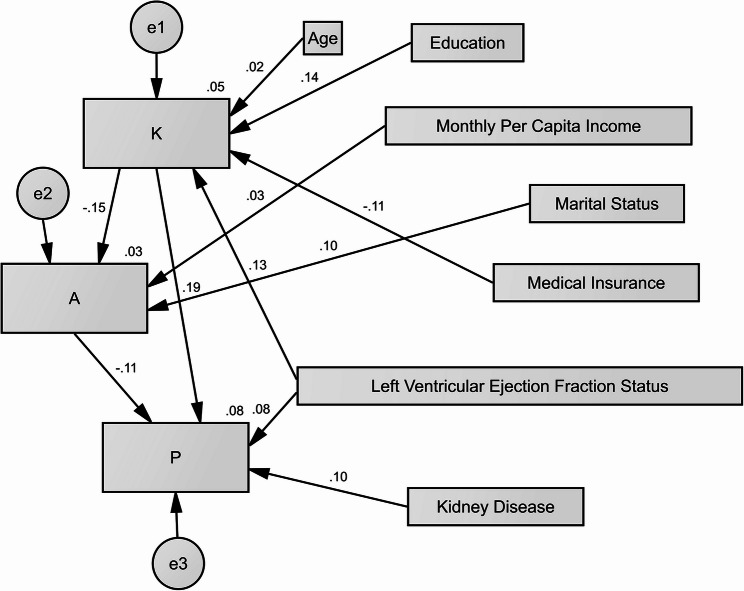
Results: The findings from 483 HF patients revealed limited knowledge (mean score: 10.75 out of 20), moderately negative attitudes (mean score: 22.93 out of 40), and relatively proactive practices (mean score: 32.21 out of 45). Higher knowledge levels and having mid-range ejection fraction emerged as significant predictors of proactive health behaviors (all P < 0.05). Structural equation modeling further demonstrated that education and marital status positively influenced knowledge, while attitudes unexpectedly showed a negative association with practices (all P < 0.05).
Conclusion: This study highlights critical gaps in knowledge and attitudes among HF patients, despite some proactive practices. By leveraging a web-based platform, this research contributes to the growing literature on digital health approaches in chronic disease management, suggesting that scalable, technology-enabled education and support strategies should be integrated into HF care. Additionally, this study provides novel insights into the unexpected negative relationship between attitudes and practices, underscoring the complexity of behavioral change in HF management.
Clinical trial number: Not applicable.
Supplementary Information: The online version contains supplementary material available at 10.1186/s12889-025-23860-4.
Keywords: Attitude; Cross-sectional study; Heart failure; Knowledge; Patients; Practice.
Conflict of interest statement
Declarations. Ethics approval and consent to participate: This work has been carried out in accordance with the Declaration of Helsinki (2000) of the World Medical Association. This study was approved by the Ethic Committee of Chongqing People’s Hospital(KY S2023-079-01), and all participants provided written informed consent. Consent for publication: Not applicable. Competing interests: The authors declare no competing interests.
References
LinkOut - more resources
Full Text Sources
Research Materials
Miscellaneous
