


A retrospective study of laryngeal squamous cell carcinoma and the significance of the PIK3CA mutation for survival
- PMID: 40757239
- PMCID: PMC12311762
- DOI: 10.3892/mco.2025.2882
A retrospective study of laryngeal squamous cell carcinoma and the significance of the PIK3CA mutation for survival
Abstract
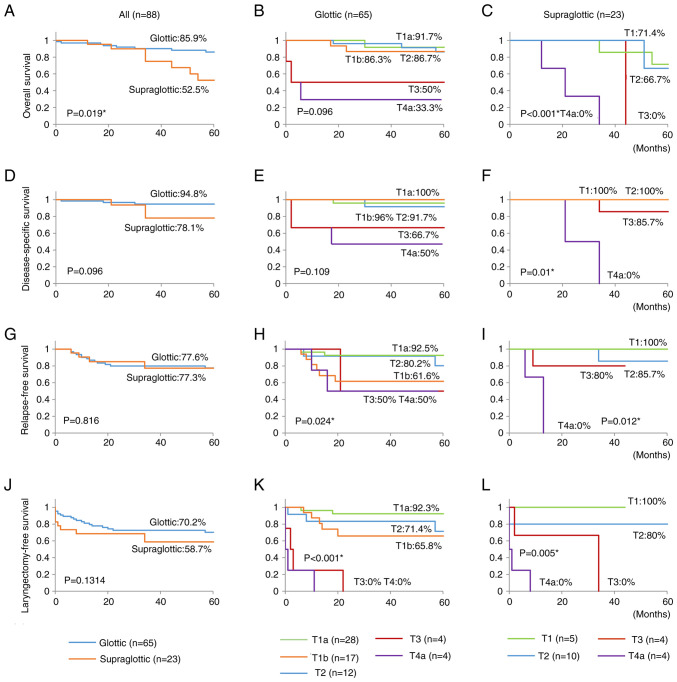
The aim of this study was to assess clinical features, outcomes and survival in patients with laryngeal squamous cell carcinoma (LSCC) and to associate mutations in cancer-related genes with clinical outcomes. A total of 88 patients with LSCC who underwent curative treatment between April 2008 and May 2024 at Hokuto Hospital (Obihiro, Japan) were included. Mutations in targeted regions of 160 cancer-related genes were analyzed using next-generation sequencing (NGS). LSCC was of glottic type in 65 patients (74%) and supraglottic type in 23 patients (26%). As initial treatment, laryngomicrosurgery, radiotherapy (RT) alone, RT with transoral administration of S-1, concurrent chemoradiotherapy with cisplatin, and total laryngectomy were performed in 6 (7%), 48 (55%), 13 (15%), 8 (9%), and 13 (15%) patients, respectively. Of the 88 patients studied, 25 (28%) died of various causes, including LSCC in 6 (7%), carcinoma other than LSCC in 11 (13%), and other causes in 8 (9%). The 5-year survival rates among all 88 patients with LSCC were 78.7% for overall survival (OS), 91.4% for disease-specific survival (DSS), 77.3% for relapse-free survival (RFS) and 67.5% for laryngectomy-free survival (LFS). OS, DSS, RFS and LFS in patients with early stage LSCC were similar to rates reported in other studies. Actionable mutations were detected in 21 (88%) of 24 patients who underwent NGS-based cancer panel testing. TP53 mutations were detected in 18 (75%), KMT2D in 5 (21%), PTEN in 3 (13%) and PIK3CA in 2 (8%) of these 24 patients. Multivariate Cox proportional hazard analysis revealed that PIK3CA mutation was an independent prognostic factor for RFS (P=0.011). Overall, detection of mutations in cancer-related genes could enhance understanding of clinical outcomes in LSCC.
Keywords: PIK3CA mutation; helical tomotherapy; laryngeal squamous cell carcinoma; next-generation sequencing; total laryngectomy.
Copyright: © 2025 Kubota et al.
Conflict of interest statement
The authors declare that they have no competing interests.
Figures
References
-
- Huang J, Chan SC, Ko S, Lok V, Zhang L, Lin X, Lucero-Prisno DE III, Xu W, Zheng ZJ, Elcarte E, et al. Updated disease distributions, risk factors, and trends of laryngeal cancer: A global analysis of cancer registries. Int J Surg. 2024;110:810–819. doi: 10.1097/JS9.0000000000000902. - DOI - PMC - PubMed
-
- Japan Society for Head and Neck Cancer Registry Committee: Report of head and neck cancer registry of Japan. http://wwwjshncuminnejp/pdf/HNCreport_2020pdf.
-
- General information of cancer in Japan: Laryngeal cancer. https://ganjoho.jp/reg_stat/statistics/stat/cancer/11_larynx.html (In Japanese).
-
- Koyanagi YN, Matsuo K, Ito H, Wakai K, Nagata C, Nakayama T, Sadakane A, Tanaka K, Tamakoshi A, Sugawara Y, et al. Cigarette smoking and the risk of head and neck cancer in the Japanese population: A systematic review and meta-analysis. Jpn J Clin Oncol. 2016;46:580–595. doi: 10.1093/jjco/hyw027. - DOI - PubMed
LinkOut - more resources
Full Text Sources
Research Materials
Miscellaneous