


Harnessing clonal diversity in grapevine: from genomic insights to modern breeding applications
- PMID: 40759826
- PMCID: PMC12321930
- DOI: 10.1007/s00122-025-04986-w
Harnessing clonal diversity in grapevine: from genomic insights to modern breeding applications
Abstract
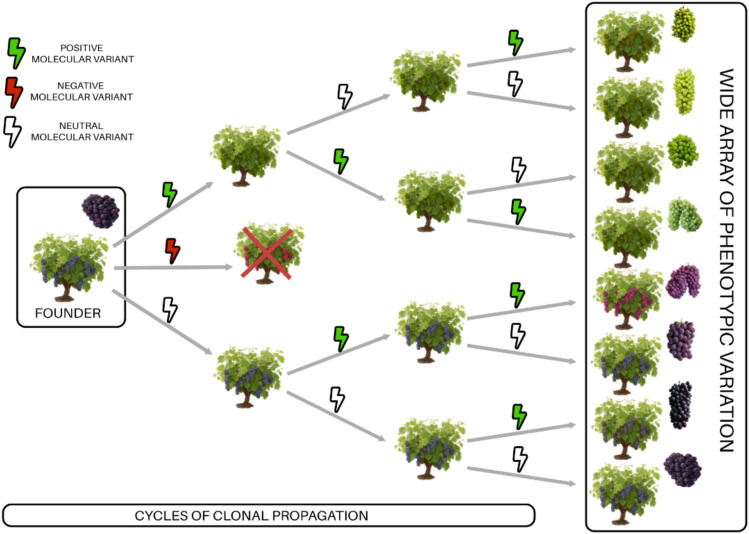
Grapevine has been clonally propagated for thousands of years. Though clonal propagation aims at maintaining varietal identity, somatic mutations and epigenetic modifications accumulated over hundreds to thousands of years lead to intra-varietal diversity. This intra-varietal variation is a very valuable resource in grapevine breeding, as it creates the opportunity to improve important traits related to yield, phenology, stress tolerance, and quality without altering the varietal identity which is extremely important for the industry. Recent advances in genomics, epigenetics, and phenotyping technologies are providing completely new opportunities to gain functional insights into the drivers underlying trait variation and to explore this for accelerated grapevine breeding. This review discusses the interaction between somatic mutations, epigenetic regulation, and emerging breeding technologies. We begin by exploring the phenotypic variation observed within clonal populations across various commercially important varieties, focusing on both agronomic and winemaking-related traits. Next, we examine the extent of genomic and epigenomic variation among clones, highlighting known mutations responsible for somatic variants. We also address how grapevine clonal populations serve as an advantageous model for understanding how genetic and epigenetic variants shape complex trait variation. Given recent advances, we discuss the potential of predictive breeding strategies to accelerate clonal evaluation and how genome editing technologies open new opportunities for targeted genetic improvements without passing through the tedium and unpredictability of clonal selection, driven by natural mutation. Ultimately, these new breeding technologies enable the integration of advanced methods into breeding programmes, optimizing grapevine performance while preserving the unique heritage of historic cultivars.
© 2025. The Author(s).
Conflict of interest statement
Declarations. Conflict of interest: The authors declare that they have no competing or financial interests. Ethical approval and consent to participate: Not applicable. Consent to publication: Not applicable.
Figures

References
-
- Alonso Villaverde V, Boso S, Santiago J, Gago P, Martínez MC (2011) Variability of Stomata among Albariño (Vitis vinifera L.) Clones and Its Relationship with Susceptibility to Downy Mildew. Vitis -Geilweilerhof- 50:45–46
-
- Alonso-Villaverde V, Boso S, Santiago JL, Gago P, Martínez M-C (2008) Relationship between susceptibility to Botrytis bunch rot and grape cluster morphology in the Vitis vinifera L. cultivar Albariño. Int J Fruit Sci 8(4):251–265. 10.1080/15538360802597481 - DOI
-
- Alston JM, Sambucci O (2019) Grapes in the WORLD EConomy. In: Cantu D, Andrew-Walker M (eds) The Grape Genome. Springer, Cham, pp 1–24
-
- Anderson MM, Smith RJ, Williams MA, Wolpert JA (2008) Viticultural evaluation of French and California Pinot noir clones grown for production of sparkling wine. Am J Enol Vitic 59(2):188–193. 10.5344/ajev.2008.59.2.188 - DOI
Publication types
MeSH terms
LinkOut - more resources
Full Text Sources
