


Genome-wide associations with metabolic syndrome among UK Biobank participants reporting use of second-generation antipsychotics
- PMID: 40762455
- PMCID: PMC12340748
- DOI: 10.1002/phar.70041
Genome-wide associations with metabolic syndrome among UK Biobank participants reporting use of second-generation antipsychotics
Abstract
Objectives: Second-generation antipsychotic (SGA) medications are frequently prescribed for mental health conditions; however, they are associated with an increased risk of metabolic syndrome (MetS). We aimed to identify genetic associations of SGA-associated MetS (SGA-MetS) using genome-wide approaches within the UK Biobank. We also set out to evaluate if genetically predicted obesity is associated with an increased risk of SGA-MetS.
Methods: We defined SGA-MetS based on the National Cholesterol Education Program (NCEP) Adult Treatment Panel III (ATP III) criteria using cross-sectional data from 1318 UK Biobank participants who reported being on an SGA medication. An SGA-MetS case was defined as meeting three or more of the five NCEP-ATP III criteria. We performed a genome-wide association study (GWAS) and gene-based analysis to identify significant variants and gene associations. We computed the polygenic risk score (PGS) for body mass index (BMI) using 2,100,302 variants validated for obesity and metabolic traits from imputed single-nucleotide polymorphism (SNP) data. We tested the association of PGS-BMI with SGA-MetS using logistic regression.
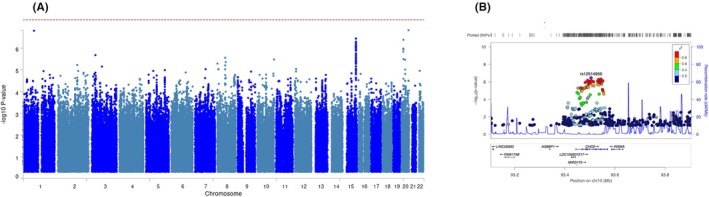
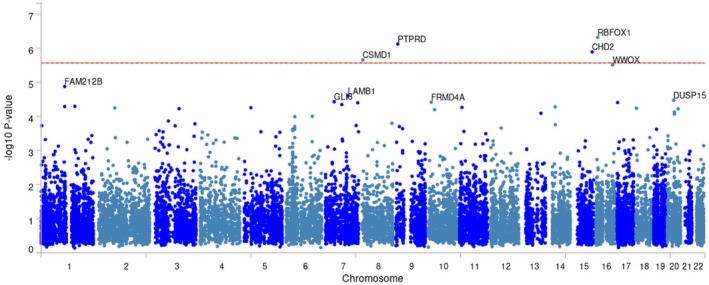
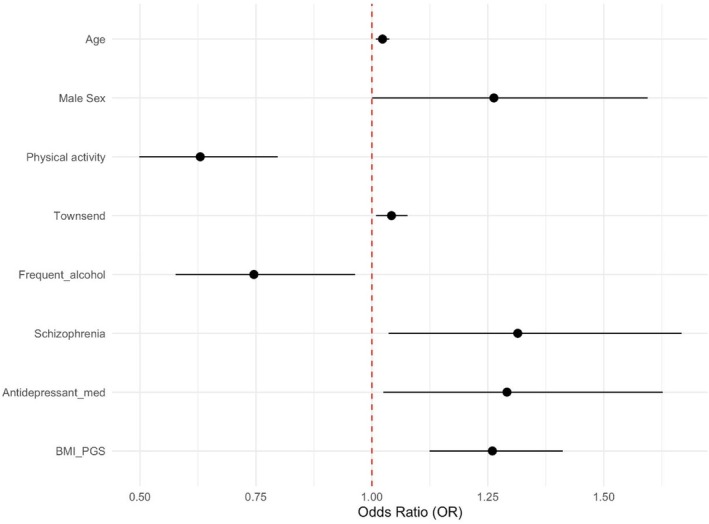
Results: GWAS identified suggestive associations (p < 1 × 10⁻⁵) on chromosome 15. The variant rs12914956 in CHD2 was associated with increased risk of SGA (odds ratio (OR) = 1.73, 95% confidence interval (CI) = 1.4-2.4, p = 3.6 × 10⁻⁷). The gene-based analysis identified significant gene associations with RBFOX1 (p = 4.85 × 10⁻⁷), PTPRD (p = 7.6 × 10⁻⁷), CSMD1 (p = 2.2 × 10⁻⁶), and CHD2 (p = 1.3 × 10⁻⁶). The PGS-BMI (β = 0.23, p = 6.8 × 10⁻⁵), was associated with increased MetS in a model adjusted for age, sex, physical activity, alcohol consumption, antidepressant medications, schizophrenia diagnosis, and principal components of ancestry.
Conclusion: Using a gene-based analysis, we identified significant gene associations with SGA-MetS that have been previously associated with obesity and metabolic traits. The PGS-BMI was associated with MetS, suggesting that a genetic predisposition to a higher BMI may increase the risk of SGA-MetS. Future research should replicate the findings in a larger dataset with more diverse populations.
Keywords: genome wide association study; metabolic syndrome; pharmacogenomics; second generation antipsychotics.
© 2025 The Author(s). Pharmacotherapy: The Journal of Human Pharmacology and Drug Therapy published by Wiley Periodicals LLC on behalf of ACCP Foundation, Ltd.
Conflict of interest statement
The authors declare no conflicts of interest.
Figures
References
-
- Pillinger T, McCutcheon RA, Vano L, et al. Comparative effects of 18 antipsychotics on metabolic function in patients with schizophrenia, predictors of metabolic dysregulation, and association with psychopathology: a systematic review and network meta‐analysis. Lancet Psychiatry. 2020;7(1):64‐77. - PMC - PubMed
MeSH terms
Substances
Grants and funding
LinkOut - more resources
Full Text Sources
Medical
