


Detecting chirality-induced spin selectivity in chromophore-linked DNA hairpins using photogenerated radical pairs
- PMID: 40763013
- PMCID: PMC12358874
- DOI: 10.1073/pnas.2515120122
Detecting chirality-induced spin selectivity in chromophore-linked DNA hairpins using photogenerated radical pairs
Abstract
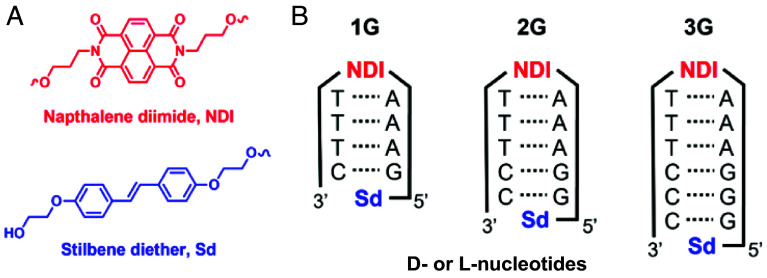
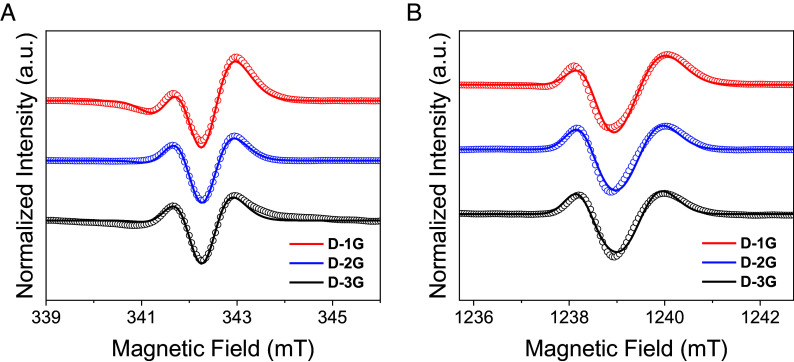
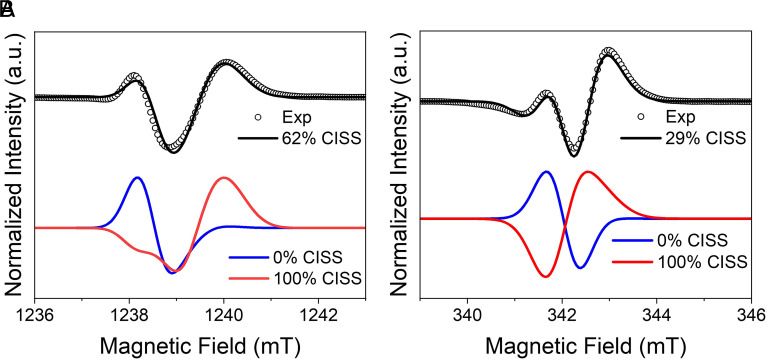
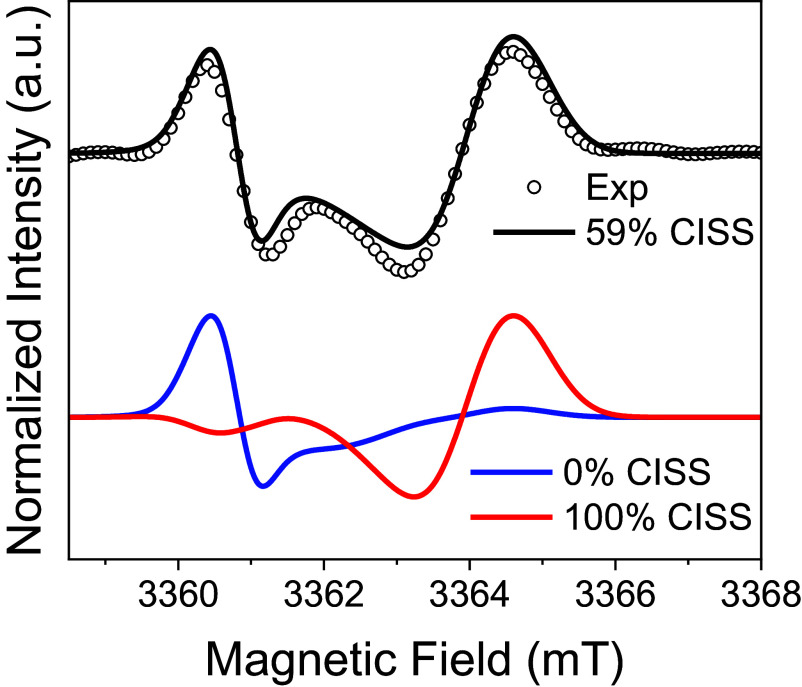
Chirality-induced spin selectivity (CISS) results in spin polarization of electrons transmitted through chiral molecules and materials. Since CISS results in spin polarization even at room temperature, it affords the possibility of using it to develop quantum technologies that can operate under ambient conditions. We have shown previously that photo-driven hole transfer within DNA hairpins provides a facile route to generate spin-correlated radical pairs (SCRPs). To study the effect of CISS on the spin dynamics of SCRPs in DNA hairpins, we prepared a series of electron donor-chiral bridge-acceptor molecules where the chiral bridge is a B-form DNA helix consisting of 4 to 6 base pairs. Naphthalene-1,8:4,5-bis(dicarboximide) (NDI) serves as the hairpin linker chromophore and electron acceptor. Photoexcitation of NDI results in rapid hole transfer through the π-stacked purine bases of the DNA and trapping of the hole on a terminal stilbene diether (Sd) to generate the NDI•-- Sd•+ SCRP. Time-resolved electron paramagnetic resonance spectra of the SCRPs at X- (9.6 GHz), Q- (34 GHz), and W- (94 GHz) bands show that the CISS effect imparts significant triplet character to the SCRP. We do not observe a significant dependence of CISS on DNA length, likely resulting from hole delocalization over the guanine bases in the G-tract. Interestingly, we find that the CISS contribution significantly increases with magnetic field strength. These findings should be considered in any future modeling of CISS.
Keywords: CISS; chirality; electron transfer; radical ion pair; spin dynamics.
Conflict of interest statement
Competing interests statement:M.J.T. was a co-author with M.R.W. on a review article that has 19 co-authors: https://pubmed.ncbi.nlm.nih.gov/39441172/. D.H.W. was a co-author on a review article with M.R.W. that has a total of 46 co-authors: https://pubmed.ncbi.nlm.nih.gov/35318848/.
Figures
Comment in
-
Probing the connection between chirality and spin through time-resolved EPR spectroscopy.Proc Natl Acad Sci U S A. 2025 Sep 23;122(38):e2519806122. doi: 10.1073/pnas.2519806122. Epub 2025 Sep 15. Proc Natl Acad Sci U S A. 2025. PMID: 40953277 No abstract available.
References
-
- Wasielewski M. R., et al. , Exploiting chemistry and molecular systems for quantum information science. Nat. Rev. Chem. 4, 490–504 (2020). - PubMed
-
- Harrow A. W., Montanaro A., Quantum computational supremacy. Nature 549, 203–209 (2017). - PubMed
-
- Awschalom D. D., Hanson R., Wrachtrup J., Zhou B. B., Quantum technologies with optically interfaced solid-state spins. Nat. Photon. 12, 516–527 (2018).
-
- Degen C. L., Reinhard F., Cappellaro P., Quantum sensing. Rev. Mod. Phys. 89, 035002 (2017).
-
- Naaman R., Waldeck D. H., Chiral-induced spin selectivity effect. J. Phys. Chem. Lett. 3, 2178–2187 (2012). - PubMed
MeSH terms
Substances
Grants and funding
LinkOut - more resources
Full Text Sources
Research Materials
Miscellaneous
