


Carbohydrates in action: influencing infection and amplification of Staphylococcus aureus bacteriophages
- PMID: 40764526
- PMCID: PMC12323223
- DOI: 10.1186/s12866-025-04219-6
Carbohydrates in action: influencing infection and amplification of Staphylococcus aureus bacteriophages
Abstract
Background: The use of bacteriophages as adjunct antibacterial agents in combating antimicrobial resistance is being actively studied worldwide. Due to their high specificity and ability to replicate within bacterial hosts, phages are used in various fields, including medicine, the food industry, agriculture, animal husbandry, biotechnology, and microbial identification. Despite their exceptional properties, the self-replication process of phages depends on multiple factors that may lead to a decrease in phage concentration during production and storage. The composition of the culture medium used for the cultivation of host bacteria is one of the critical parameters affecting phage infection and replication processes.
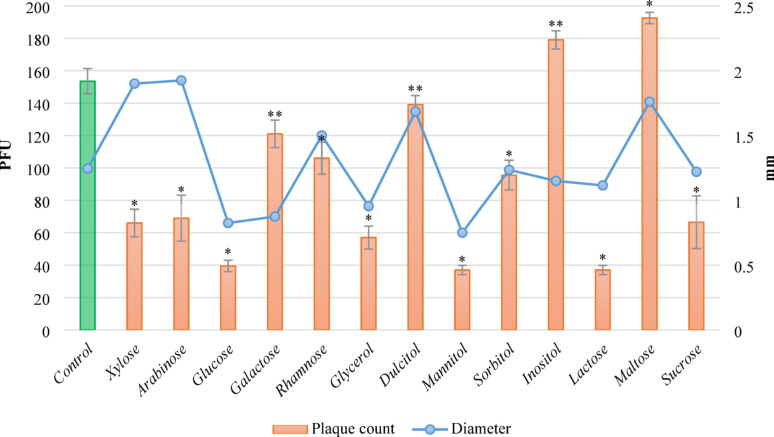
Results: In this study, we evaluated the effect of different carbohydrates in the nutrient medium on the infection and amplification of bacteriophages in a Staphylococcus aureus bacterial culture. We used the bacteriophage St12f, isolated from environmental samples, and tested 21 carbohydrates and their derivatives. The experimental results confirmed that the addition of carbohydrates to nutrient media either inhibited or enhanced the plaque formation. The addition of 1% inositol (P ≥ 0.05) and maltose (P < 0.05) to the nutrient medium enhanced plaque formation by the St12f phage, whereas sucrose, lactose, mannitol, sorbitol, glycerol, rhamnose, xylose, arabinose, and glucose (P < 0.05) at the same concentration significantly inhibited the formation of phage plaques. Furthermore, we identified a dependence of phage replication (inhibition/enhancement) on the carbohydrate concentration in the medium.
Conclusions: The experimental data obtained contribute to a deeper understanding of the metabolic interactions between bacteriophages and their bacterial hosts, as well as to the optimization of phage production for therapeutic applications. Further research should focus on elucidating the molecular mechanisms underlying this phenomenon and assessing its clinical significance.
Keywords: Staphylococcus aureus; Bacteriophages; Carbohydrates; Infection cycle; Plaque formation.
© 2025. The Author(s).
Conflict of interest statement
Declarations. Ethics approval and consent to participate: Not applicable. Consent for publication: Not applicable. Competing interests: The authors declare no competing interests.
Figures




References
-
- Kourtis AP, Hatfield K, Baggs J, Mu Y, See I, Epson E, et al. Vital Signs: epidemiology and recent trends in Methicillin-Resistant and in Methicillin-Susceptible Staphylococcus aureus bloodstream Infections — United States. MMWR Morbidity Mortal Wkly Rep. 2019;68(9):214–9. 10.15585/mmwr.mm6809e1. - DOI - PMC - PubMed
-
- European Centre for Disease Prevention and Control. Point prevalence survey of healthcare-associated infections and antimicrobial use in European acute care hospitals. Stockholm: ECDC; 2024.
MeSH terms
Substances
LinkOut - more resources
Full Text Sources
