


Motor elements of the third month variously predict individual later motor elements
- PMID: 40765766
- PMCID: PMC12322975
- DOI: 10.3389/fnhum.2025.1586228
Motor elements of the third month variously predict individual later motor elements
Abstract
Objective: This study aims to determine the correlations between axial and distal motor features observed at 3 months of age on later motor elements at 4-5 and 7-8 months.
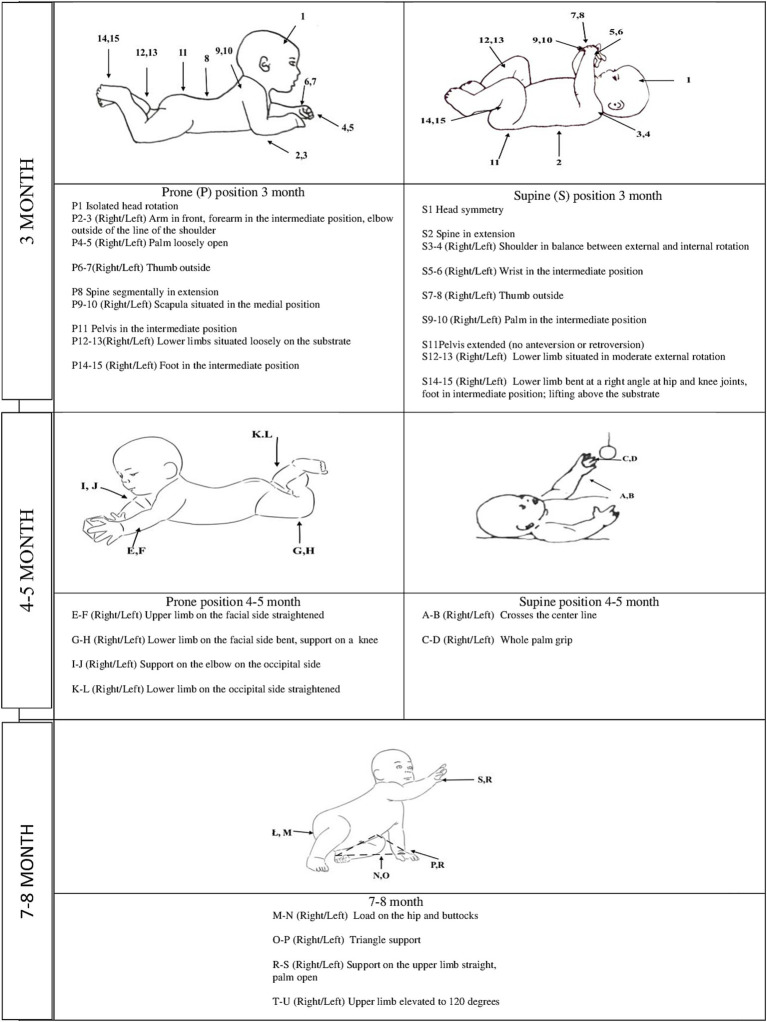
Materials and methods: We analyzed 93 children (50 boys); 24 were born prematurely. All children underwent a prospective qualitative evaluation of motor development, performed by the physiotherapist, at 3, 4-5, and 7-8 months of age. We analyzed infants' motor development in the third month using the validated Quantitative and Qualitative Assessment of Motor Development Worksheet. The qualitative assessment determined for 4-5 and 7-8 months was based on the Vojta development concept.
Results: Studies showed that axial features observed in the third month significantly and relatively strongly correlated (Cramer's V = 0.4-0.6) with proper asymmetric elbow support. In the supine position, crossing the body's midline and grasping correlated relatively strongly with the correct positioning of the pelvis and lower limbs observed in the third month. The axial and distal elements from the third month remain necessary to achieve a qualitatively correct oblique sitting position at 7-8 months. The relatively high values of Cramer's V were also confirmed by the relatively high values of the Tau test. At 7-8 months, this relationship was quite strong sometimes (high Cramer's V) but applied to a minor part of the variability (low Tau).
Conclusion: Axial elements observed at 3 months of age correlate relatively strongly with axial elements at 4-5 months. The relationships between the elements at 3 months of age and those studied at 7-8 months were moderate but related to axial and distal features. Without proper spine functioning, the development of the shoulders and pelvis will not occur properly. Findings support the early use of axial motor features as developmental indicators for motor progression, with implications for early intervention programs.
Keywords: axial control; early motor development; infant neuromotor assessment; motor milestone prediction; preterm infants.
Copyright © 2025 Gajewska, Moczko and Sobieska.
Conflict of interest statement
The authors declare that the research was conducted in the absence of any commercial or financial relationships that could be construed as a potential conflict of interest.
Figures
References
-
- Berger S., Horger M., DeMasi A., Karasik L. (2021). “Motor development in context” in Oxford research encyclopedia of psychology. eds. Vickers J. N., Williams A. M. (Oxford: Oxford University Press; ).
-
- Bruggink J. L., Cioni G., Einspieler C., Maathuis C. G., Pascale R., Bos A. F. (2009). Early motor repertoire is related to level of self-mobility in children with cerebral palsy at school age: early motor repertoire and functional outcome. Dev. Med. Child Neurol. 51, 878–885. - PubMed
-
- Bruggink J. L. M., Einspieler C., Butcher P. R., Stremmelaar E. F., Prechtl H. F. R., Bos A. F. (2009). Quantitative aspects of the early motor repertoire in preterm infants: do they predict minor neurological dysfunction at school age? Early Hum. Dev. 85, 25–36. doi: 10.1016/j.earlhumdev.2008.05.010, PMID: - DOI - PubMed
LinkOut - more resources
Full Text Sources
