


Initial Meropenem Plasma Concentration and Its Correlation with Sepsis Mortality: A Real-World Retrospective Study
- PMID: 40766046
- PMCID: PMC12323782
- DOI: 10.2147/IDR.S514088
Initial Meropenem Plasma Concentration and Its Correlation with Sepsis Mortality: A Real-World Retrospective Study
Abstract
Purpose: Meropenem is a first-line antibiotic for sepsis in settings with high prevalence of multidrug-resistant organisms due to its broad-spectrum activity. However, the relationship between meropenem plasma concentration and prognosis of sepsis is unclear. This study aims to investigate whether optimizing meropenem plasma levels improves 28-day outcomes in sepsis patients, while also exploring the potential impact of continuous versus intermittent infusion methods.
Patients and methods: This real-world retrospective study included 202 sepsis patients treated with meropenem at Hunan University of Medicine General Hospital from January 2022 to December 2023. Patients received either prolonged intravenous infusion or intermittent intravenous infusion of meropenem, as determined by the attending physician. Prolonged infusion involved a 3-hour duration with an infusion pump, while intermittent infusion lasted 30 minutes to 1 hour. Patients were grouped by the quartiles of meropenem plasma concentration (Q1, Q2, Q3, and Q4) to facilitate analysis of dose-response relationships and control for variability in plasma concentration distributions. Mortality rates at 7, 14, and 28 days, as well as the detection rates of resistant bacteria and ICU length of stay, were compared among groups.
Results: Prolonged intravenous infusion yielded higher meropenem plasma concentrations compared to intermittent infusion (P=0.024), aligning with expected therapeutic targets for optimal antimicrobial efficacy. However, no significant differences were observed in mortality rates at 7, 14, and 28 days between infusion methods or across plasma concentration quartiles. Multivariable logistic regression confirmed these findings after adjusting for confounding factors. Additionally, no significant differences were found in resistant bacteria detection rates or ICU length of stay across quartiles.
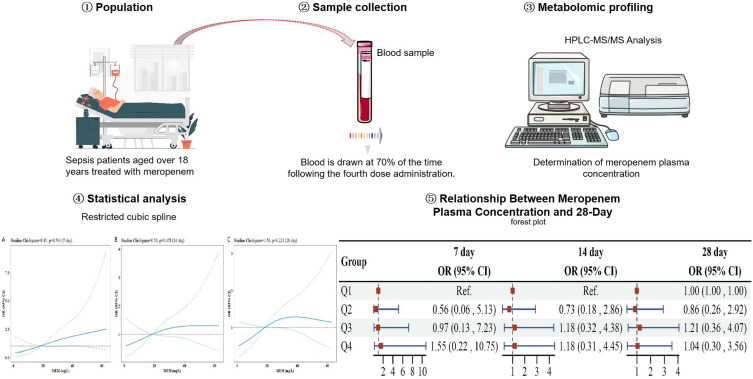
Conclusion: While prolonged infusion increases plasma meropenem concentration, it does not impact 28-day mortality risk, ICU stay, or resistant bacteria detection in sepsis patients. These findings suggest that prolonged infusion may not offer significant clinical advantages over intermittent infusion and highlight the importance of balancing antibiotic use with stewardship principles (Graphical abstract).
Keywords: concentration; meropenem; mortality; sepsis.
© 2025 Deng et al.
Conflict of interest statement
The authors report no conflicts of interest in this work.
Figures
References
-
- Rhee C, Jones TM, Hamad Y, et al; The Centers for Disease Control and Prevention (CDC) Prevention Epicenters Program. Prevalence, underlying causes, and preventability of sepsis-associated mortality in US acute care hospitals. JAMA Network Open. 2019;2(2):e187571. doi: 10.1001/jamanetworkopen.2018.7571 - DOI - PMC - PubMed
LinkOut - more resources
Full Text Sources
