


This is a preprint.
Development of ENTV reverse genetics system and phenotypic evaluation of rescued virus reveals host-specific replication patterns in mosquitoes
- PMID: 40766458
- PMCID: PMC12324323
- DOI: 10.1101/2025.07.29.667424
Development of ENTV reverse genetics system and phenotypic evaluation of rescued virus reveals host-specific replication patterns in mosquitoes
Abstract
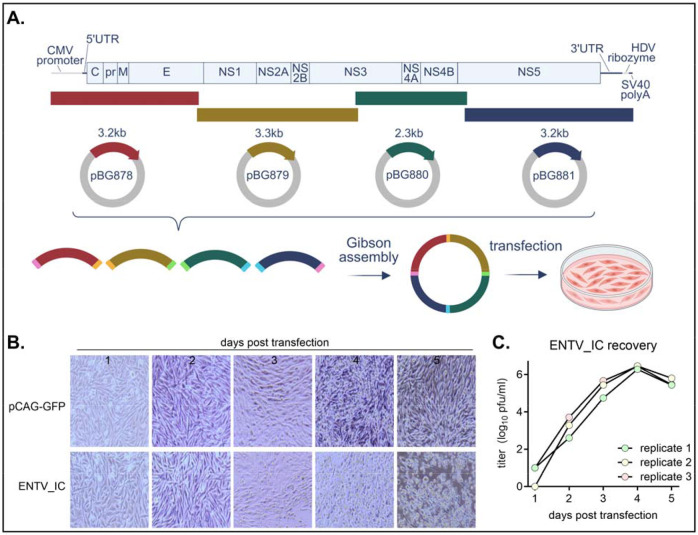
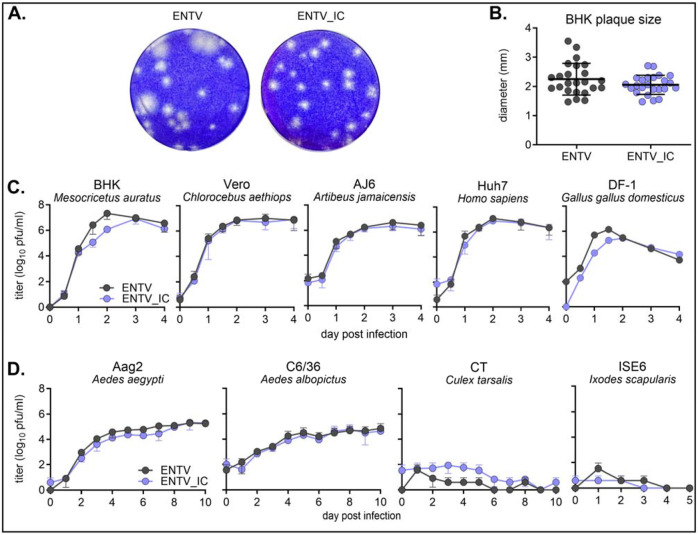
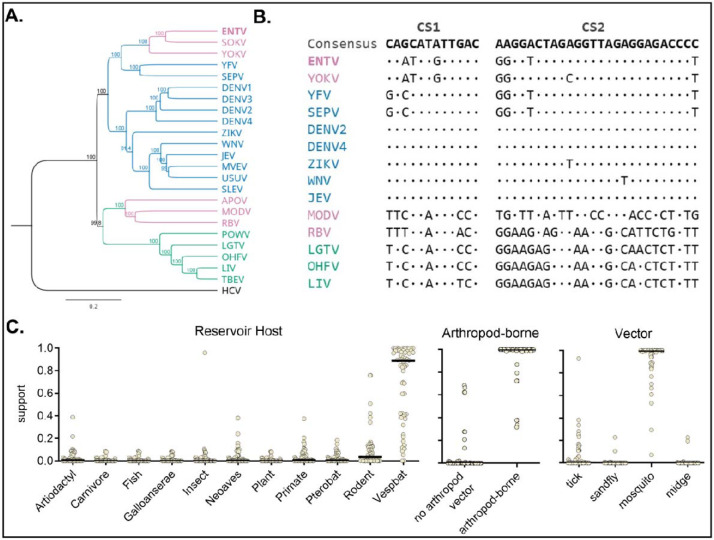
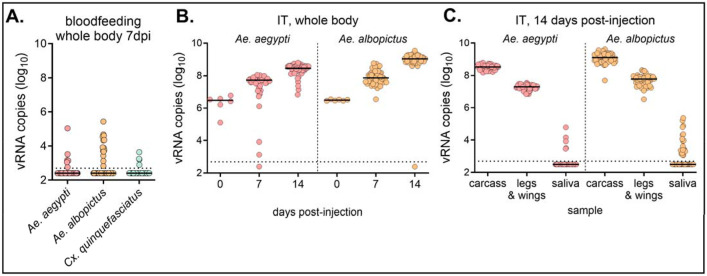
Entebbe bat virus (ENTV) is a bat-associated flavivirus with no known vector. Research into the biology of this virus, including assessment of the possibility that it may be vector-transmitted, is hindered by a lack of molecular tools and robust genetic systems. Therefore, we sequenced the complete 3' untranslated region, which was not previously available, and developed an infectious clone of ENTV to facilitate further investigation of the virus. Virus derived from the clone replicated similarly to the parental virus isolate in various vertebrate cells. Surprisingly, ENTV replicated to high titers in Aedes aegypti and Aedes albopictus mosquito cell lines, but there was no replication or infection in Culex tarsalis cells. In addition, phylogenetic and bioinformatics analyses strongly suggested that ENTV may be associated with a mosquito host. Given the bioinformatics support and efficient growth in Aedes cells, we orally exposed Ae. aegypti and Ae. albopictus to ENTV to evaluate infection. The ENTV blood-fed mosquitoes were all negative for infection; however, when ENTV was intrathoracically inoculated, bypassing the initial midgut infection and escape barriers, it replicated to high levels in the body, without dissemination of infectious virus into the saliva. These findings suggest that, despite demonstrating high molecular compatibility at the cellular level in Aedes mosquitoes, Ae. aegypti and Ae. albopictus are unlikely to serve as competent vectors for ENTV transmission due to strong midgut infection barriers. The clone presented in this manuscript should help to clarify the mechanisms for transmission and maintenance of ENTV, which remain poorly understood.
Conflict of interest statement
Disclosures The authors declare no conflicts of interest.
Figures
Similar articles
-
The Incompetence of Mosquitoes-Can Zika Virus Be Adapted To Infect Culex tarsalis Cells?mSphere. 2023 Apr 20;8(2):e0001523. doi: 10.1128/msphere.00015-23. Epub 2023 Feb 16. mSphere. 2023. PMID: 36794947 Free PMC article.
-
Dynamics of vector competence for dengue virus type 2 in rural and urban populations of Aedes albopictus: implications for infectious disease control.Parasit Vectors. 2025 Jun 1;18(1):201. doi: 10.1186/s13071-025-06826-8. Parasit Vectors. 2025. PMID: 40452062 Free PMC article.
-
Assessing the vector competence of Italian Culex pipiens and Aedes albopictus mosquitoes for the re-emerging Oropouche virus.Parasit Vectors. 2025 Jul 8;18(1):268. doi: 10.1186/s13071-025-06912-x. Parasit Vectors. 2025. PMID: 40629438 Free PMC article.
-
Natural vertical transmission of dengue virus in Aedes aegypti and Aedes albopictus: a systematic review.Parasit Vectors. 2018 Feb 1;11(1):77. doi: 10.1186/s13071-018-2643-9. Parasit Vectors. 2018. PMID: 29391071 Free PMC article.
-
The effect of sample site and collection procedure on identification of SARS-CoV-2 infection.Cochrane Database Syst Rev. 2024 Dec 16;12(12):CD014780. doi: 10.1002/14651858.CD014780. Cochrane Database Syst Rev. 2024. PMID: 39679851 Free PMC article.
References
-
- Lumsden W. H. R., Williams M. C. & Mason P. J. From Bat Salivary Gland. 22 (1957).
-
- Mayanja M. N. et al. Mosquito-borne arboviruses in Uganda: history, transmission and burden. J. Gen. Virol. 102, (2021). - PubMed
Publication types
Grants and funding
LinkOut - more resources
Full Text Sources
