


Quantitative HILIC-Q-TOF-MS Analysis of Glycosaminoglycans and Non-reducing End Carbohydrate Biomarkers via Glycan Reductive Isotopic Labeling
- PMID: 40767435
- PMCID: PMC12368834
- DOI: 10.1021/acs.analchem.5c02338
Quantitative HILIC-Q-TOF-MS Analysis of Glycosaminoglycans and Non-reducing End Carbohydrate Biomarkers via Glycan Reductive Isotopic Labeling
Abstract
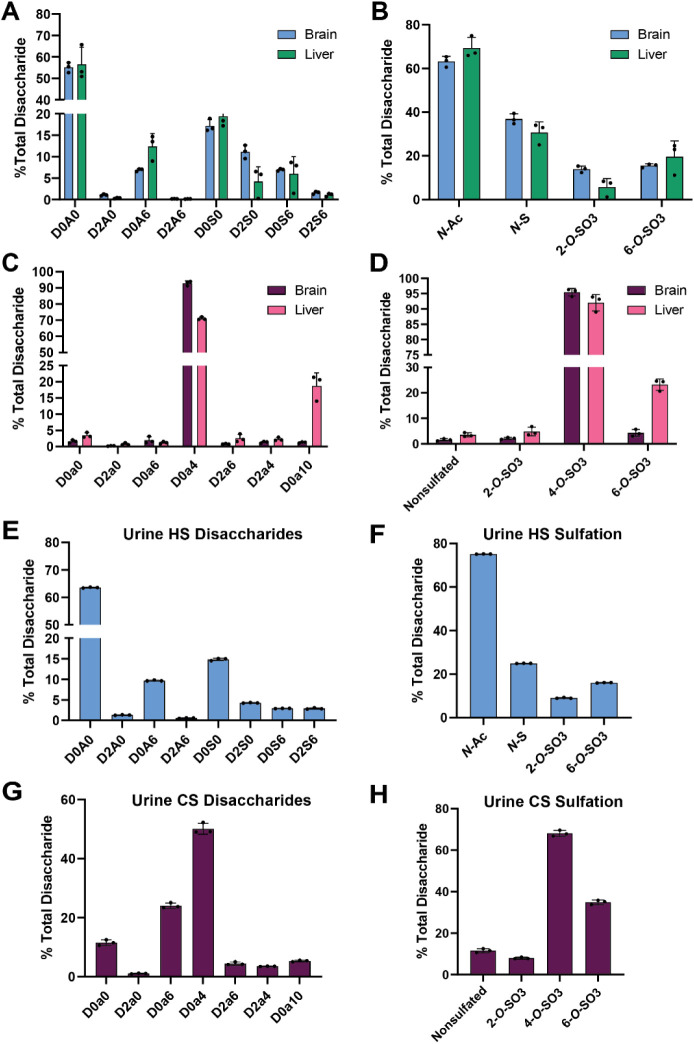
Glycosaminoglycans (GAGs) are linear, heterogeneous polysaccharides expressed on all animal cells. Sulfated GAGs, including heparan sulfate (HS) and chondroitin/dermatan sulfate (CS/DS), are involved in numerous physiological and pathological processes; therefore, precise and robust analytical methods for their characterization are essential to correlate structure with function. In this study, we developed a method utilizing hydrophilic interaction liquid chromatography coupled with time-of-flight mass spectrometry (HILIC-Q-TOF-MS) and glycan reductive isotopic reducing end labeling (GRIL) for the quantitative compositional analysis of HS and CS/DS polysaccharides. Lyase-generated disaccharides and commercial standards were chemically tagged on the reducing end with aniline stable isotopes, thus enabling the absolute quantification of HS and CS/DS disaccharides in complex biological samples. In addition, we adapted this workflow, in conjunction with new synthetic carbohydrate standards, for the quantification of disease-specific non-reducing end (NRE) carbohydrate biomarkers that accumulate in patients with mucopolysaccharidoses (MPS), a subclass of lysosomal storage disorders. As a proof of concept, we applied this method to measure NRE biomarkers in patient-derived MPS IIIA and MPS IIID fibroblasts, as well as in cortex tissue from a murine model of MPS VII. Overall, this method demonstrates improved sensitivity compared to previous GRIL-LC/MS techniques and, importantly, avoids the use of ion-pairing reagents, which are undesirable in certain mass spectrometry instrumentation and contexts. By combining the benefits of HILIC separation with isotopic labeling, our approach offers a robust and accessible tool for the analysis of GAGs, paving the way for advancements in understanding GAG structure and function.
Figures



References
MeSH terms
Substances
Grants and funding
LinkOut - more resources
Full Text Sources
Research Materials
