


Automatic detection of foreign object intrusion along railway tracks based on MACENet
- PMID: 40768523
- PMCID: PMC12327662
- DOI: 10.1371/journal.pone.0329303
Automatic detection of foreign object intrusion along railway tracks based on MACENet
Abstract
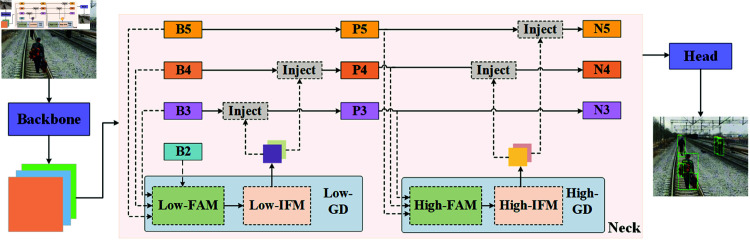
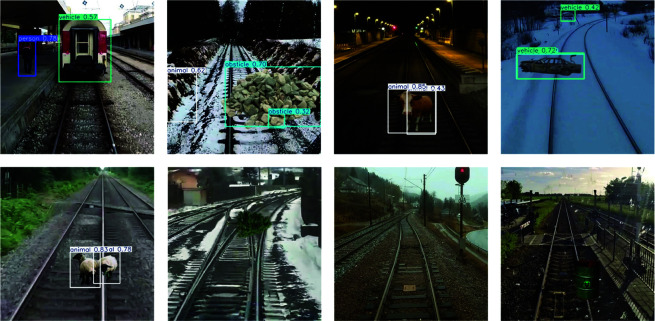
Ensuring high accuracy and efficiency in foreign object intrusion detection along railway lines is critical for guaranteeing railway operational safety under limited resource conditions. However, current visual detection methods generally exhibit limitations in effectively handling diverse object shapes, scales, and varying environmental conditions, while typically incurring substantial computational overhead. To overcome these limitations, this study proposes a multi-level feature aggregation and context enhancement network (MACE-Net). The network architecture integrates the GOLD-YOLO module, an advanced object detection approach, alongside the updated deformable convolutional networks (DCNv3). The incorporation of DCNv3 allows the model to dynamically adapt its sampling positions according to actual object shapes, significantly enhancing feature extraction accuracy, especially for irregularly shaped intrusions. Additionally, the convolutional block attention module (CBAM) is employed to refine spatial and channel-wise feature representation, enabling the model to emphasize crucial object characteristics without substantially increasing computational complexity. Meanwhile, to improve localization robustness, the generalized intersection over union (GIoU) loss function is implemented, offering more reliable detection across various object sizes and shapes. Furthermore, to address the shortage of domain-specific datasets, we created a railway intrusion dataset comprising 7,200 images. Experimental results demonstrate that MACE-Net achieves superior detection performance, improving mAP@0.5 from 78.9% (baseline YOLOv8) to 83.8%-a notable increase of 4.9%. Meanwhile, the F1-score also rises by 5.2%. Importantly, despite significant accuracy gains, MACE-Net maintains computational efficiency similar to that of the baseline, affirming its suitability for real-time railway foreign object detection tasks under constrained energy and computational environments.
Copyright: © 2025 Chen et al. This is an open access article distributed under the terms of the Creative Commons Attribution License, which permits unrestricted use, distribution, and reproduction in any medium, provided the original author and source are credited.
Conflict of interest statement
The authors declare that they have no known competing financial interests or personal relationships that could have appeared to influence the work reported in this paper.
Figures



References
-
- Zhang Z, Chen P, Huang Y, Dai L, Xu F, Hu H. Railway obstacle intrusion warning mechanism integrating YOLO-based detection and risk assessment. J Indust Inf Integrat. 2024;38:100571.
-
- Wang J, Zhai H, Yang Y, Xu N, Li H, Fu D. A review of intrusion detection for railway perimeter using deep learning-based methods. IEEE Access. 2024.
-
- Song X, Song H, Wang H, Zhang Z, Dong H. Deep learning-based railway foreign object intrusion intelligent perception using attention-aggregated semantic segmentation. IEEE/ASME Trans Mechatron. 2024.
-
- Cao Z, Qin Y, Jia L, Xie Z, Gao Y, Wang Y. Railway intrusion detection based on machine vision: a survey, challenges, and perspectives. IEEE Trans Intell Transp Syst. 2024.
MeSH terms
LinkOut - more resources
Full Text Sources
