


Distinct effects of three knee-preserving surgeries on hip-knee-ankle alignment in patients with knee osteoarthritis
- PMID: 40770822
- PMCID: PMC12326634
- DOI: 10.1186/s13018-025-06161-9
Distinct effects of three knee-preserving surgeries on hip-knee-ankle alignment in patients with knee osteoarthritis
Abstract
Background: Unicompartmental knee arthroplasty (UKA), high tibial osteotomy (HTO), and distal femoral osteotomy (DFO) are common knee-preserving surgeries for knee osteoarthritis (KOA), yet systematic comparisons of their effects on lower limb biomechanical parameters remain limited.
Objective: To retrospectively evaluate and compare the impacts of UKA, HTO, and DFO on hip-knee-ankle alignment in KOA patients, providing evidence for personalized surgical strategy formulation. We hypothesized that these procedures would exert differential effects on specific alignment parameters.
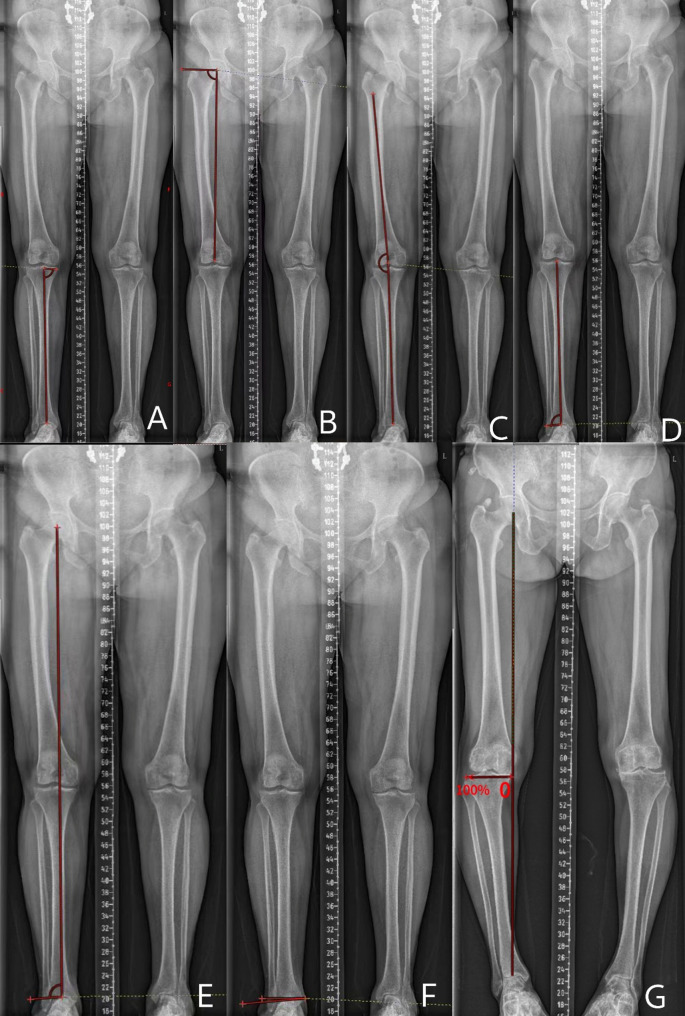
Methods: A total of 256 patients with knee osteoarthritis were initially screened. After applying the inclusion and exclusion criteria, 150 patients were enrolled and assigned to the UKA, HTO, or DFO group (50 patients per group). Preoperative and postoperative changes in seven alignment parameters were measured: medial proximal tibial angle (MPTA), mechanical greater trochanter angle (MGTA), femorotibial anatomic angle (FTA), distal tibial femoral angle (DTTA), talar dome mechanical axis angle (TDMA), talar tilt angle (TTA), and the mechanical axis percentage (%MA). Intergroup differences in these parameters were analyzed statistically.
Results: (1) Baseline demographics and preoperative lower limb alignment parameters were comparable across groups. (2) UKA significantly changed MPTA, FTA, DTTA, TDMA, and %MA, but not MGTA or TTA. (3) DFO significantly changed MPTA, MGTA, FTA, and %MA, but not DTTA, TDMA, or TTA. (4) HTO significantly modified MPTA, MGTA, FTA, DTTA, TDMA and %MA, except for TTA. (5) UKA vs. HTO: No differences in FTA or DTTA, but significant differences in MPTA, MGTA, TDMA, TTA, and %MA. (6) UKA vs. DFO: No differences in MPTA or DTTA, but significant disparities in MGTA, FTA, TDMA, TTA and %MA.
Conclusion: UKA, HTO, and DFO each influence lower limb biomechanics in KOA patients, with distinct effects on specific alignment parameters. Surgical selection should prioritize individual anatomical and pathological characteristics to achieve personalized care.
Keywords: Biomechanics; Distal femoral osteotomy; High tibial osteotomy; Knee osteoarthritis; Knee-preserving surgery; Lower limb alignment; Unicompartmental knee arthroplasty.
© 2025. The Author(s).
Conflict of interest statement
Declarations. Competing interests: The authors declare no competing interests.
Figures
References
-
- Baljozovic A, Lekovic A, Nikolic S, Djonic D, Djuric M, Bascarevic Z et al. Osteochondral alterations in patients treated with total knee arthroplasty due to rheumatoid arthritis and primary osteoarthritis: Cross-Sectional study with focus on elucidating effects of knee malalignment. Life (Basel). 2025;15(5). - PMC - PubMed
-
- Goodell PB, Johansen PM, Bartels DW, Sherman SL, Amanatullah DF. Comparing unicompartmental knee arthroplasty and high tibial osteotomy for isolated medial compartment knee osteoarthritis. JBJS Rev. 2023;11(3). - PubMed
-
- Giurazza G, Tanzilli A, Franceschetti E, Campi S, Gregori P, Parisi FR, et al. Coronal plane alignment of the knee phenotypes distribution varies significantly as a function of geographic, Osteoarthritic and sex-related factors: A systematic review and meta-analysis. Knee Surg Sports Traumatol Arthrosc; 2025. - PubMed
-
- Giurazza G, Perricone G, Franceschetti E, Campi S, Gregori P, Zampogna B, et al. Femorotibial angle on short knee radiographs fails to accurately predict the lower limb mechanical alignment. A systematic review and meta-analysis on different femorotibial angle definitions and short knee radiograph types. Orthop Rev (Pavia). 2024;16:120053. - PMC - PubMed
Publication types
MeSH terms
LinkOut - more resources
Full Text Sources
Medical
