


When the World Pivots: Changes in Infant Negative Affect Trajectories Following the Onset of the COVID-19 Pandemic
- PMID: 40770936
- PMCID: PMC12329392
- DOI: 10.1111/infa.70041
When the World Pivots: Changes in Infant Negative Affect Trajectories Following the Onset of the COVID-19 Pandemic
Abstract
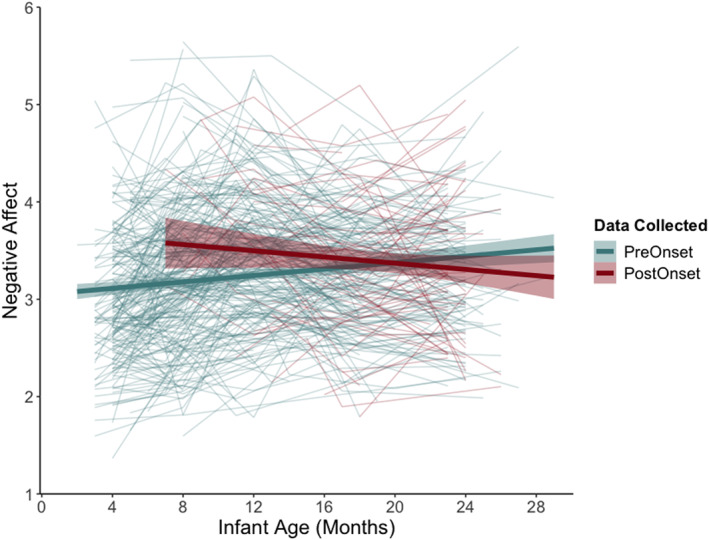
Research on the COVID-19 pandemic's effect on infant emotional development has produced mixed results, often limited by methodological constraints, such as not having access to data prior to and after pandemic onset. This study helps overcome these limitations by analyzing data from 330 infants (51% female; 54% White, non-Hispanic) across five points in the first 2 years of life, from October 2016 to August 2021. Multilevel growth models indicated that negative affect decreased following pandemic onset, contrary to the expected and observed increase in negative affect prior to the pandemic. Higher levels of contextual risk (maternal trait anxiety, neighborhood disadvantage) were associated with higher levels of infant negative affect, irrespective of the pandemic. These findings further our understanding of the pandemic's impact on child development.
Keywords: COVID‐19; maternal anxiety; negative affect; neighborhood disadvantage; pandemic.
© 2025 The Author(s). Infancy published by Wiley Periodicals LLC on behalf of International Congress of Infant Studies.
Figures
References
-
- Bates, D. , Maechler M., Bolker B., and Walker S.. 2015. “Fitting Linear Mixed‐Effects Models Using lme4.” Journal of Statistical Software 67: 1–48. 10.18637/jss.v067.i01. - DOI
-
- Cicchetti, D. , and Valentino K.. 2015. “An Ecological‐Transactional Perspective on Child Maltreatment: Failure of the Average Expectable Environment and Its Influence on Child Development.” Developmental Psychopathology: Risk, Disorder, and Adaptation: 129–201. 10.1002/9780470939406.ch4. - DOI
MeSH terms
Grants and funding
LinkOut - more resources
Full Text Sources
Medical
