


Unmet maternal health information needs and mass media exposure for maternal health among women in the Gedeo zone, South Ethiopia
- PMID: 40771254
- PMCID: PMC12325304
- DOI: 10.3389/fpubh.2025.1497606
Unmet maternal health information needs and mass media exposure for maternal health among women in the Gedeo zone, South Ethiopia
Abstract
Introduction: The Agenda 2030 for Sustainable Development Goals (SDGs) of the United Nations emphasizes that any society's social, political, and economic well-being depends on access to pertinent health information. To lower maternal and child mortality, it is vital to provide mothers with timely and relevant health information for informed decision-making. However, there is a limited study about unmet maternal health information needs and mass media exposure towards maternal healthcare among women in Ethiopia. Therefore, this study aimed to evaluate unmet maternal health information needs and mass media exposure among women in the Gedeo zone, South Ethiopia.
Methods: A community-based cross-sectional study was conducted from February to March 2023 among 845 women who had given birth in the last 2 years before the survey. A multistage sampling technique was employed to select the study participants. Chi-square tests were used to show the relationship between categorical variables. Logistic regression was employed to identify the existence of statistically significant associations. An adjusted odds ratio (AOR) with a 95% confidence interval (CI) was used to show the strength of the association between the dependent and independent variables. A p-value less than 0.05 was used to declare statistical significance.
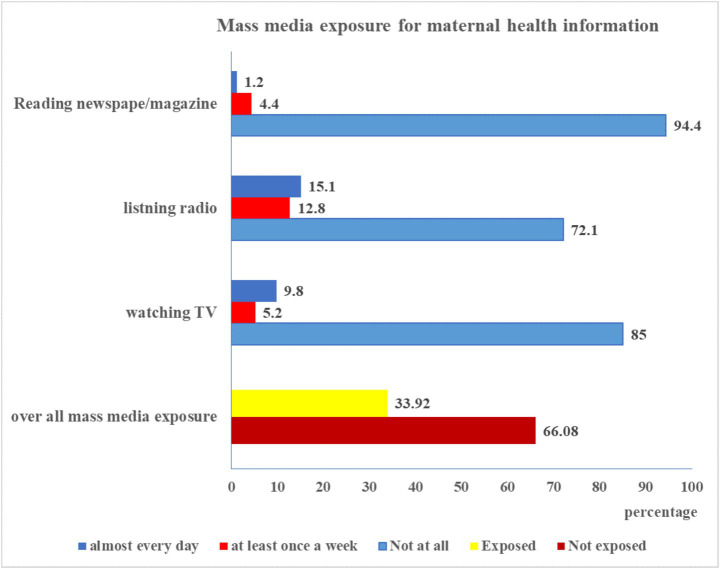
Results: Of the total study participants, 72.5% (95% CI: 69.34-75.37) had high unmet maternal health information needs. Only 33.9% (95% CI: 30.80-37.19) of participants reported that they are exposed to mass media for maternal health information. Living in rural areas (AOR = 0.3, 95%CI: 0.13-0.69), primary school education (AOR = 1.6, 95%CI: 1.15-2.28), household monthly income 4,501-6,000 birr (AOR = 2.8, 95%CI: 1.72-4.64), household monthly income >6,000 birr (AOR = 3.4, 95%CI: 1.68-7.07), counseled by health extension workers (AOR = 2.0, 95%CI: 1.41-2.82), visiting health facilities (AOR = 1.5, 95%CI: 1.02-1.99), and owning mobile phones (AOR = 3.4, 95%CI: 2.01-5.75) were significantly associated with mass media exposure.
Conclusion: Nearly three-quarters of the participants reported that they had high unmet maternal health information needs. Healthcare organizations, policymakers, and other governmental and non-governmental organizations should continuously work on maternal health educational programs by using different types of mass media platforms to fulfill the information needs of women.
Keywords: health information; mass media; maternal health; unmet need; women.
Copyright © 2025 Tesfa, Getnet and Seboka.
Conflict of interest statement
The authors declare that the research was conducted in the absence of any commercial or financial relationships that could be construed as a potential conflict of interest.
Figures
References
-
- World Health Organization . (2025). Maternal health. Available online at: https://www.afro.who.int/health-topics/maternal-health (Accessed April 10, 2025).
-
- World Health Organization . (2023). Maternal mortality. Available online at: https://www.who.int/news-room/fact-sheets/detail/maternal-mortality (Accessed April 10, 2025).
-
- United Nations Population Fund . (2024). Maternal health. Available online at: https://www.unfpa.org/maternal-health (Accessed January 20, 2024).
MeSH terms
LinkOut - more resources
Full Text Sources
