


Poor Sleep Pattern Might Increase the Prevalence of Abdominal Aortic Calcification in US Adults: Data from the NHANES (2013-2014)
- PMID: 40771302
- PMCID: PMC12326320
- DOI: 10.2147/VHRM.S532476
Poor Sleep Pattern Might Increase the Prevalence of Abdominal Aortic Calcification in US Adults: Data from the NHANES (2013-2014)
Abstract
Background: Abdominal aortic calcification (AAC) is a reliable predictor of cardiovascular events. Sleep is an essential component of cardiovascular health. This study aimed to assess the association between sleep patterns (including sleep duration, trouble sleeping, and sleep disorders) and the risk of AAC.
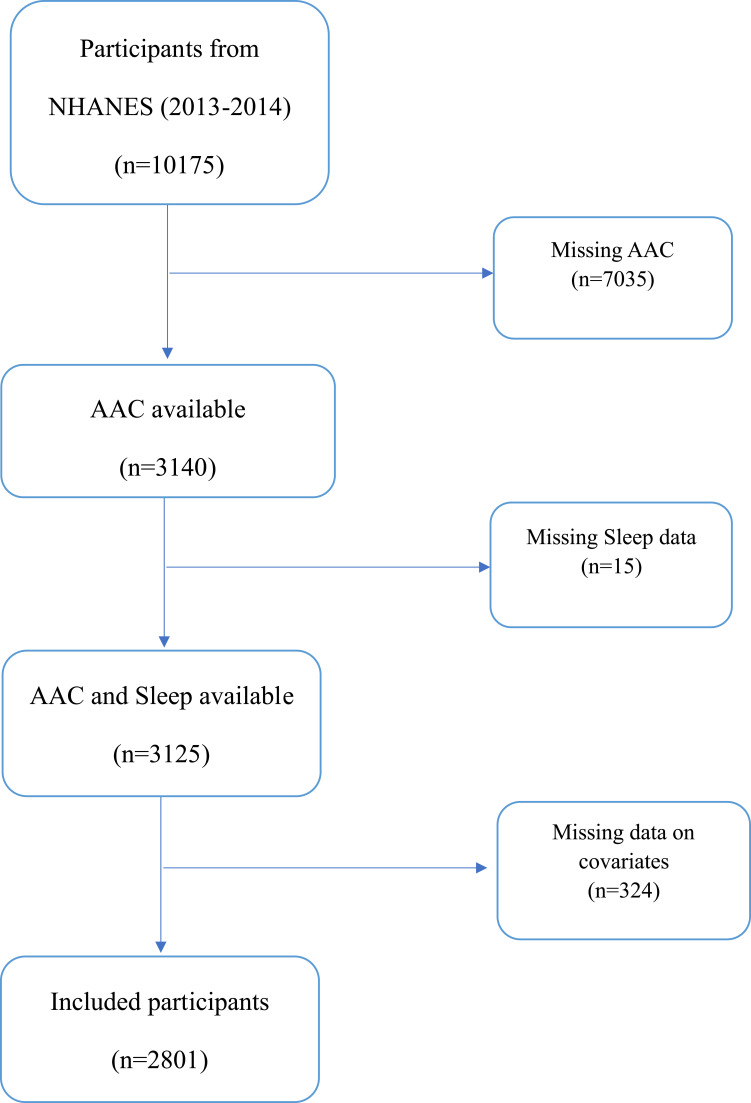
Methods: A total of 2801 participants from the 2013 to 2014 National Health and Nutrition Examination Survey (NHANES) 2013-2014 cycle were included in the study. AAC score was assessed using the Kauppila scoring system. Sleep patterns were defined according to the overall sleep score, which was calculated based on the sleep duration, self-reported trouble sleeping, and sleep disorders. Weighted multivariable linear regression models were used to analyze the association between sleep patterns and AAC.
Results: AAC prevalence was higher in older age groups, smokers, those with hypertension or diabetes, and those with less physical activity, lower eGFR, or higher levels of total 25-hydroxyvitamin D, serum uric acid, and serum calcium. Compared with the healthy sleep pattern group, participants in the poor sleep pattern group had a higher prevalence of AAC (odds ratio [OR] = 1.664, 95% CI: 1.286-2.152) and a higher prevalence of severe AAC (OR = 2.179, 95% CI: 1.539-3.087). After adjusting for potential confounders, the poor sleep pattern group remained significantly associated with a higher risk of AAC (OR = 1.657, 95% CI: 1.235-2.222) and severe AAC (OR = 2.374, 95% CI: 1.616-3.488).
Conclusion: Sleep patterns were related to the risk of AAC in middle-aged and elderly populations. Poor sleep patterns may increase AAC prevalence.
Keywords: NHANES; abdominal aortic calcification; cardiovascular event; sleep pattern.
© 2025 Chen et al.
Conflict of interest statement
The authors declare no competing interests in this work.
Figures
References
MeSH terms
LinkOut - more resources
Full Text Sources
Medical
Research Materials
Miscellaneous
