


Association of gastroesophageal reflux disease with the incidence of pulmonary disease
- PMID: 40772230
- PMCID: PMC12327043
- DOI: 10.3389/fcell.2025.1552126
Association of gastroesophageal reflux disease with the incidence of pulmonary disease
Erratum in
-
Correction: Association of gastroesophageal reflux disease with the incidence of pulmonary disease.Front Cell Dev Biol. 2025 Oct 22;13:1719856. doi: 10.3389/fcell.2025.1719856. eCollection 2025. Front Cell Dev Biol. 2025. PMID: 41199771 Free PMC article.
Abstract
Objective: Concurrent pulmonary diseases are common in patients with gastroesophageal reflux disease (GERD). However, whether GERD increase the incidence of pulmonary diseases is uncertain because of a lack of quantitative evidence. We conducted a meta-analysis to determine whether GERD was associated with the increased incidence of subsequent of pulmonary diseases.
Methods: The PubMed, Embase, Web of Science and Cochrane Library databases were searched through 12 July 2024. The primary outcomes were asthma and pneumonia, and the secondary outcomes were pulmonary fibrosis (PF), chronic obstructive pulmonary disease (COPD), lung cancer, interstitial lung disease (ILD), bronchiectasis, bronchitis, acute lung injury (ALI), pulmonary embolism, pulmonary tuberculosis (PTB) and nontuberculous mycobacterial pulmonary disease (NTMPD). Odds ratios (ORs) with 95% confidence intervals (CIs) were calculated to investigate the associations of prior GERD with the incidence of pulmonary diseases, and subgroup analyses based on the treatment of GERD, age and source of OR were performed.
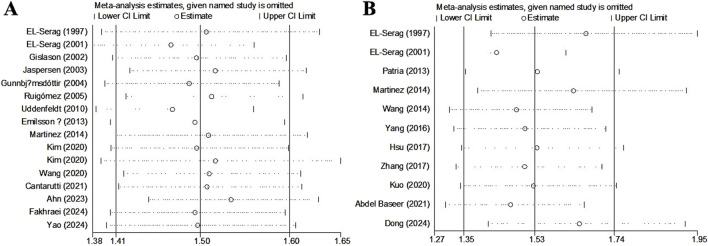
Results: A total of 45 cohort studies were included. The pooled results indicated that GERD was significantly linked to an increased incidence of asthma (OR = 1.50, P < 0.001) and pneumonia (OR = 1.53, P < 0.001), as did PF (OR = 1.43, P = 0.001), COPD (OR = 1.41, P = 0.004), lung cancer (OR = 1.51, P < 0.001), ILD (OR = 1.28, P = 0.015), bronchiectasis (OR = 1.63, P = 0.039), bronchitis (OR = 1.24, P < 0.001), ALI (OR = 2.07, P < 0.001), pulmonary embolism (OR = 1.33, P = 0.013), PTB (OR = 1.63, P = 0.015) and NTMPD (OR = 3.36, P < 0.001). Subgroup analyses stratified by age and source of OR yielded similar results. However, no significant associations between treated GERD and the incidence of asthma (OR = 1.27, P = 0.081) or lung cancer (OR = 1.01, P = 0.97) were observed.
Conclusion: The presence of GERD is associated with an increased incidence of subsequent various pulmonary diseases, but regular treatment may eliminate this effect. These findings highlight the importance of screening and management for pulmonary diseases and of standardized therapy in patients with GERD.
Clinical trial registration no: INPLASY202490013.
Keywords: asthma; gastroesophageal reflux disease; meta-analysis; pneumonia; pulmonary disease.
Copyright © 2025 Wang, Wang, Bu, Liu, Gong and Che.
Conflict of interest statement
The authors declare that the research was conducted in the absence of any commercial or financial relationships that could be construed as a potential conflict of interest.
Figures



References
-
- Ahn K., Penn R. B., Rattan S., Panettieri R. A., Jr., Voight B. F. (2023). An SS: Menmelian randomization analysis reveals a complex genetic interplay among atopic dermatitis, asthma, and gastroesophageal reflux Disease. Am. J. Respir. Crit. Care Med. 207 (2), 130–137. 10.1164/rccm.202205-0951OC - DOI - PMC - PubMed
LinkOut - more resources
Full Text Sources
