


Genetic evidence for causal effects of inflammatory protein factors on breast cancer
- PMID: 40773112
- PMCID: PMC12331559
- DOI: 10.1007/s12672-025-03370-w
Genetic evidence for causal effects of inflammatory protein factors on breast cancer
Abstract
Background: Breast cancer (BC) represents a significant public health challenge characterized by complex pathogenic mechanisms. While inflammatory proteins are known to play crucial roles in cancer development, their causal relationships with breast cancer risk remain inadequately understood. This study employed Mendelian randomization (MR) analysis to investigate potential causal associations between inflammatory proteins and breast cancer susceptibility.
Methods: We utilized genome-wide association study (GWAS) data for inflammatory protein levels from 14,824 European individuals as exposure data. The primary outcome data were obtained from BC GWAS summary statistics, with an additional independent BC cohort serving as validation(FinnGen_R12). The primary analysis was conducted using inverse-variance weighted (IVW) method, supplemented by MR-Egger and weighted median approaches. Comprehensive sensitivity analyses included Cochran's Q test, MR-Egger intercept test, MR-PRESSO, and leave-one-out analysis. The causal direction was verified through Steiger test and reverse MR. We further performed multivariable MR (MVMR), linkage disequilibrium score regression (LDSC), and colocalization analysis to strengthen our findings.
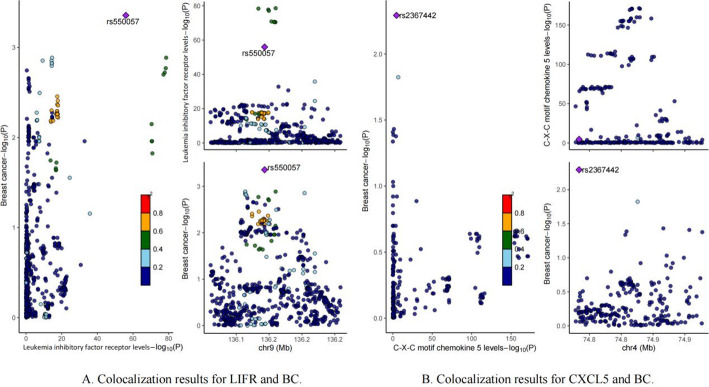
Results: After Bonferroni correction, we identified a significant inverse genetic association between Leukemia inhibitory factor receptor (LIFR) levels and BC risk. While C-X-C motif chemokine 5 (CXCL5) did not survive Bonferroni correction, it showed significant negative association with BC in MVMR analysis. Reverse MR analyses found no evidence of causal effects of BC on these inflammatory proteins, supporting the direction of our primary findings. Colocalization analysis revealed strong evidence of shared genetic variants between LIFR and BC, suggesting common genetic determinants underlying their relationship.
Conclusion: This study provides genetic evidence for causal relationships between inflammatory proteins and BC risk, particularly highlighting the protective role of LIFR. These findings enhance our understanding of BC pathogenesis and may inform future therapeutic strategies.
Keywords: Breast cancer; Colocalization analysis; Inflammatory protein factors; Mendelian randomization.
© 2025. The Author(s).
Conflict of interest statement
Declarations. Ethics approval and consent to participate: This study utilized publicly available summary-level GWAS data and did not require additional ethical approval. All original studies from which the data were derived (UK Biobank and FinnGen) obtained appropriate ethical approval from their respective institutional review boards and ethics committees. The UK Biobank study received ethical approval from the North West Multi-Centre Research Ethics Committee (REC reference: 11/NW/0382), and the FinnGen study was approved by the Finnish Institute for Health and Welfare (THL) and the Ethics Committee of the Hospital District of Helsinki and Uusimaa (HUS). No direct participant consent was required for this study as it exclusively used publicly available summary-level GWAS data. All participants in the original studies (UK Biobank and FinnGen) provided informed consent for participation in genetic research, including the use of their anonymized data in approved research projects. The current study did not involve direct contact with participants or access to individual-level data. Consent for publication: No specific consent to publish was required for this study as it utilized publicly available summary-level GWAS data that have been previously published and made available for research purposes. All original studies obtained appropriate consent from participants for the publication of research findings derived from their anonymized data. Competing interests: The authors declare no competing interests.
Figures


References
-
- Loibl S, Poortmans P, Morrow M, Denkert C, Curigliano G. Breast cancer. Lancet. 2021;397:1750–69. - PubMed
-
- Sun D, Luo X, Ma L, Wang Y, Zhang F. Identifying of miR-98-5p/IGF1 axis contributes breast cancer progression using comprehensive bioinformatic analyses methods and experiments validation. Life Sci. 2020;261:118435. - PubMed
Grants and funding
- 32470963/the National Natural Science Foundation of China
- BJZYYB-2023-69/Beijing Administration of Traditional Chinese Medicine
- 2023ZD0502500/China National Center for Biotechnology Development, National Health Commission, Noncommunicable Chronic Diseases-National Science and Technology Major Project
LinkOut - more resources
Full Text Sources
Miscellaneous