


Planning for the Unexpected and Unintended Effects of mHealth Interventions: Systematic Review
- PMID: 40774342
- PMCID: PMC12331364
- DOI: 10.2196/68909
Planning for the Unexpected and Unintended Effects of mHealth Interventions: Systematic Review
Abstract
Background: Mobile health (mHealth) interventions can produce both intended and unintended effects. Examining these unintended effects helps create a more complete and objective understanding of mHealth interventions and can reduce potential harm to participants. Existing studies on the unintended effects, which were published several years ago, tend to have either a general focus on health IT or a specific focus on health care providers, thereby excluding other key stakeholders (eg, patients and community health workers). Additionally, these studies did not systematically outline the causes of the unintended effects or strategies for their prevention.
Objective: To address this gap, this systematic review, guided by the ecological framework, aims to systematically identify the unintended effects of mHealth interventions, create a typology for them, investigate the reasons for their occurrence, describe how they were detected, and propose ways to prevent or lessen them.
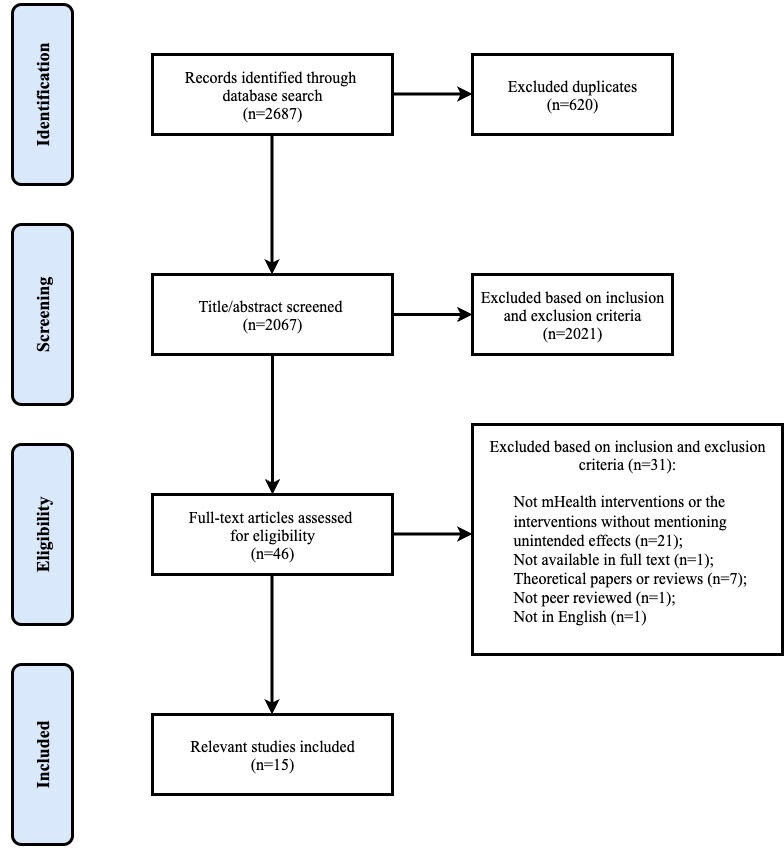
Methods: Following the PRISMA (Preferred Reporting Items for Systematic Reviews and Meta-Analyses) guidelines, a systematic review was performed to examine the unintended effects of health interventions that use mobile technology.
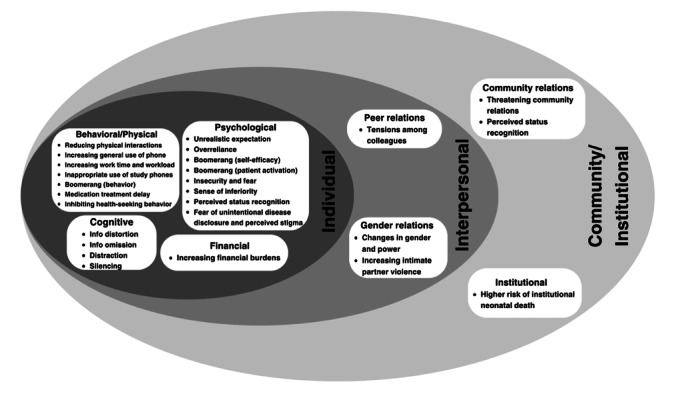
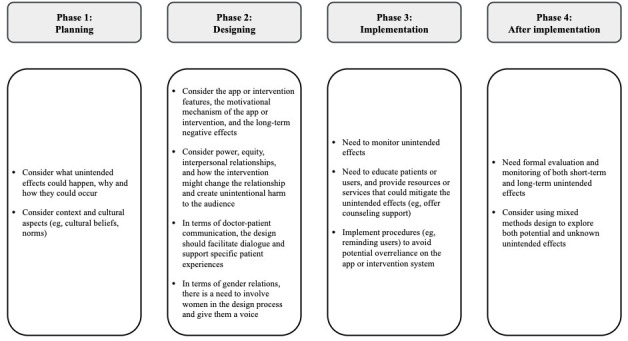
Results: A total of 15 papers were included in the review. An ecological typology of mHealth intervention unintended effects (mHUE) was developed, which includes 26 distinct effects (eg, silencing and boomerang). The majority of these unintended effects (n=20) occur at the individual level and span physical or behavioral (n=7), psychological (n=8), cognitive (n=4), and financial (n=1) domains. Three effects occur at the interpersonal level and another 3 at the community or institutional level. Most of the identified effects (n=22) were negative. Potential causes for these effects include the improper use of mHealth technology, poorly designed interventions, the application of unsuitable intervention mechanisms, or a misalignment between the intended outcomes and the sociocultural context. Strategies and recommendations (eg, considering the context such as cultural norms) were suggested to help prevent or reduce the unintended effects.
Conclusions: The unintended effects detailed in the mHUE typology were heterogenous and context-dependent. These effects can influence individuals across different domains and also affect unintended people within the ecological system. As most of the unintended effects are negative, if they are not monitored, mHealth interventions designed to empower participants could paradoxically disempower them (eg, decreasing self-efficacy for disease management, undermining patient control, and engagement). The mHUE typology, together with the proposed recommendations and strategies, can be used as a guide to enhance the planning, design, implementation, and postimplementation evaluation on mHealth interventions. Future research should concentrate on understanding the specific mechanisms behind these unintended effects.
Keywords: ecological typology; mHealth interventions; mobile phone; systematic review; unintended effects.
© Weidan Cao, Xiaohui Cao, Andrew David Sutherland. Originally published in the Journal of Medical Internet Research (https://www.jmir.org).
Conflict of interest statement
Figures
References
-
- Baumann H, Fiedler J, Wunsch K, Woll A, Wollesen B. mHealth interventions to reduce physical inactivity and sedentary behavior in children and adolescents: systematic review and meta-analysis of randomized controlled trials. JMIR Mhealth Uhealth. 2022 May 11;10(5):e35920. doi: 10.2196/35920. doi. Medline. - DOI - PMC - PubMed
-
- Cruz-Cobo C, Bernal-Jiménez MÁ, Vázquez-García R, Santi-Cano MJ. Effectiveness of mHealth interventions in the control of lifestyle and cardiovascular risk factors in patients after a coronary event: systematic review and meta-analysis. JMIR Mhealth Uhealth. 2022 Dec 2;10(12):e39593. doi: 10.2196/39593. doi. Medline. - DOI - PMC - PubMed
Publication types
MeSH terms
LinkOut - more resources
Full Text Sources
Medical
Research Materials
Miscellaneous
