


Comparative analysis of Chlamydia pneumoniae pneumonia (CPP) and Mycoplasma pneumoniae pneumonia in children and risk factors of severe CPP
- PMID: 40775274
- PMCID: PMC12329983
- DOI: 10.1186/s12879-025-11405-4
Comparative analysis of Chlamydia pneumoniae pneumonia (CPP) and Mycoplasma pneumoniae pneumonia in children and risk factors of severe CPP
Abstract
Background: Chlamydia penumoniae (CP) pneumonia (CPP) in children often receives less clinical attention due to its relatively mild presentation. This study comparatively analyzed CPP and Mycoplasma pneumoniae pneumonia (MPP), and investigated risk factors for severe CPP.
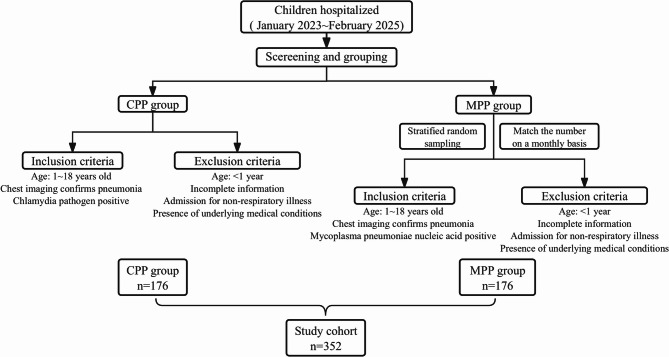
Methods: A retrospective analysis was conducted on 176 CPP patients and 176 concurrently hospitalized MPP patients during the same period to compare clinical features. CPP cases were further stratified into severe and mild subgroup to identify risk factors.
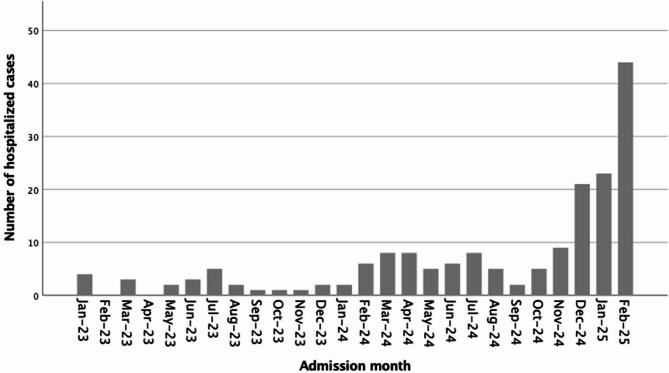
Results: The number of hospitalized children with CPP increased in 2024 compared to 2023, with a significant surge observed from December 2024 to February 2025. CPP patients were significantly older than MPP patients (mean age: 10.53 ± 2.89 vs. 6.68 ± 2.88, p < 0.05) and exhibited longer durations of cough and higher rates of chest pain (p < 0.05). Laboratory findings revealed significantly elevated white blood cell (WBC) and eosinophil (EOS) counts in CPP versus MPP (p < 0.05). Severe CPP accounted for 6.8% of cases, and binary logistic regression identified eosinophil count as a potential biomarker for severe CPP (p < 0.05).
Conclusions: The number of hospitalized children with CPP increased in 2024 compared to 2023. CPP manifested more prominent cough and chest pain symptoms compared to MPP patients. EOS count levels may serve as a potential biomarker of severe CPP.
Keywords: Chlamydia pneumoniae pneumonia; Community-acquired pneumonia; Cough; Mycoplasma pneumoniae pneumonia.
© 2025. The Author(s).
Conflict of interest statement
Declarations. Ethics approval and consent to participate: The study adheres to the statement of the Declaration of Helsinki. This study was approved by the ethics committee of the children’s hospital affiliated to Zhejiang University school of medicine and informed consent was obtained from the child’s parents. The children’s parents have informed and consented to the publication. This study does not involve any animal experiments, and ethics approval and informed consent for animals are not required. Consent for publication: Not applicable. Competing interests: The authors declare no competing interests.
Figures
References
-
- Infections GBDLR, Antimicrobial Resistance C. Global, regional, and national incidence and mortality burden of non-COVID-19 lower respiratory infections and aetiologies, 1990–2021: a systematic analysis from the global burden of disease study 2021. Lancet Infect Dis. 2024;24(9):974–1002. - PMC - PubMed
-
- Ma Y, Sun J, Che G, Cheng H. Systematic infection of Chlamydia Pneumoniae. Clin Lab 2022;68(8). 10.7754/Clin.Lab.2021.210908. - PubMed
-
- Smith-Norowitz TA, Chotikanatis K, Erstein DP, Perlman J, Norowitz YM, Joks R, Durkin HG, Hammerschlag MR, Kohlhoff S. Chlamydia pneumoniae enhances the Th2 profile of stimulated peripheral blood mononuclear cells from asthmatic patients. Hum Immunol. 2016;77(5):382–8. - PubMed
-
- Hansbro PM, Beagley KW, Horvat JC, Gibson PG. Role of atypical bacterial infection of the lung in predisposition/protection of asthma. Pharmacol Ther. 2004;101(3):193–210. - PubMed
Publication types
MeSH terms
Grants and funding
LinkOut - more resources
Full Text Sources
Miscellaneous
