


Novel and repurposed antiviral molecules for arbovirus infections with epidemic Potential: A systematic review
- PMID: 40776987
- PMCID: PMC12329100
- DOI: 10.1016/j.nmni.2025.101614
Novel and repurposed antiviral molecules for arbovirus infections with epidemic Potential: A systematic review
Abstract
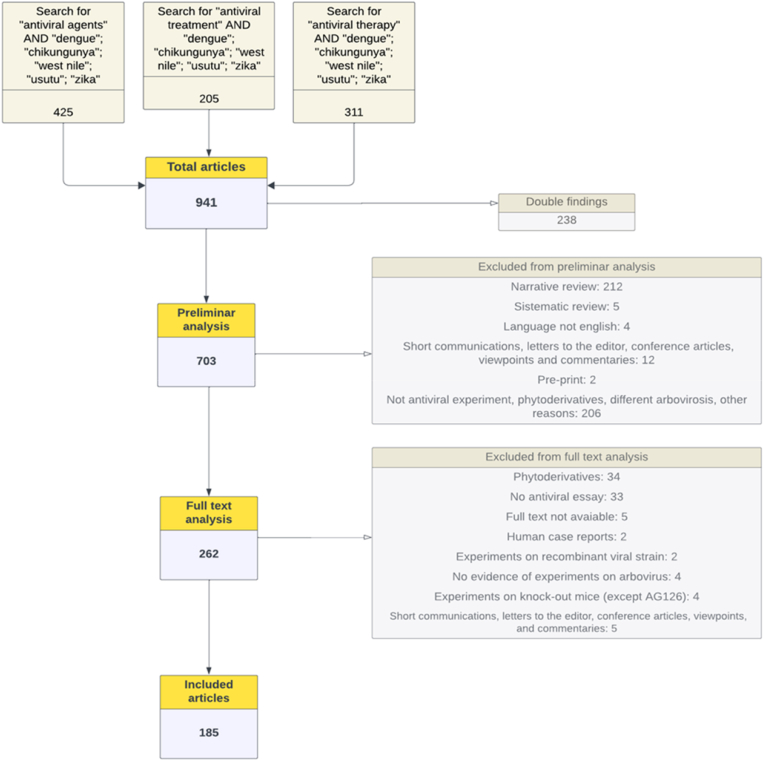
This systematic review investigates experimental and repurposed antiviral molecules for epidemic-potential arboviruses, including dengue (DENV), Zika (ZIKV), chikungunya (CHIKV), West Nile (WNV), and Usutu (USUV) viruses. Arboviral diseases pose a growing public health concern, exacerbated by climate change and increased global travel. Despite the absence of approved antiviral therapies for most arboviruses, numerous in vitro, in vivo and in human studies have evaluated candidate molecules targeting the different stages of viral replication. Methods: Our methods adhere to the Preferred Reporting Items for Systematic Reviews and Meta-Analyses (PRISMA) 2020 guidelines. Pubmed, Embase, and Cochrane Library trials were searched. Studies published until March 2024 were included. After abstract review and duplication removal, full-text articles were obtained for further review, reviewed by two independent reviewers, and disagreements were resolved by a third reviewer. Results: Our analysis, based on 185 studies, highlights the antiviral role of molecules such as nucleoside analogs, protease inhibitors, and immune-modulators. No studies conducted in humans have been reported to demonstrate the antiviral efficacy of any molecule. Favipiravir, ribavirin, and sofosbuvir demonstrated viremia reduction and symptoms improvement in vitro and in vivo experiments. Cholesterol-lowering agents, such as atorvastatin and ezetimibe, showed promise in disrupting viral assembly. Montelukast and doxycycline exhibited anti-inflammatory effects, contributing to improved clinical outcomes. The cytokine modulation profiles varied, with notable reductions in pro-inflammatory markers in certain studies. Conclusions: Currently, there are no studies in humans demonstrating effective treatments against arboviral infections. Although some molecules have shown efficacy in reducing viral titters, further clinical evaluation of promising candidates and the exploration of combination therapies targeting viral replication and host immune-response are needed.
Keywords: Antiviral therapy; Antiviral treatment; Arbovirus; Arboviruses; DENV; Dengue; WNV; West nile.
© 2025 The Authors.
Conflict of interest statement
The authors declare that they have no conflicts of interest related to this work.
Figures
References
-
- World Health Organization . new edition. World Health Organization; 2009. Dengue guidelines for diagnosis, treatment, prevention, and control.https://apps.who.int/iris/handle/10665/44188 [Internet] - PubMed
Publication types
LinkOut - more resources
Full Text Sources