


This is a preprint.
Primary bovine embryonic fibroblasts support seasonal influenza A virus infection and demonstrate variable fitness of HPAI H5N1
- PMID: 40777344
- PMCID: PMC12330616
- DOI: 10.1101/2025.07.26.666677
Primary bovine embryonic fibroblasts support seasonal influenza A virus infection and demonstrate variable fitness of HPAI H5N1
Abstract
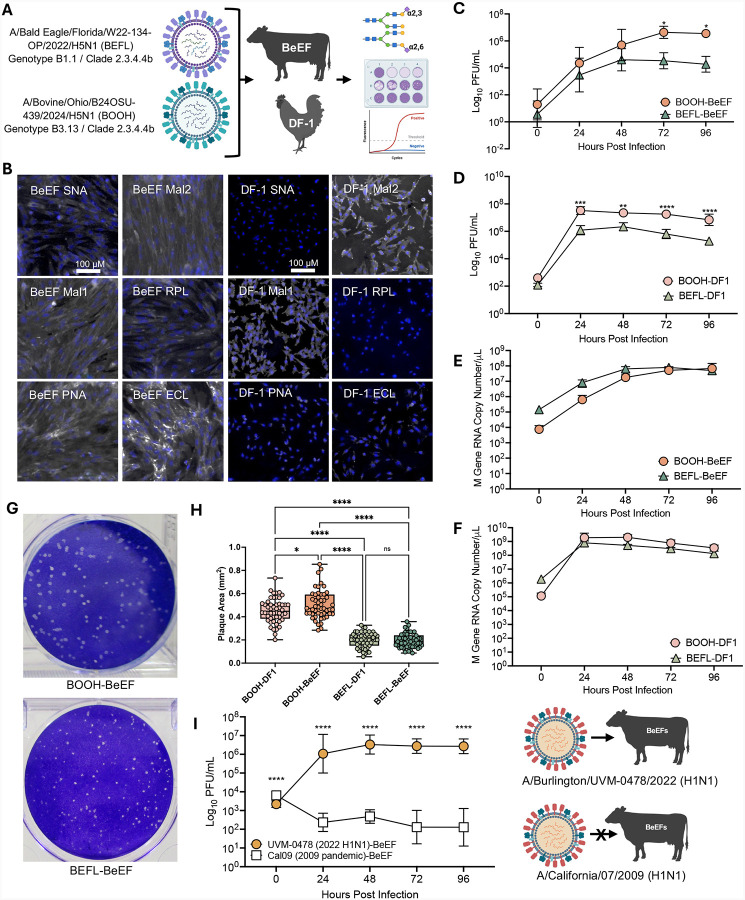
The emergence of highly pathogenic avian influenza (HPAI) H5N1 (clade 2.3.4.4b, genotype B3.13) in dairy cattle presents substantial challenges to the agricultural sector and public health. Mechanistic studies of infection and transmission in cattle have proven difficult due to animal handling restrictions as well as limited availability of established cell culture models. Primary Bovine Embryonic Fibroblasts (BeEFs) were collected from a Montana cow and are investigated here as a model to study influenza A virus (IAV) infection dynamics. We compared sialylation profiles, infectious virus production, viral replication, and plaque morphology in both BeEFs and chicken DF-1 cells following infection with the bovine HPAI H5N1 and an earlier 2.3.4.4b genotype (B1.1) isolated in 2022. The data presented here show increased viral fitness of the bovine origin HPAI H5N1 strains across multiple species and bovine susceptibility to human seasonal IAV. This study highlights the ability of BeEFs to serve as a model for studying IAV infections in bovine hosts.
Conflict of interest statement
Competing Interest Statement: The authors declare no competing interests.
Figures
References
-
- Nguyen T.-Q., et al. , Emergence and interstate spread of highly pathogenic avian influenza A(H5N1) in dairy cattle in the United States. Science 388, eadq0900 (2025). - PubMed
-
- University of Wyoming Extension, Economic considerations for dairy herds With HPAI. Fence Post (2024).
Publication types
Grants and funding
LinkOut - more resources
Full Text Sources
Miscellaneous
