


High-dose-rate brachytherapy lowers travel burden for men with localized prostate cancer compared with external beam radiation
- PMID: 40777601
- PMCID: PMC12327330
- DOI: 10.3389/fruro.2025.1598726
High-dose-rate brachytherapy lowers travel burden for men with localized prostate cancer compared with external beam radiation
Abstract
Objective: There are many treatment options for localized prostate cancer, including external beam radiation therapy (EBRT), stereotactic body radiation therapy (SBRT), and prostate brachytherapy (BT). This study aimed to compare the travel burdens of high-dose-rate brachytherapy (HDR-BT) at our BT center and EBRT or SBRT if administered close to home.
Materials and methods: This single-institution retrospective cohort study included 69 patients who had HDR-BT monotherapy for their prostate cancer from August 2017 to December 2022. The travel burden for HDR-BT monotherapy was estimated using Google Maps by measuring the distance from each patient's home address to our BT center. The total travel burden was calculated by multiplying the number of treatment fractions required for each modality by the roundtrip travel distance between the home and the treatment facility. Treatment toxicity was evaluated using the Expanded Prostate Index Composite for Clinical Practice (EPIC-CP) questionnaire.
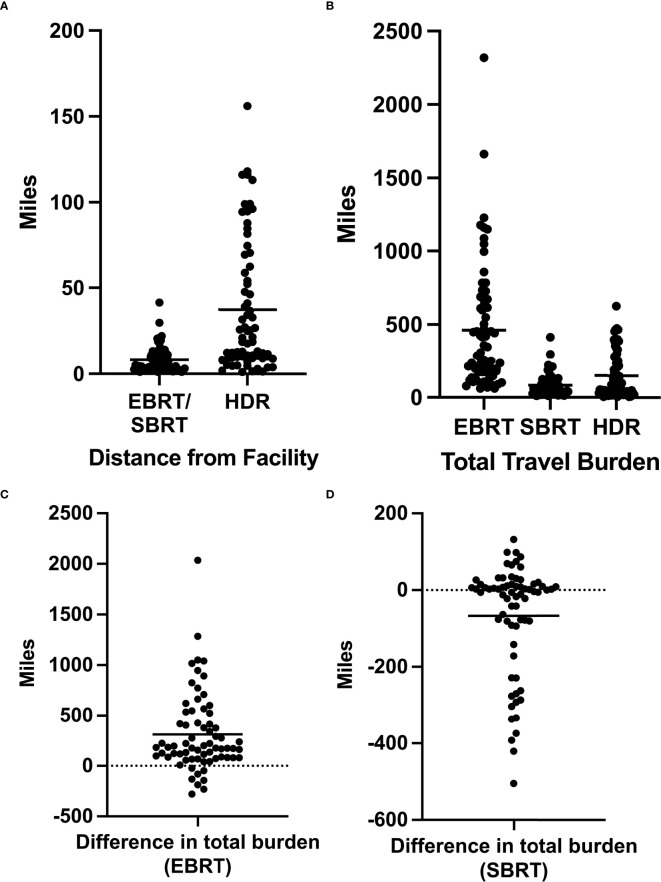
Results: The median age of the 69 patients was 67 years. The mean distance from home to the BT center was 37.4 mi, while the mean distance to the nearest radiation facility was 8.3 mi. The mean total travel distance for HDR-BT was 150 mi, while those for EBRT and SBRT were 463 and 83 mi, respectively. HDR-BT resulted in a mean travel burden reduction of 313 mi compared with EBRT. The EPIC-CP scores indicated minimal posttreatment toxicity, with most patients reporting stable or improved symptoms.
Conclusion: HDR-BT monotherapy significantly reduces the travel burden compared with EBRT for localized prostate cancer, with minimal treatment-associated toxicity. Increasing the availability of BT centers could further alleviate the travel burden. Alternatively, providing transportation support could improve access to care.
Keywords: access to care; external beam radiation therapy; high-dose-rate brachytherapy; patient travel burden; prostate cancer.
Copyright © 2025 Liu, Yang, Bylund, Cummings and Zhang.
Conflict of interest statement
The authors declare that the research was conducted in the absence of any commercial or financial relationships that could be construed as a potential conflict of interest.
Figures

References
-
- Society AC. Key statistics for prostate cancer (2024). Available online at: https://www.cancer.org/cancer/types/prostate-cancer/about/key-statistics... (Accessed June 23, 2025).
-
- Slevin F, Zattoni F, Checcucci E, Cumberbatch MGK, Nacchia A, Cornford P, et al. A systematic review of the efficacy and toxicity of brachytherapy boost combined with external beam radiotherapy for nonmetastatic prostate cancer. Eur Urol Oncol. (2024) 7:677–96. doi: 10.1016/j.euo.2023.11.018 - DOI - PubMed
LinkOut - more resources
Full Text Sources
Miscellaneous
