. 2025 Jul 15;33(3):101532.
doi: 10.1016/j.omtm.2025.101532. eCollection 2025 Sep 11.

AAV6 vectors provide superior gene transfer compared to AAV9 vectors following intramyocardial administration

Affiliations

AAV6 vectors provide superior gene transfer compared to AAV9 vectors following intramyocardial administration

Jianan Wang et al. Mol Ther Methods Clin Dev. .

Abstract

Cardiac gene therapy using adeno-associated viral (AAV) vectors holds great promise for treating heart diseases but would benefit from more potent AAV vectors. Vectors based on the AAV serotypes 6 and 9 have been used in pre-clinical gene therapy studies, yet the therapeutic outcomes varied depending on the experimental model and delivery route used. Here, we evaluated the transduction efficiency of AAV6, AAV9, and AAV9-derived MyoAAVs for local cardiac delivery. Vectors were tested in neonatal rat ventricular myocytes, and subsequently in mouse hearts by direct intramyocardial injection. Vector genome levels, mRNA expression levels, and fluorescence were measured. The AAV6 and AAV9 vectors were further validated in porcine hearts, human-induced pluripotent stem-cell-derived cardiomyocytes, and human atrial myocardial slices. In both rat cardiomyocytes and mouse hearts, AAV6 exhibited the highest transduction efficiency. Direct comparison of the AAV6 and AAV9 vectors in porcine and human models confirmed that AAV6 is more potent. In conclusion, AAV6 vectors are superior to AAV9 and its derivative vectors for cardiac transduction by direct intramyocardial injection. In addition, the in vivo transduction efficiency correlates with in vitro and ex vivo assays, thereby facilitating the development of more potent AAV variants for cardio-selective delivery methods.

Keywords: AAV vector; cardiac gene transfer; gene therapy; intramyocardial injection; transduction efficiency.


Conflict of interest statement

O.F.K., H.L.T., and G.J.J.B. are co-founders of PacingCure BV and report ownership interest in PacingCure BV. J.W. and E.E.B. are employees of PacingCure BV. T.J., V.M.C., and G.J.J.B. have pending patent applications related to this work.

Figures

None
Graphical abstract
Figure 1
Figure 1
AAV6 and MyoAAV4A efficiently transduce NRVMs (A) Experimental design. (B) Direct fluorescent images of NRVMs 3 days post-transduction with various AAV vector pseudotypes. Scale bars, 100 μm. (C) Percentage of GFP-expressing cells determined by flow cytometry. (D) Relative expression levels of GFP determined by RT-qPCR. Data are presented as mean ± SEM. Data were compared using one-way ANOVA with post-hoc Fisher’s LSD test. ∗∗p < 0.01; ∗∗∗, ###p < 0.001. ∗ denotes comparison between groups and UT. # denotes comparison between groups and AAV6. UT, untransduced; AAV9_10×, AAV9 at a 10 times higher dose.
Figure 2
Figure 2
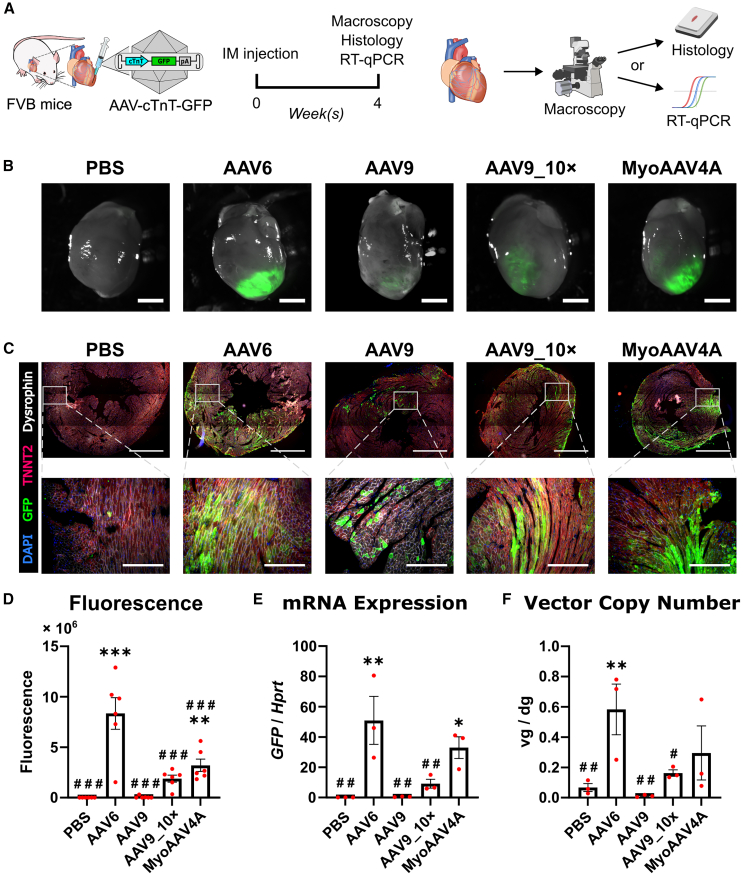
AAV6 and MyoAAV4A efficiently transduce mouse myocardium (A) Experimental design. (B) Direct fluorescent images of mouse hearts. Scale bars, 2 mm. (C) Immunostaining images of hearts and zoom-in images from the injection sites. Scale bars, 1 mm (upper) or 200 μm (lower). (D) Quantification of the integrated density of direct GFP fluorescence, n = 6. (E) mRNA expression level of GFP in left ventricles, n = 3. (F) AAV vector genome copies in ventricles, n = 3. Data are presented as mean ± SEM. Data were compared using one-way ANOVA with post-hoc Fisher’s LSD test. ∗, #p < 0.05; ∗∗, ##p < 0.01; ∗∗∗, ###p < 0.001. ∗ denotes comparison between groups and PBS. # denotes comparison between groups and AAV6. IM, intramyocardial; AAV9_10×, AAV9 at a 10 times higher dose; vg/dg, vector genomes per diploid genome.
Figure 3
Figure 3
Intramyocardial injection of AAV vector does not induce vector-related cardiac fibrosis (A) Example of picrosirius red staining images of hearts injected with PBS or AAV6-cTnT-GFP vector. Black arrows indicate regions of cardiac fibrosis. Scale bars, 1 mm. (B) Quantification of the fibrosis area in hearts injected with PBS or AAV vectors. No significant differences were observed among the groups, n = 3. (C) Picrosirius red (left) and immunofluorescence (right) staining images of a heart injected with AAV6-cTnT-GFP. Stainings were performed using consecutive sections. Scale bars, 500 μm. Data are presented as mean ± SEM. Data were compared using one-way ANOVA with post-hoc Fisher’s LSD test. ns, not significant.
Figure 4
Figure 4
AAV6 outperforms AAV9 independently of the expression cassette and mouse background (A) Scheme of the in vitro experiment. (B) Direct fluorescent images of NRVMs 3 days post-transduction with AAV6- and AAV9-pseudotyped vectors. Yellow arrows indicate weakly GFP-expressing cells. Scale bars, 100 μm. (C) Expression level of GFP mRNA determined by RT-qPCR, n = 4. (D) Scheme of the in vivo experiment and representative heart images. Scale bars, 2 mm. (E) Quantification of direct GFP fluorescence, (F) GFP mRNA expression, and (G) AAV vector genome copies in FVB female mice injected with AAV6- or AAV9-CMV-GFP, n = 3. (H) Scheme of the in vivo experiment and representative heart images. Scale bars, 2 mm. (I) Quantification of direct GFP fluorescence, (J) GFP mRNA expression, and (K) AAV vector genome copies in C57BL/6J male mice injected with AAV6- or AAV9-CMV-GFP, n = 4. Data are presented as mean ± SEM. Data were compared using Student’s t test. ∗p < 0.05; ∗∗p < 0.01. ∗ denotes comparison between AAV6 and AAV9. vg/dg, vector genomes per diploid genome.
Figure 5
Figure 5
AAV6 outperforms AAV9 in transducing pig myocardium (A) Experimental design. (B) Direct fluorescent macroscopy of pig heart tissues injected with AAV6- or AAV9-CMV-GFP. Sampled tissues are encircled using a white dashed line. Scale bars, 1 cm. (C) Immunostaining images from pig heart tissues injected with 200 μL (high dose) AAV6- or AAV9-CMV-GFP. Scale bars, 200 μm. (D) Quantification of the GFP mRNA expression and (E) AAV vector genome copies in pig heart tissues injected with AAV6- or AAV9-CMV-GFP, n = 3. Data are presented as mean ± SEM. Data were compared using two-way ANOVA with post-hoc Fisher’s LSD test. ∗,#p < 0.05; ##p < 0.01; ∗∗∗p < 0.001. ∗ denotes comparison between AAV serotypes. # denotes comparison between injection volumes. IM, intramyocardial. vg/dg, vector genomes per diploid genome.
Figure 6
Figure 6
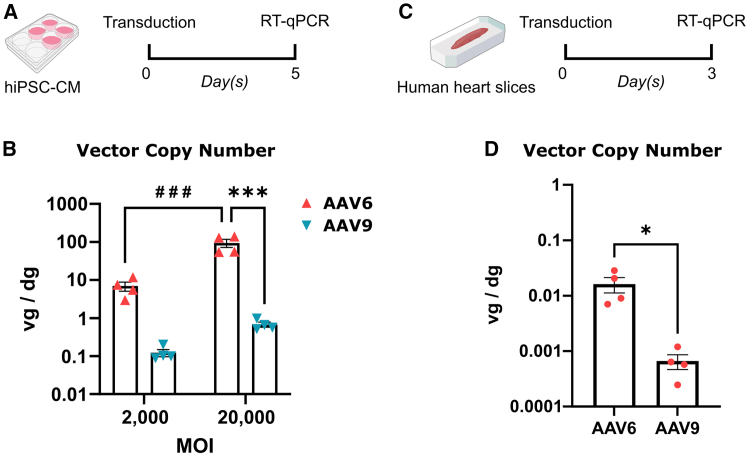
AAV6 outperforms AAV9 in transducing hiPSC-CMs and human heart slices (A) Scheme of the hiPSC-CM experiment. (B) Quantification of the AAV vector genomes in hiPSC-CMs transduced with AAV6- or AAV9-CMV-GFP, n = 4. (C) Scheme of the human LAAS experiment. (D) Quantification of the AAV vector genomes in human LAASs transduced with AAV6- or AAV9-CMV-GFP, n = 4 donors. Data are presented as mean ± SEM. Data were compared using two-way ANOVA with post-hoc Fisher’s LSD test (B) or Student’s t test (D). ∗p < 0.05; ∗∗∗, ###p < 0.001. ∗ denotes comparison between AAV serotypes. # denotes comparison between multiplicities of infection. MOI, multiplicity of infection. vg/dg, vector genomes per diploid genome.

References

    1. Roth G.A., Mensah G.A., Johnson C.O., Addolorato G., Ammirati E., Baddour L.M., Barengo N.C., Beaton A.Z., Benjamin E.J., Benziger C.P., et al. Global Burden of Cardiovascular Diseases and Risk Factors, 1990-2019: Update From the GBD 2019 Study. J. Am. Coll. Cardiol. 2020;76:2982–3021. doi: 10.1016/j.jacc.2020.11.010. - DOI - PMC - PubMed
    1. Bulcha J.T., Wang Y., Ma H., Tai P.W.L., Gao G. Viral vector platforms within the gene therapy landscape. Signal Transduct. Target. Ther. 2021;6 doi: 10.1038/s41392-021-00487-6. - DOI - PMC - PubMed
    1. Konkalmatt P.R., Beyers R.J., O'Connor D.M., Xu Y., Seaman M.E., French B.A. Cardiac-selective expression of extracellular superoxide dismutase after systemic injection of adeno-associated virus 9 protects the heart against post-myocardial infarction left ventricular remodeling. Circ. Cardiovasc. Imaging. 2013;6:478–486. doi: 10.1161/CIRCIMAGING.112.000320. - DOI - PMC - PubMed
    1. Singh M., Brooks A., Toofan P., McLuckie K. Selection of appropriate non-clinical animal models to ensure translatability of novel AAV-gene therapies to the clinic. Gene Ther. 2024;31:56–63. doi: 10.1038/s41434-023-00417-x. - DOI - PubMed
    1. Philippidis A. Patient Dies in Beam Trial of Sickle Cell Disease Candidate; Company Cites Conditioning. Hum. Gene Ther. 2024;35:951–954. doi: 10.1089/hum.2024.111924. - DOI - PMC - PubMed

LinkOut - more resources