This is a preprint.
Altered oscillatory coupling reflects possible inhibitory interneuron dysfunction in Rett syndrome
- PMID: 40778166
- PMCID: PMC12330464
- DOI: 10.1101/2025.07.21.25331927
Altered oscillatory coupling reflects possible inhibitory interneuron dysfunction in Rett syndrome
Abstract
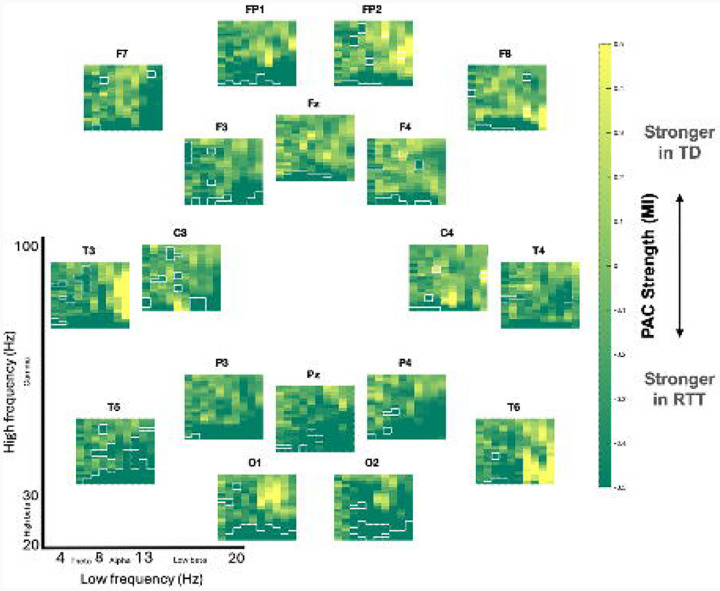
Rett syndrome is a rare neurodevelopmental disorder caused primarily by pathogenic variants in the MECP2 gene, leading to lifelong cognitive impairments. To understand the broad neural disruptions in Rett syndrome, it is essential to examine large-scale brain dynamics at the level of neural oscillations. Phase-amplitude coupling-a form of cross-frequency interaction that supports information integration across temporal and spatial scales-is a promising candidate measure for capturing such widespread neural dysfunction. Phase-amplitude coupling depends on the coordinated activity of specific neuronal subtypes, and while multiple subtypes are implicated in different aspects of the Rett syndrome phenotype, their role in shaping large-scale oscillatory dynamics in Rett syndrome is not well understood. To investigate this, we utilized a multi-level approach, combining EEG recordings with computational modeling to identify alterations in phase-amplitude coupling in Rett syndrome and probe their underlying cellular and circuit-level mechanisms. We recorded resting-state EEG from 38 individuals with Rett syndrome and 30 age- and sex-matched typically developing individuals. Phase-amplitude coupling was quantified: modulation index was obtained to determine coupling strength, and phase bias was assessed to examine the preferred phase of coupling. We characterized phase-amplitude coupling across all low and high frequency combinations and electrodes, as well as within canonical theta-gamma and alpha-gamma frequency pairs across four predefined cortical regions. Finally, we modeled a biophysically-constrained Layer 4 cortical network to propose a possible mechanism underlying changes to oscillatory dynamics. We found significantly stronger phase-amplitude coupling in Rett syndrome across widespread cortical regions and frequency pairs, with a pronounced increase in theta-gamma and alpha-gamma coupling in anterior, posterior, and whole-brain regions (P < 0.05). Individuals with Rett syndrome also exhibited a more positive alpha-gamma phase bias in anterior and whole-brain regions (P < 0.05). Biophysically constrained modelling demonstrated that reduced VIP-expressing interneuron activity alone could recapitulate the pattern of increased theta-gamma and alpha-gamma phase-amplitude coupling observed in Rett syndrome (P < 0.001). These findings identify alterations in awake-state phase-amplitude coupling in Rett syndrome and propose a mechanistic link to VIP+ interneuron dysfunction. Elevated phase-amplitude coupling may serve as a promising biomarker of cortical dysfunction and a translational bridge from neural circuitry to clinically observable EEG signatures. By implicating VIP+ interneurons, our results open new avenues for testing interventions in preclinical models to identify potential novel therapeutic targets for individuals with Rett syndrome.
Keywords: EEG; Rett syndrome; VIP+ interneurons; neurogenetic disorders; phase-amplitude coupling.
Conflict of interest statement
Dr. Percy has received research support from the NIH and has been a site PI for Acadia Pharmaceuticals. He is a consultant for Acadia Pharmaceuticals, Taysha Gene Therapies, and Neurogene. He has prepared educational materials for WebMD, Medscape, Pharmacy Times Continuing Education, Prime Inc., and the CME Institute. Dr. Marsh has received research support from the NIH and has been a site PI for Acadia, Stoke, Takeda, Marinus, Zogenix, and SK Life Pharmaceuticals. He is a consultant for Acadia Pharmaceuticals, Stoke Pharmaceuticals, Taysha Gene Therapies, and Neurogene. He has prepared educational materials for Medscape and the CME Institute. Dr. Benke has received research funding from GRIN2B Foundation, the International Foundation for CDKL5 Research, Loulou Foundation, the National Institutes of Health, and Simons Foundation. He has consulted for Alcyone, AveXis, GRIN Therapeutics, GW Pharmaceuticals, the International Rett Syndrome Foundation, Marinus Pharmaceuticals, Neurogene, Ovid Therapeutics, and Takeda Pharmaceutical Company Limited. He has acted as a clinical trial investigator for Acadia Pharmaceuticals Inc., GW Pharmaceuticals, Marinus Pharmaceuticals, Ovid Therapeutics, and Rett Syndrome Research Trust. All remuneration has been made to his department. Dr. Lieberman has served as a site PI for Acadia Pharmaceuticals and Neurogene Clinical Trials in Rett syndrome. He is a consultant for Acadia Pharmaceuticals, Taysha Gene Therapies, and Neurogene.
Figures



References
Publication types
Grants and funding
LinkOut - more resources
Full Text Sources